Editor’s choice
Editor’s choice
In the Tropical Andean mountains of Colombia’s Southwestern Antioquia, history has taken an unexpected turn. Land once shaped by conflict and narcotrafficking is now becoming a beacon of regeneration with transformative potential far beyond its boundaries. Working from a painful past towards a vision of “our best possible future”, what imaginaries of change can this territory offer?
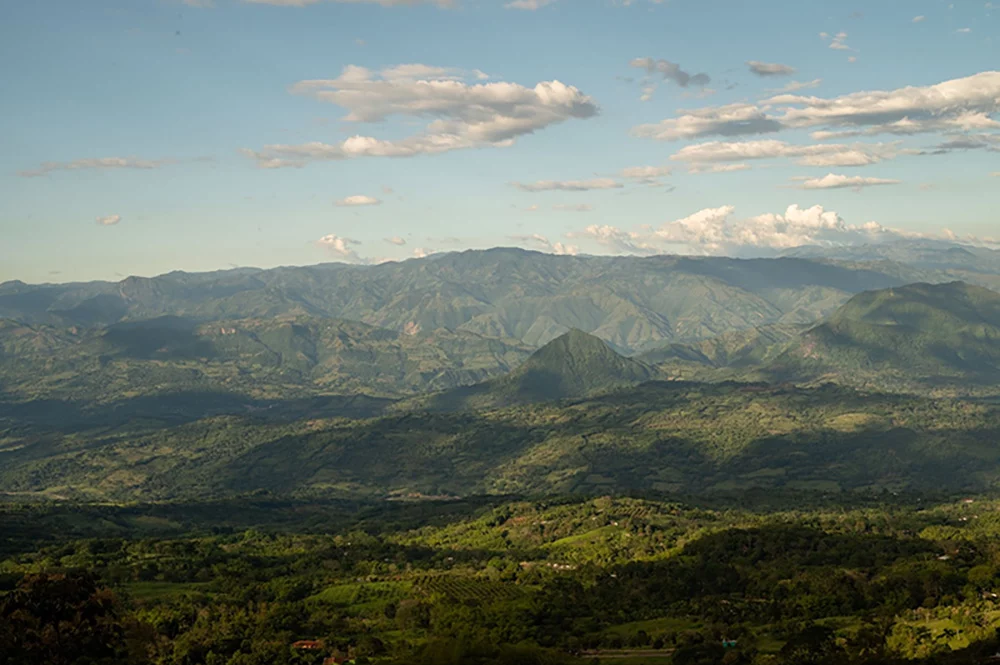
Nested in mountainous terrain shaped by the Cartama river, between 700 and 900 metres above sea level, Biosuroeste sits at an ecological threshold: humid tropical forests climbing the slopes of the northwestern Andes meet the remnants of Colombia’s endangered tropical dry forests. The result is a mosaic of habitats marked by striking transitions, where life develops continuously along the gradient. This diversity gives the region extraordinary agroecological potential, nourished further by centuries of agricultural tradition. Returned to the public through Colombia’s first collective land restitution, the 600-hectare site now known as Biosuroeste is emerging as a living laboratory for agroecological transformation at the bioregional scale.
A view of Provincia Cartama and the Cartama River valley, where Biosuroeste is located, at an altitude between 700 and 900 metres above sea level.
Photo: Biosuroeste, Comfama.
History has shaped layers of social and cultural crossings on this land, visible in ancient petroglyphs as well as the scars of a more recent era. After decades marked by conflict and narcotrafficking, the site was returned to the municipalities of Valparaíso and Támesis – a landmark effort to restore land to a region affected by violence.
Local actors then formed the Biosuroeste Corporation, a non-profit bringing together municipalities, regional universities and research centres, grassroots groups, and private-sector partners convened through Proantioquia. The Inter-American Development Bank, with EAFIT University’s urbam centre, contributed to designing the park’s Master Plan. Agroecologist Clara Nicholls (UC Berkeley, co-founder of SOCLA with Miguel Altieri) introduced the concept of the Faro Agroecológico – the agroecological lighthouse – that became central to the model.
In 2021, the social enterprise Comfama assumed leadership, integrating Biosuroeste into its strategy for social mobility and territorial development. At the intersection of scientific design and community imagination, a shared idea took shape: to transform Biosuroeste into a living park for the wider public, a demonstrative beacon for a bioregional future centred on regeneration and socio-ecological restoration.
Through the Amplifying Stories of Agroecology Principles and Practices (ASAPP) project, we shed light on models for agroecological transformation at scale – not by simply scaling up practices, but by scaling deep: reshaping the values, relationships and imaginaries that guide how people relate to nature, to each other, and to the future of their territories. Biosuroeste offers a living example.
This video is in Spanish. English subtitles are available through YouTube’s automatic captions. Please note that auto-generated captions may not be fully accurate.
Biosuroeste operates as a multifunctional living lab, where nature-based tourism – bird watching, hiking, horseback riding – sits alongside regenerative food production as the basis for a collective learning model. Working with emerging sectors, high-value markets and regional lighthouse farms, the park has developed two productive systems that reflect the cultural history of the territory while positioning them as agroecological reference points in the region. In doing so, it engages with real market dynamics, seeking to amplify them, catalyse their growth, and contribute to formal employment and improved quality of life across the region.
These systems intentionally reflect the size of local family farms (0.5–15 ha), embedding them in the realities from which they emerge. They include an edible forest centred on cacao and vegetable production, and a livestock system sustained by adaptive rotational grazing with a diversity of native tree species relevant to bioeconomy markets.
Livestock plays a central role in the landscapes and economies of Southwest Antioquia, accounting for roughly 60% of land use across the province. In this context, Biosuroeste’s integration of native trees and adaptive grazing offers a regenerative response to the erosion and biodiversity loss associated with conventional pasture systems on steep slopes.
Early results point to tangible differences. Even when starting from degraded pastures, the livestock system achieves 40% higher meat production per hectare than the national average – with less manual labour and higher nutritional quality.
Working with farmer associations, companies, research institutions and local families, the edible forest and livestock systems function as both model farms and technological learning hubs for regenerative food production – showcasing possibilities adjacent to the lived reality of local smallholders and agricultural companies alike.
In a region where agricultural traditions run deep but extractive practices still shape much of the landscape, these systems do more than demonstrate alternatives: they make them visible and workable. Biosuroeste does not step outside the dominant horizon of the territory – it begins to shift it, grounding change in practice and opening spaces where a different future is already taking form.
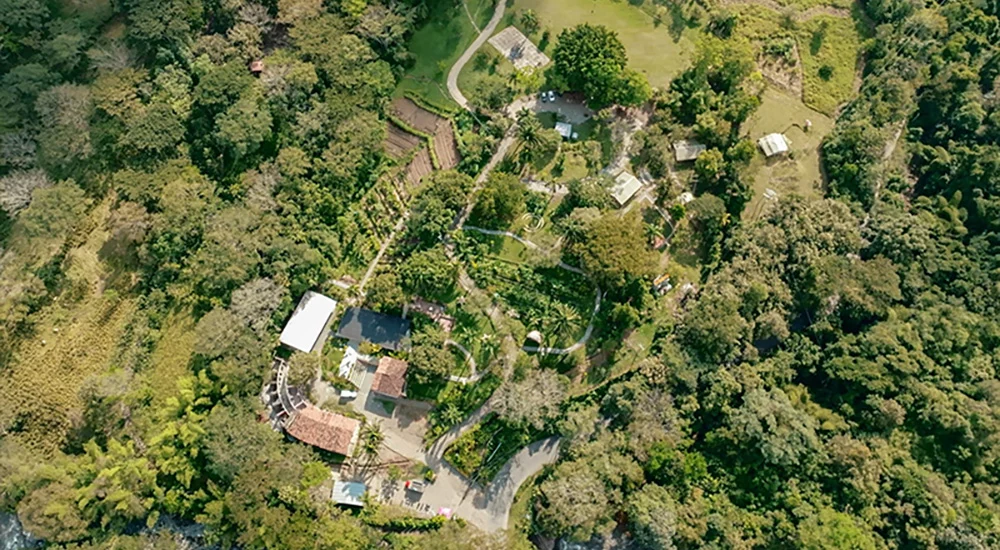
An aerial view of the Finca Viva module at Biosuroeste, the Agroforestry Systems focused on Cacao (“Edible Forest”), and the Biofactory.
Photo: Biosuroeste, Comfama.
Field visits, workshops and regional gatherings hosted at the park generate communities of practice centred on regenerative bioregional development. In 2025 alone, Biosuroeste offered training to over 2,500 producers, students and rural campesino families across the territory. More than 500 livestock producers participated in training programmes and talks, and over 1,200 people engaged in regional events bringing together producer associations, technical experts, and institutions working on sustainable livestock.
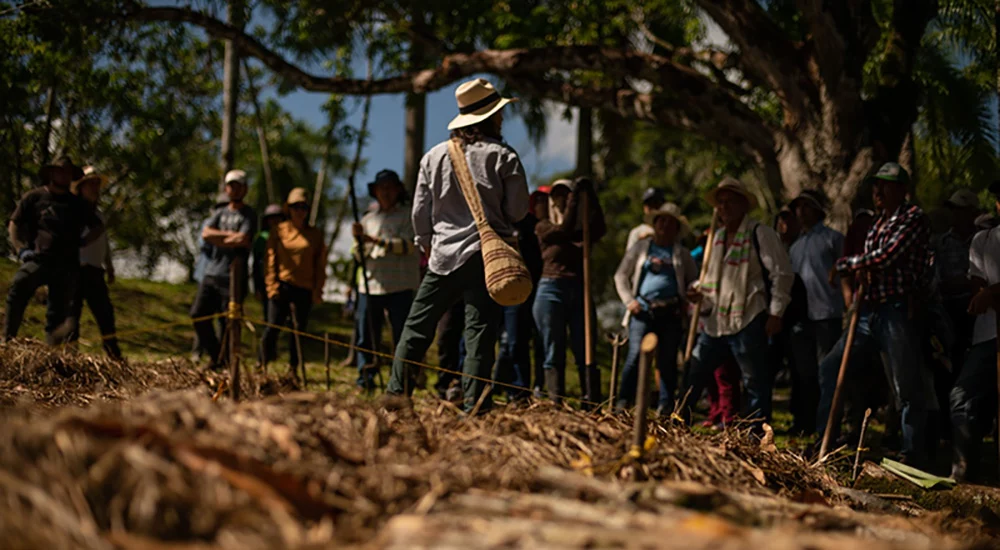
Gathering in Biosuroeste with groups of producers and rural and peasant families around the establishment of the Agroforestry System focused on Cacao (Edible Forest).
Photo: Biosuroeste, Comfama.
These encounters strengthen the visibility and credibility of agroecological practices across the region, while bridging rural communities with public institutions and markets.
Through the guiding principle of integrated system health, Biosuroeste seeks to demonstrate that soil health, ecosystem vitality, animal welfare and human wellbeing are inseparable dimensions of the same living system. This challenges a common narrative in agriculture that frames environmental care and productivity as competing objectives. For many producers, the understanding is reinforced in practice through the co-evolution of soil recovery and farm productivity on their own land:
We have understood that everything starts from the microorganisms in the soil. If I have good pastures, my sheep, rabbits, chickens, and cows will be healthy, and if I have healthy soils, the crops will be healthy for us.
Ridrigo Echeverry, local entrepreneur and farmer, participant of Biosuroestes training program
By demonstrating rather than enforcing alternative models, Biosuroeste invites people to sense and imagine the future of their territory as a place where nature restoration benefits all – an approach intended to cultivate agency and self-sustaining engagement. When producers recognize their own realities in the living experiments taking place at Biosuroeste, the park becomes a mirror of the territory, a beacon of hope directed at its transformative potential.
Today the site acts as a bridge between past and future, between extractive land use and regenerative possibilities for the wider Southwest Antioquia bioregion. Biosuroeste shows how agroecological transformation can begin with places that make new possibilities visible. As a Faro Agroecológico – an agroecological lighthouse – the park illuminates regenerative pathways that others can observe, adapt and carry forward. When such lighthouses emerge, they reshape not only landscapes, but the imaginaries through which territories envision their futures.
Wilma Lagerman
MSc candidate in Agroecology and food systems consultant
Federico Botero Jaramillo
Manager of Biosuroeste
Aziliz Le Rouzo is a Research Associate in SEI’s Agriculture, Land and Bioeconomy team, working with the Swedish International Agricultural Network Initiative (SIANI). Her background spans environmental management, economics and policy, with a strong interest in food systems transformation and agroecology.
Federico Botero Jaramillo leads Biosuroeste from within Comfama, since Comfama assumed the leadership of the project in 2023. He is an entrepreneur for Nature. For more than 16 years he has worked to connect Nature and development through business models that nurture living systems and territories.
Wilma Lagerman is an MSc candidate in Agroecology at the Swedish University of Agricultural Sciences (SLU) and a food systems consultant. She is also an entrepreneur working with food in diverse ways and supports agroecology research projects, bridging academic enquiry with practical work in food and farming.
Biosuroeste was built through a coalition of public, private, academic and grassroots partners. Proantioquia articulated and incubated the initiative, while the Inter-American Development Bank, with EAFIT University’s urbam centre, helped design the park’s Master Plan. Since 2021, the project has been led by Comfama, a Colombian social innovation platform working at scale across employment, health, education and wellbeing, including through its Finca Viva network of regenerative living farms.
Project / ASAPP works with farmers worldwide to document and share real examples of agroecology in practice, bridging theory and action for sustainable food systems.
Project / The Swedish International Agricultural Network Initiative – SIANI – is a global network that supports and promotes dialogue and action around food systems.
Past event / SEI joins global leaders in Santa Marta, Colombia, for the first international conference dedicated to transitioning away from fossil fuels.
Feature / Resilient Coasts – Caribbean Sea has officially been endorsed as a Decade Action under the UN Decade of Ocean Science for Sustainable Development.
Project / Does granting rivers legal rights help people and nature? This study analyzes the Atrato, Whanganui, and Turag rivers to find fair, effective governance.