Flooding in Bangkok in late September exposed a critical gap: although forecasts identified the threat days in advance, warnings and preparedness did not translate quickly enough into action. The absence of a single command to integrate information, coordinate agencies and guide timely decisions appear to have undermined the government response.
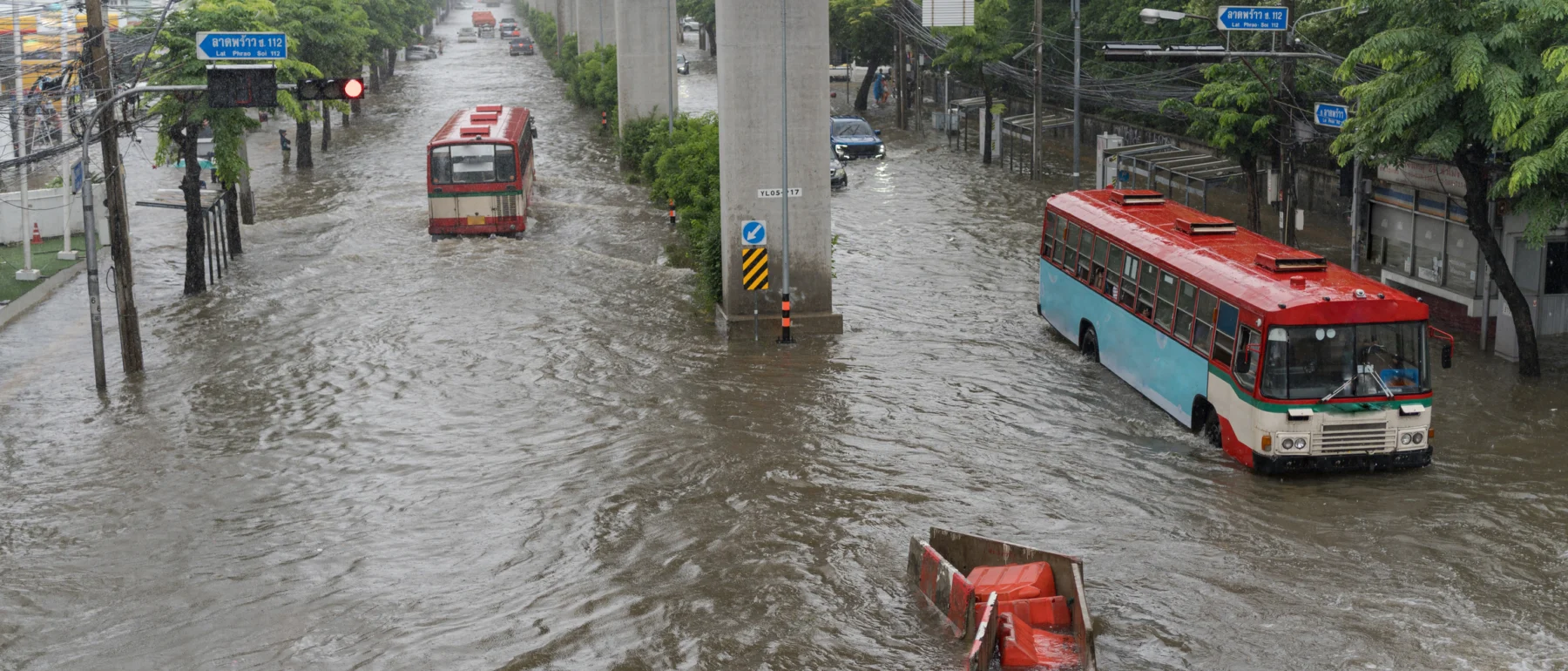
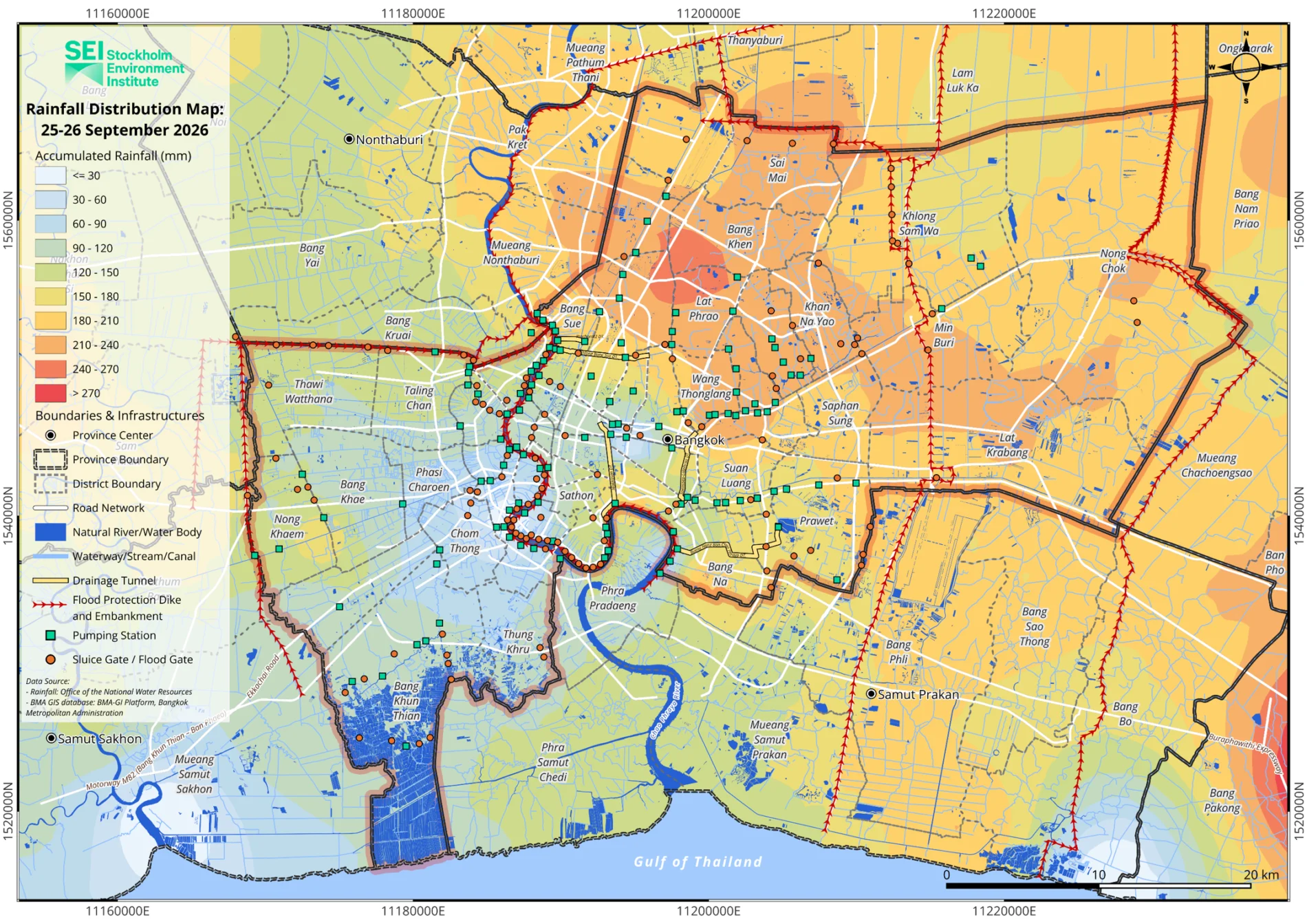
During persistent rain from 25–27 September, nearly 200 mm fell in 24 hours and 300 mm in 48 hours, flooding eastern Bangkok, particularly Lat Krabang, Bang Kapi, Khan Na Yao and Khlong Sam Wa. By 28 September, around 700 000 people were affected. Water exceeded 1 m in some low-lying communities, while total economic losses remain uncertain. (See Figure 1)
This “worst-case rainfall scenario” tested Bangkok’s flood preparedness, response, recovery and long-term mitigation. The key question is therefore not simply ‘Why did Bangkok flood?’ but what this worst-case event tested, and what the performance of each part of the system tells us about Bangkok’s urban flood resilience.
Figure 1. Accumulated rainfall during 25–26 September 2026.
Source: Phorntip Saensri / SEI.
The event tested the flood-risk chain. That includes forecasting, community preparedness, coordination, water management, evacuation and recovery.
The warning was there, but action lagged. The Thai Meteorological Department warned on 21 September that heavy to very heavy rain was expected across Thailand, including Bangkok, during 23–27 September. The Hydro-Informatics Institute also published forecasts indicating elevated cumulative-rainfall and flood risk. Forecasting was a strength: the hazard was visible several days in advance.
The weakness was translating forecasts into clear, location-specific advice. The Bangkok Metropolitan Administration (BMA) and national agencies, including the Department of Disaster Prevention and Mitigation (DDPM) and Office of the National Water Resources (ONWR), needed to communicate where flooding was likely, when it might begin, how deep it could become and what action to take.
Reports from affected communities and media suggest the event’s severity and persistence were underestimated, while messages sometimes created uncertainty. The warning from the cell broadcast emergency alert system reportedly arrived after flooding had begun.
This highlights the need to move from weather-based warnings to impact-based early warning. Forecasts should trigger action: preparing shelters and evacuation support, protecting vulnerable residents, deploying response teams before roads become impassable and adjusting transport and airport operations. The BMA should also consider proactive measures, such as work-from-home advisories, to reduce exposure and disruption. Forecasts save lives and reduce losses only when institutions and the public can act on them.
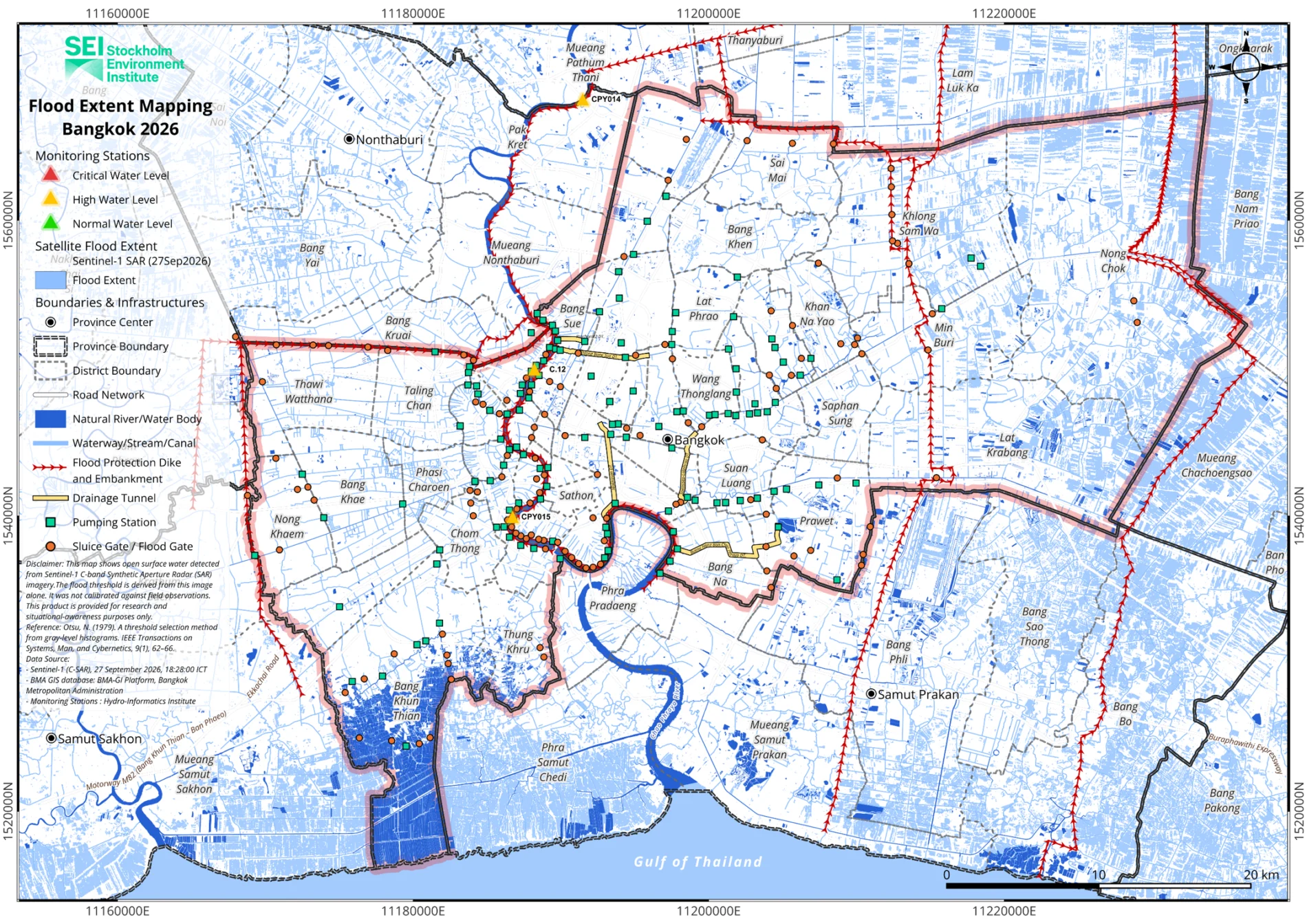
Bangkok did not enter the 2026 monsoon unprepared. The BMA’s flood action plan included 207 pumping stations, 244 water gates and five major drainage tunnels, backed by around THB 4.2 billion (USD 124 million) for flood protection and maintenance (Figure 2).
Yet all 50 districts were declared disaster-affected. The scale and speed of flooding raise critical questions: was the drainage system adequately prepared? Were the impacts driven by extreme, persistent rainfall, or by weaknesses in drainage management and coordination? Or all of the above?
Figure 2. The BMA flood drainage system and a flood map on 27 September 2026.
Source: Phorntip Saensri / SEI.
The challenge extends beyond Bangkok’s infrastructure. Flood risk is shaped by rainfall, upstream flows, tides, Chao Phraya River levels and drainage capacity across the city and surrounding areas, including Pathum Thani and Chachoengsao. The Royal Irrigation Department (RID), which manages upstream and surrounding water flows, must coordinate closely with the BMA. Without effective coordination, decisions can shift risks between upstream and downstream communities, creating competing interests and unequal impacts.
Urbanization and the loss of natural retention areas and floodways further constrain water storage. Concerns over changes to the BMA’s land-use plan also raise questions about future flood exposure. Resilience requires improved drainage and operational coordination, alongside stronger protection and restoration of wetlands, retention areas and floodways across the wider urban region.
The event exposed gaps in data sharing, warning protocols, coordination and communication. Despite forecasts days ahead, no unified command appears to have been activated during preparedness or response. Confusion over responsibilities reportedly delayed public alerts and action. Thailand has legal mechanisms to improve coordination, including the Disaster Prevention and Mitigation Act B.E. 2550 (2007) and Section 24 of the Water Resources Act B.E. 2561 (2018), which allows for a command centre for a severe water crisis.
These arrangements must be operational before the next emergency. A pre-agreed protocol linking the BMA, DDPM, ONWR, RID and the Prime Minister’s Office should define when command is activated, who makes decisions, how information is shared and what actions are triggered at each risk level. The system should be rehearsed, not improvised during a flood.
Citizen- and private-sector platforms, including Flood Help Center, FloodBoard, BKK FloodWatch and Flood69 People’s Party, helped share information on flood depths, blocked drains and local access. Some information may not have been independently verified and should be cross-checked. With data-quality standards and links to official systems, citizen reporting and AI-supported tools could improve situational awareness and help target responses.
Below we suggest four priorities in advance of the next storm. People must be considered in the water equation, with stronger, earlier warnings based on the science and urban conditions we already know well.
Tool / This tool supports in monitoring and analysis of riverbank erosion, shoreline change, and wetland dynamics using satellite-based earth observation data.
Perspective / Chea Sameang and Ridhi Saluja share perspectives on how water storage mechanisms in the Mekong Region can be more equitable and inclusive.
Feature / Learn about SEI's efforts with local partners to improve early warning systems and resilience to flooding in Thailand’s Sai-Ruak River basin.