At SEI we strive to maximize our own sustainability and transparency while tackling climate, environment and sustainable development challenges globally.
Our Environmental Policy outlines our actions to minimize the negative impacts of our operations on the environment and society, and sets targets for reducing our emissions from air travel.
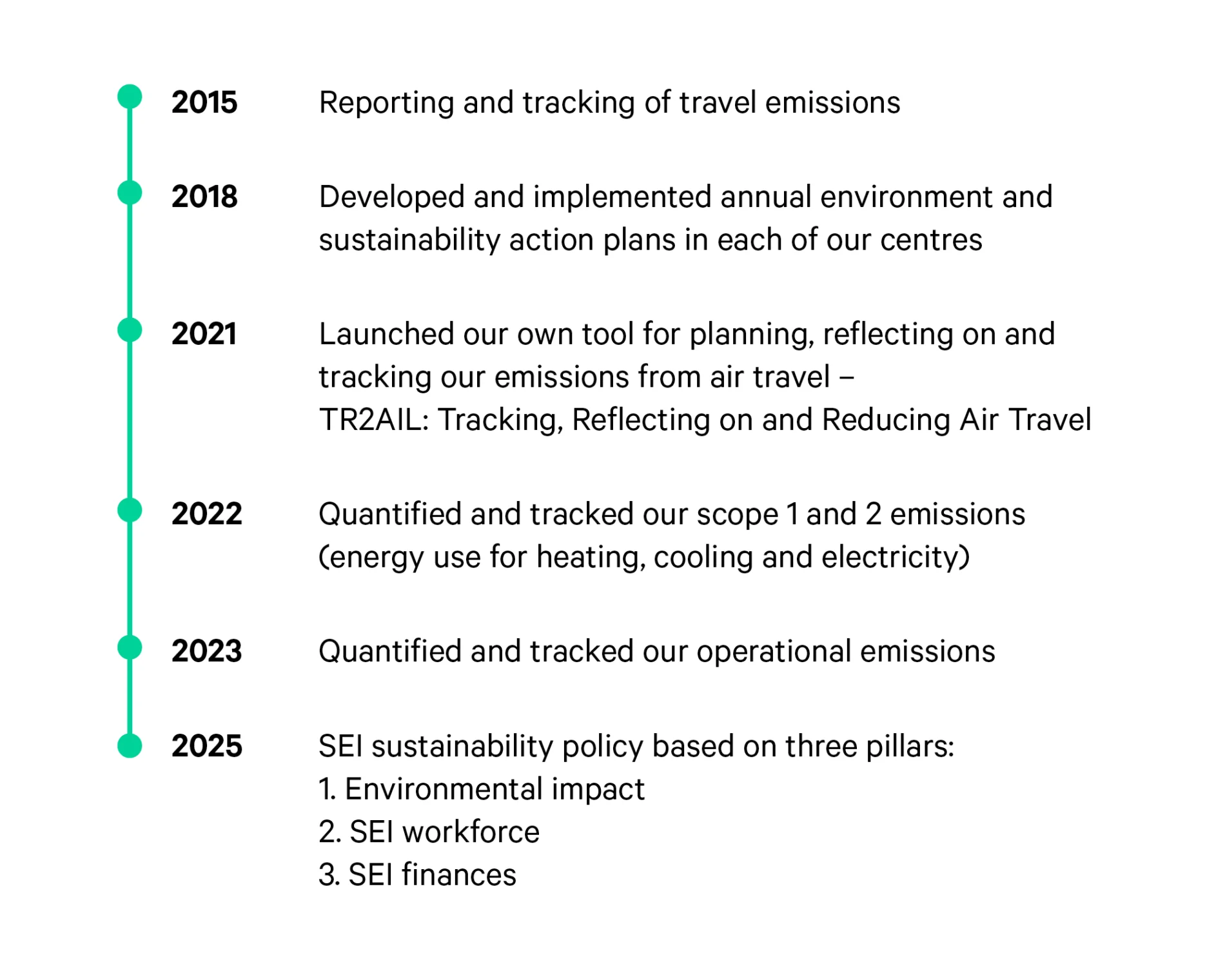
We have tracked and reported our emissions from our business air travel since 2015, developed and implemented annual environment and sustainability action plans in each of our centres since 2018, and quantified and tracked our operational emissions since 2023. This work is led by our institute-wide Environmental Policy team, who work together to promote environmental action throughout SEI. You can find examples of our centre-led sustainability initiatives in our annual reports and annual results reports.
In 2021 we launched our own tool for planning, reflecting on and tracking emissions from air travel – TR2AIL: Tracking, Reflecting on and Reducing Air Travel – which we continue to develop and make available to partners looking to reduce their own footprints.
Forthcoming updates to TR2AIL include a major revision of the emissions calculation methodology to reflect the latest science, and the launch of the TR2AIL ground module, which will also let users plan and track emissions from travel by car, train and ferry.
Graphic: Mia Shu / SEI.
The Environmental Policy team and our TR2AIL tool have fast-tracked our emissions reduction efforts. In 2019 we set our first target: to reduce our air travel emissions per full-time equivalent (FTE) employees by 25% by 2024, compared with our 2017 baseline. We achieved this in 2023 – a year unaffected by Covid-19 travel restrictions. In 2024 we set a new goal: to reduce our air travel emissions per FTE by 50% by 2030, compared with our 2017 baseline. We achieved this in 2025, along with a 14% reduction in our absolute emissions from air travel since 2017. Over the same period, the distance flown by SEI personnel fell 25% – 1.7 million fewer kilometres – while our workforce grew by 78%, from 191 to 339. Having achieved our goals, we are now setting more ambitious targets for 2030 and beyond.
SEI’s air travel emissions per employee since 2015, compared with our 2017 baseline and our targets for 2024 and 2030.
Note: Since 2021, we have calculated our air travel emissions using the methodology developed by Kamb and Larsson (2019). Earlier figures were calculated using a simple distance-based multiplier.
Total distance flown by SEI personnel on work travel since 2015.
In 2024 we began working towards voluntary alignment with the EU’s Corporate Sustainability Reporting Directive, bringing together our work and reporting on environmental and social sustainability with that of our human resources team and our finance and operations teams. This environmental, social and governance approach is helping us expand our commitment to transparency and build stronger connections between sustainability work throughout SEI. In 2027 we will release our first sustainability report aligned with the directive.
Explore TR2AIL – our online tool that helps organizations and individuals track, report, reflect on and take actions to reduce their travel-related greenhouse gas emissions.
Tool / TR2AIL is an online tool that helps organizations and individuals track, report, reflect on, and take actions to reduce their travel-related emissions.