After several years of growing optimism, the global green steel and green iron sector is entering a pivotal moment. Momentum slowed in 2025, with new project announcements captured in the Leadership Group for Industry Transition (LeadIT) Green Steel Tracker falling from a peak of 15 projects in 2021 to just two in 2025.
Planned primary green steel production capacity for 2050 currently represents less than 2%* of today’s total global steel production. Despite the slowdown in announcements, 2026 is set to be a decisive year for delivery.
The Green Steel Tracker identifies Stegra’s Boden project in Sweden as the most significant near-term milestone in 2026. It represents the first potential full-scale commercial commissioning of green steel. Several pilot and demonstration projects are also scheduled to advance this year including in Germany and the United States.
Successful commissioning of Stegra in Boden in 2026 and the roll-out of longer-term projects in the Hybrit alliance of SSAB, LKAB and Vattenfall, alongside pilot projects globally, will impact the sector in the coming years. These projects will influence confidence and the pace of transition not just in Sweden and not just in steel production but internationally and across industry.
Per Andersson, Head of Secretariat, LeadIT.
However, the Green Steel Tracker shows that delays are common among projects with publicly reported commissioning dates, while limited transparency makes it difficult to assess timelines for many others. In 2025, several high-profile projects, particularly in Europe, were paused or cancelled, as shown below.
Project status by planned commissioning year, global
Graphic: Harry Woodrow / SEI
LeadIT’s analysis of tracked projects indicates that planned primary green steel capacity by 2050 currently totals 28 million tonnes per year, alongside 18 million tonnes per year of green iron used as feedstock for steelmaking. These volumes represent only a small fraction of today’s 1 800 million tonnes per year of global steel production, including both primary and scrap-based output. This underscores the scale of ambition still required to decarbonize the sector.
Progress on the ground remains limited. At present, only around 270 000 tonnes per year of green iron capacity and 60 000 tonnes per year of green steel capacity are operational, meaning only a small share of announced projects has reached production.
Despite falling short of emissions reduction targets so far, incumbent global steelmakers continue to signal commitment to decarbonization, even as they face rising costs, weak demand and uncertain policy environments. Future policy intervention may prove decisive in sustaining momentum until green steel becomes cost-competitive at scale.
Policy support to get first-of-a-kind green steel projects up and running can deliver benefits far beyond any single plant by accelerating learning, proving the technology at scale, and helping create early markets and confidence across the entire sector.
Aaron Maltais, Policy Lead, LeadIT.
*The 2% figure should not be viewed as a direct comparison. The planned production figures in the Green Steel Tracker represent primary steel deep decarbonization projects capable of delivering 85% or more emissions reductions compared with conventional primary steel production. Total global production includes both primary steel production and scrap-based production.
Jane Birch, Communications Lead, LeadIT, [email protected], +46-72 214 9616
Ulrika Lamberth, Senior Press Officer, SEI, [email protected], +46-73 801 7053
The methodology focuses on primary steelmaking from iron ore rather than scrap recycling because primary production is far more emissions-intensive and therefore where deep decarbonization has the greatest impact. As a broad benchmark, green iron and steel pathways are defined as those capable of around an 85% emissions reduction compared with average conventional production, which is approximately 300 kg or less of carbon dioxide per tonne of steel produced. Of 160 projects reviewed, only the most ambitious qualify as green under this methodology.
Full details of all qualifying projects and all those reviewed but not meeting the criteria are available in the Green Steel Tracker downloadable database.
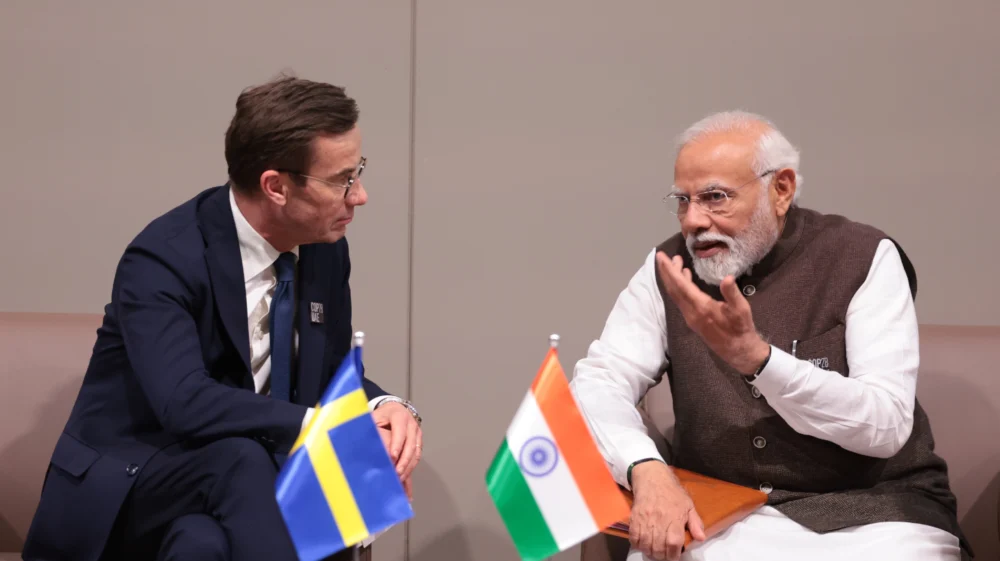
The Leadership Group for Industry Transition (LeadIT) was established by the governments of India and Sweden in 2019 to mobilize public and private sector action to drive the global industrial transition. The initiative brings together 18 countries and 30 companies committed to accelerating pathways towards an inclusive, just and equitable transition to net zero emissions from heavy industry. Stockholm Environment Institute (SEI) hosts its secretariat.
To learn more, connect with LeadIT on LinkedIn.
Project / The Leadership Group for Industry Transition (LeadIT) aims to enable the transition of heavy industry towards net zero carbon emissions by 2050.
Feature / From 22-29 September 2024, key stakeholders in government, business and civil society gathered at Climate Week NYC to drive action on industry decarbonization.
Feature / COP28 launches LeadIT 2.0, uniting global leaders for a sustainable, inclusive industrial transition aligned with the Paris Agreement.
Press release / India and Sweden has launched a strengthened partnership aiming to spearhead a more ambitious and accelerated global industry transition.