A timber construction industry that supports climate action, creates rural jobs and manages forests sustainably is taking shape in Thailand, built on Swedish expertise.
The Wood Solution Thailand Forum, recently held in Bangkok, explored practical solutions for Thailand’s timber industry by connecting Swedish forestry expertise with the country’s forest sector. The forum was part of the Wood Solution Thailand Program, which brings together researchers, foresters, architects, investors, and policymakers from across Thailand and Sweden to build a sustainable timber construction ecosystem.
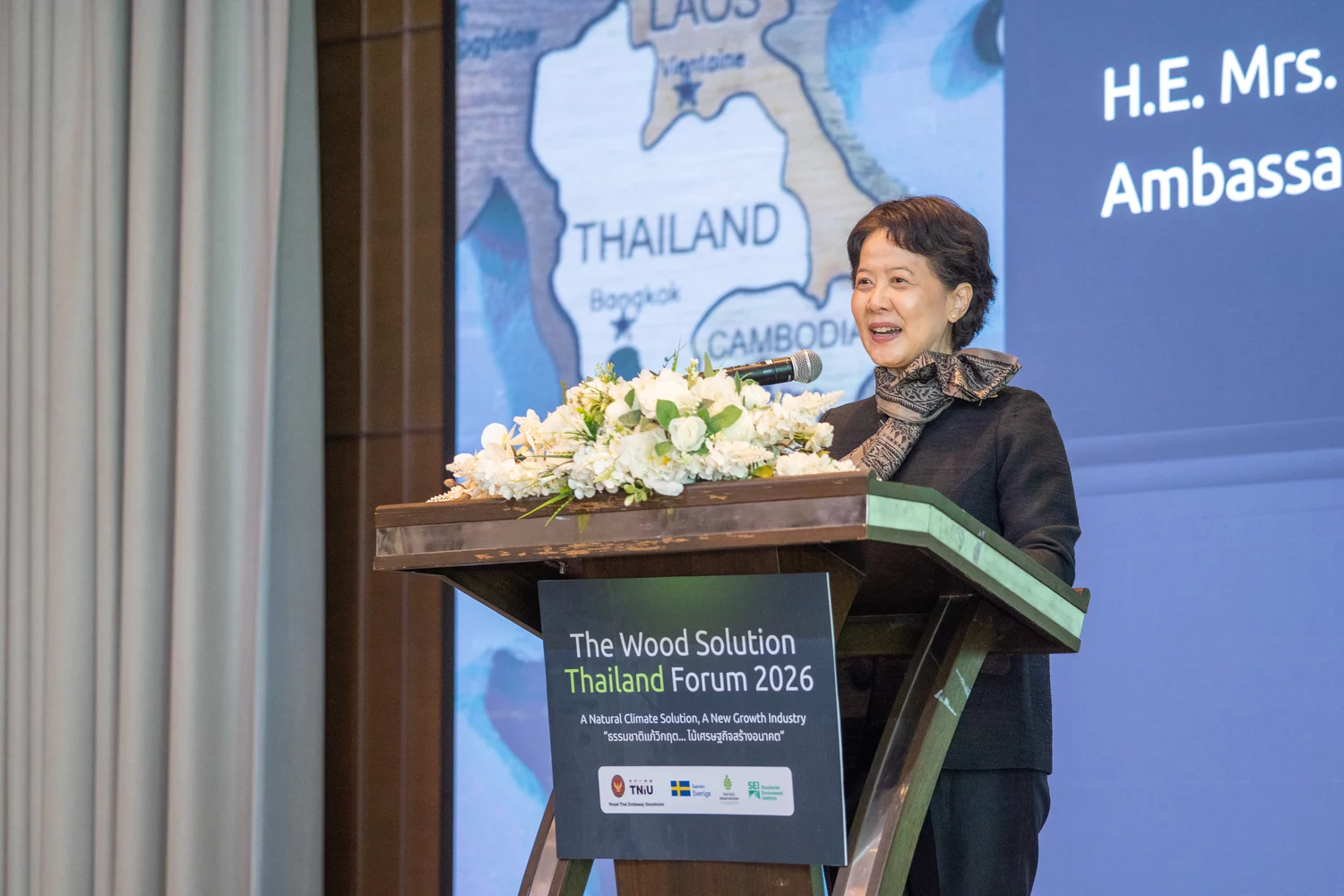
Speaking at the forum, H.E. Mrs. Arunrung Phothong Humphreys, Ambassador of Thailand to Sweden, explained why Sweden’s experience offers a powerful model.
Sweden has a strong forestry sector, an advanced wood-processing industry and decades of experience balancing economic growth with environmental stewardship.
H.E. Mrs. Arunrung Phothong Humphreys, Ambassador of Thailand to Sweden
She also pointed to the broader diplomatic foundation, noting that the relationship has been strengthened by the Strategic Partnership Agreement signed between the two countries, and described the project as a new model linking grassroots communities with emerging green industries.
H.E. Mrs. Arunrung Phothong Humphreys, Ambassador of Thailand to Sweden, at the Wood Solution Thailand Forum. Photo: Thai-Nordic Innovation Unit (TNIU).
Emanuel Lundin, First Secretary at the Embassy of Sweden in Bangkok, highlighted how the partnership is turning years of dialogue into collective action: “The process is important … the journey matters as much as the eventual outcome.”
Since 2022, partners including the Thailand-Nordic Countries Innovation Unit (TNIU), the Eco-Innovation Foundation (EIF), and SEI have worked to lay the groundwork for wood innovation in Thailand, aiming to establish timber construction as both an economic driver and a climate solution. The program’s engagement phase (March–June 2026) is designed to prepare the ground for a long-term initiative promoting sustainable wood-based construction, forest restoration and climate-smart bioeconomy solutions.
Klas Bengtsson, Director of the Eco-Innovation Foundation (EIF) said: “This is a great opportunity to address the climate change issue while creating an economic growth engine for Thailand, that’s the big picture.”
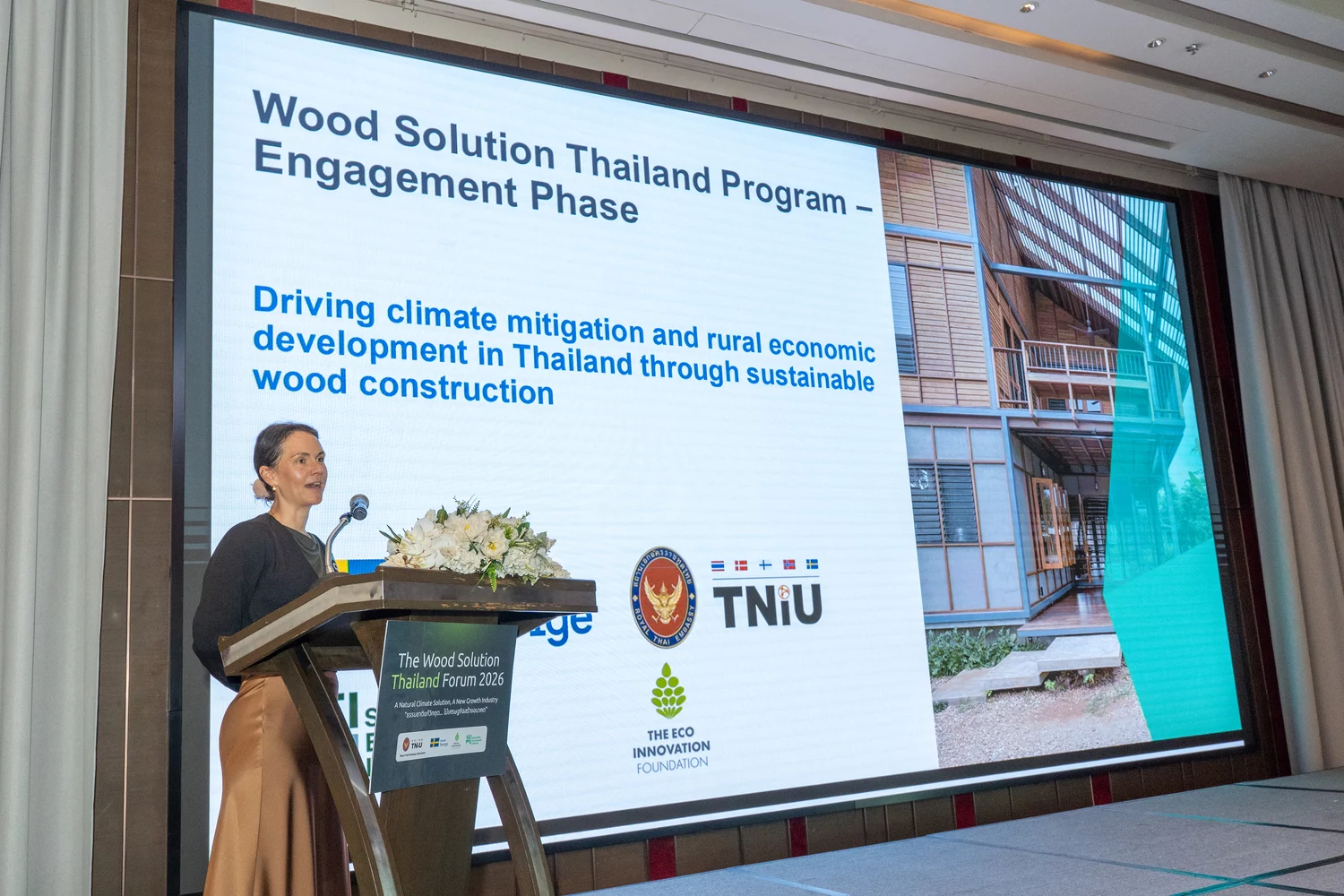
Marie Jürisoo, Centre Director of SEI Asia, introduced the engagement phase and its strategic role, explaining that it had been designed to accelerate momentum, deepen stakeholder participation and identify practical next steps.
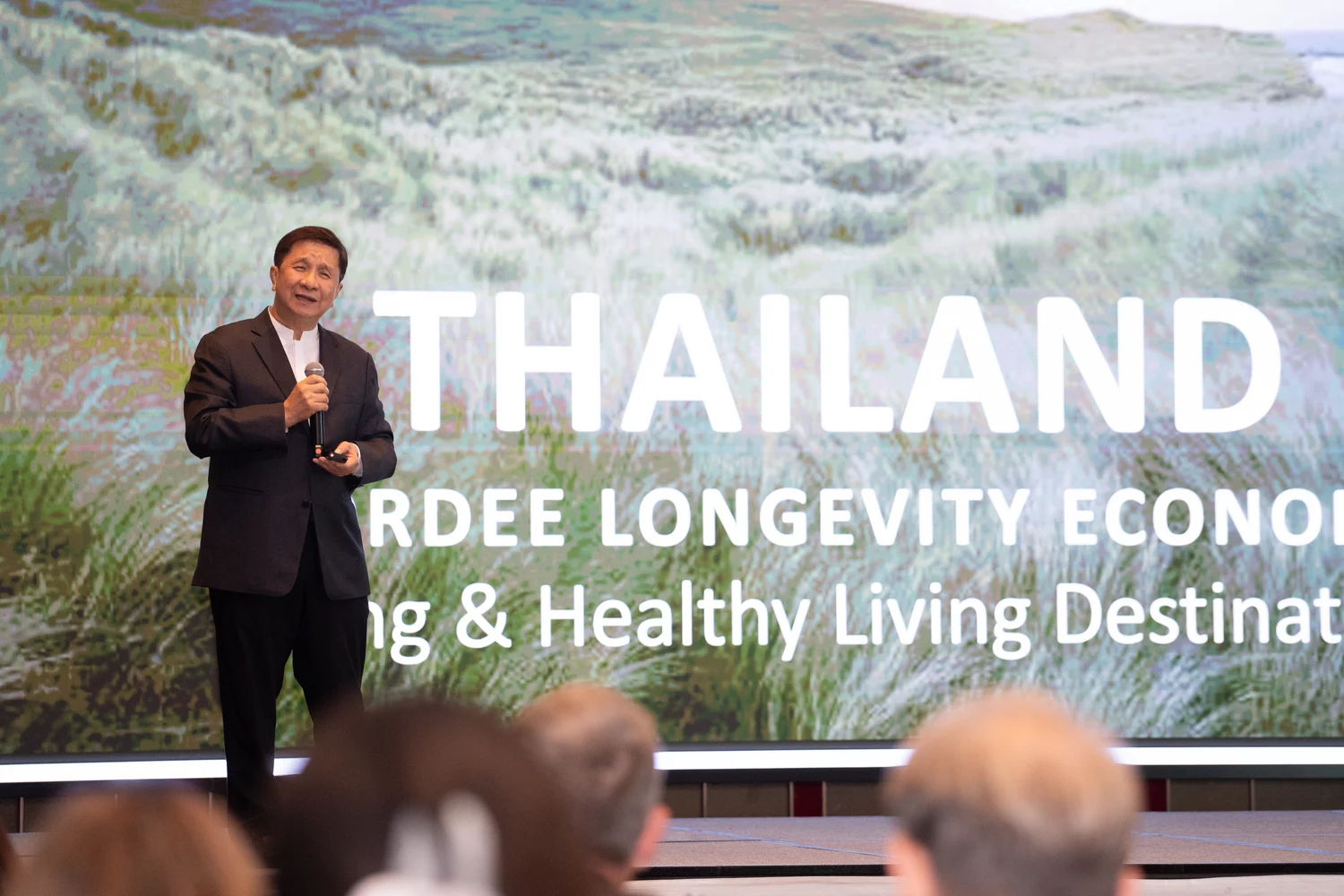
Marie Jürisoo, Centre Director of SEI Asia, at the Wood Solution Thailand Forum. Photo: Thai-Nordic Innovation Unit (TNIU).
The engagement phase is supporting “pioneer initiatives” across the full value chain, from forest management to construction, demonstrating practical wood-based solutions. The forum showcased more than ten such initiatives.
Thanyaporn Wongtitirote, Coordinator of theThailand and Nordic Countries Innovation Unit (TNIU)/Royal Thai Embassy in Stockholm, is involved in supporting the pioneer projects. She said: “The results are now adding up from what we’ve been discussing for many years. Now we’re making stronger connections across many groups and sectors and figuring out the key challenges and milestones.”
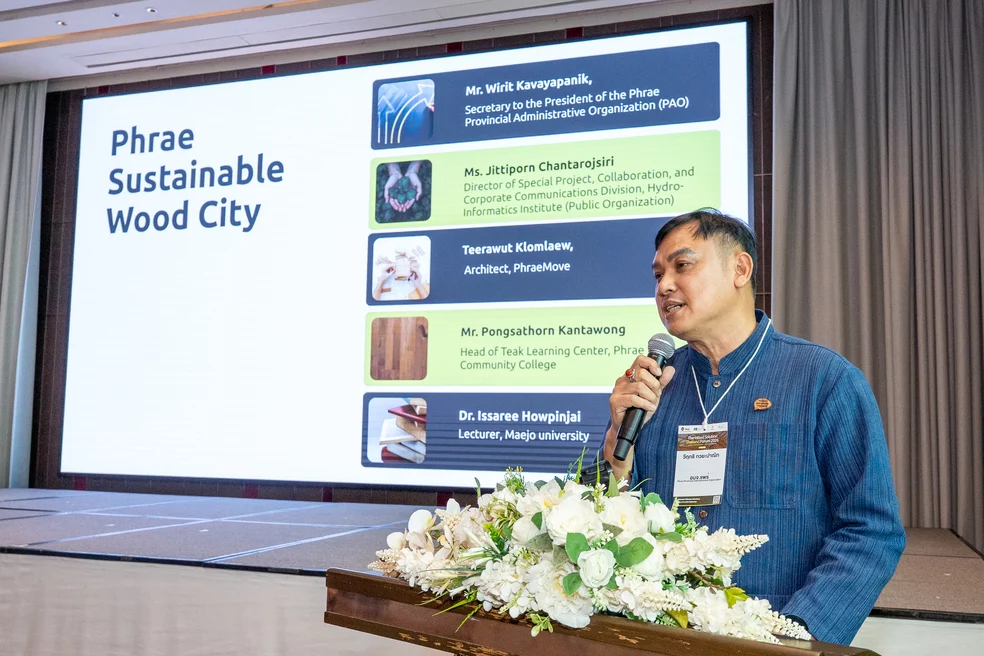
One flagship model is the Phrae Sustainable Wood City initiative. Reflecting Phrae’s long association with teak, the project has already trained around 150 postgraduate students as future forestry, resource and environmental managers – and it is emerging as a potential model for nationwide development.
We have five working frameworks: first, sustainable plantations like Sweden; second, modern processing technology using AI and innovation to increase quality and safety; third, wooden construction and teak products; fourth, education – we have three institutions that can connect with Sweden; fifth, policy, with provincial and local governments driving sustainability.
Veerit Kanlayapanik, Secretary to the President of the Phrae Provincial Administrative Organization (PAO)
He added: “We have about 300,000 rai (48,000 hectares) of plantations, 44,000 skilled people, around 200 wood-processing factories, and strong academic institutions such as Maejo University and three newly established forestry schools.”
Veerit Kanlayapanik, Secretary to the President of the Phrae Provincial Administrative Organization (PAO), at the Wood Solution Thailand Forum. Photo: Thai-Nordic Innovation Unit (TNIU).
These initiatives are also driving rural income. The Grow Longevity Ecovillage, championed by Pordee Society, integrates sustainable agronomy, AI smart farming and wellness principles to build resilient communities. The project focuses on “right livelihood,” combining traditional ecological wisdom with modern innovation to ensure food safety and long-term health.
Its founder Mr Sak (Chayadis Hutanuwatr), said: “The problem with planting teak is you have to wait 20–30 years with no income. But with smart farming – using sensors, organic fertilizer, automated shade – a couple can work about four hours a day and earn 30,000-40,000 baht per month after expenses. That’s real.”
Chayadis Hutanuwatr, Founder of Pordee Society, at the Wood Solution Thailand Forum. Photo: Thai-Nordic Innovation Unit (TNIU).
To support long-term success, the program is developing the Wood Solution Support Platform, an international network of experts and technology providers to help Thailand and other tropical countries build sustainable timber construction ecosystems. The effort also involves forming funding partnerships with bilateral, multilateral, philanthropic and private-sector actors to support the program’s next phases.
Throughout, Sweden’s role has been supportive – bridging expertise between countries rather than imposing a one-size fits all solution.
“What I witnessed was no longer a Swedish project. It was a Thai movement … the Swedish role had become almost invisible. Perhaps that is the highest achievement of all,” said Gregers Møller, editor-in-chief of ScandAsia, who joined the meeting online and wrote about it on the ScandAsia website.
Thanapon Piman, SEI Asia’s Senior Research Fellow and the Project Lead said: “The long term vision of the program is to provide forest-based climate solutions that can lead to a sustainable timber industry.”
To implement this vision, the Wood Solution Thailand Program has set out a phased roadmap extending to 2037, showing how international partnership, sustainable forest use and innovative construction can work together to support rural income and climate action.
As Marie Jürisoo put it: “This kind of initiative requires a whole-of-society approach and a collaborative mindset. We can all contribute in many ways.”
The model now shifts its focus to implementing the long-term roadmap, scaling and building a sustainable timber future for Thailand.
The Wood Solution Thailand Program is a collaboration between TNIU, EIF, SEI and Sida, supported by the Royal Thai Embassy in Stockholm and the Embassy of Sweden in Thailand.
Project / A preparatory phase towards building a sustainable timber construction ecosystem in Thailand
Media advisory / Experts from SEI will be at CBD COP17 in Yerevan from 19–30 October and are available for commentary and analysis.
Media advisory / SEI invites journalists to a media briefing where its experts will share their perspectives on key topics ahead of the UN Biodiversity Conference (COP17).
Past event / SEI Asia, in collaboration with Eco-Innovation Foundation (EIF), will host the Wood Solution Thailand Forum 2026 on 2 June.