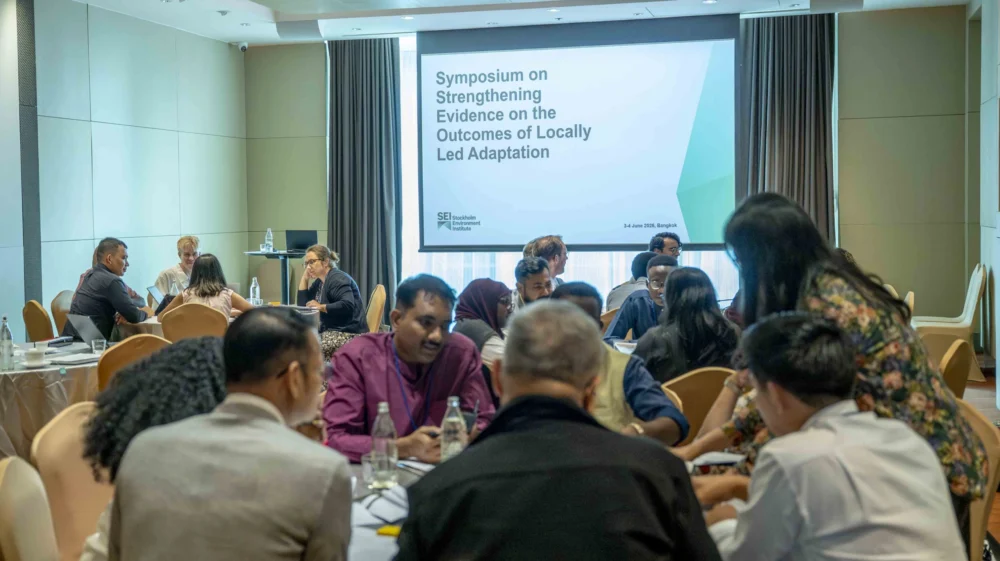
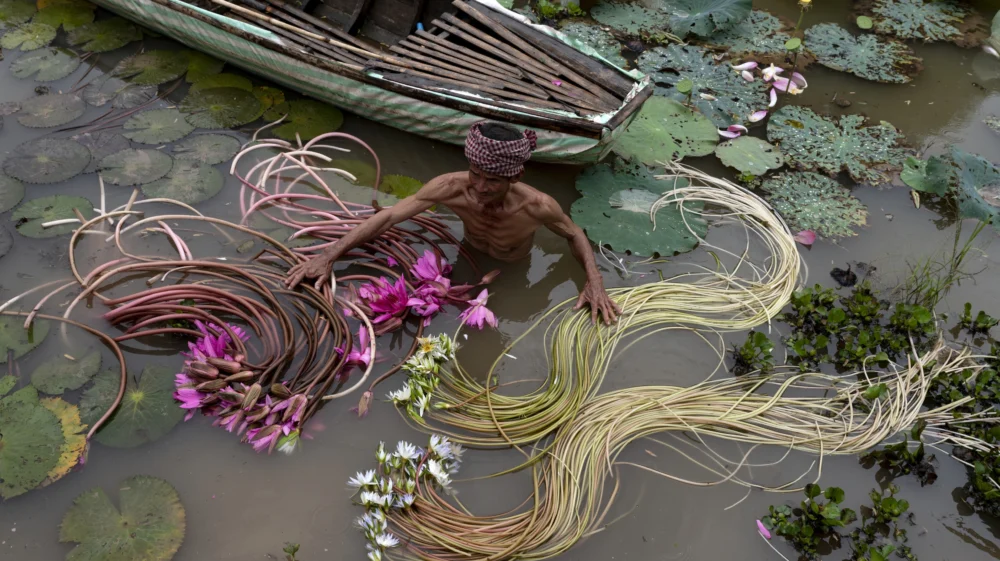
Please note the call is now closed. The Strengthening Evidence on the Outcomes of Locally Led Adaptation (LLA) symposium, to be held in Bangkok in June 2026, invites researchers, practitioners, policy analysts and community knowledge holders working on or with LLA, to submit proposals to contribute to a forward-looking agenda aiming to strengthen evidence on outcomes of LLA.
The event seeks to broaden conventional understandings of “evidence” by valuing participatory, lived and narrative forms of knowledge alongside empirical research, with the aim of strengthening credible, inclusive and decision-relevant evidence on LLA outcomes.
The symposium is jointly organized by the Stockholm Environment Institute (SEI) in collaboration with a core organizing committee including the World Resources Institute (WRI), SouthSouthNorth (SSN), the International Institute for Environment and Development (IIED), Climate Analytics, the Caribbean Natural Resources Institute (CANARI), and BRAC, with additional partners to be confirmed. The symposium is supported the Foreign, Commonwealth, and Development Office of the United Kingdom (FCDO).
More than 130 organizations and governments have endorsed the Principles for Locally Led Adaptation (LLA), yet only a small share of international climate finance supports adaptation at local levels – and even less of this funding is truly locally led. Across recent global convenings, funders, policymakers, and practitioners have consistently highlighted the need for stronger, more nuanced evidence on the effectiveness of LLA approaches to help drive investment. Others argue that this evidence exists but is not reaching decision-makers.
In response, a consortium of researcher and practitioner organizations will convene a two-day, in-person symposium June 3–4, 2026, in Bangkok. The symposium will bring together 25-30 researchers, practitioners, and knowledge holders to share new findings, take stock of the current state of evidence on the outcomes of LLA, and co-develop a forward-looking agenda for strengthening evidence that is credible, inclusive, and usable for decision-making.
Limited funding is earmarked to support attendance from community organizations; other attendees are expected to self-fund. Please limit to one submission per organization.
The symposium aims to deepen collective understanding of whether, how, and under what conditions LLA contributes to climate resilience – both in the short and long term. Importantly, it seeks to broaden prevailing notions of “evidence” beyond conventional academic and policy research, recognizing that knowledge about climate resilience outcomes is also generated through participatory processes, lived experience, storytelling, and locally grounded ways of knowing.
The symposium will contribute to the development of a flagship report to be launched in August 2026 and will inform a targeted information campaign aimed at shifting perceptions of LLA among funders, policymakers, and the broader climate community.
We invite proposals that engage with evidence of LLA outcomes and impacts. Contributions may be empirical, conceptual, methodological, or reflective, and may draw on diverse epistemologies and methods. Contributions should not be published in the academic literature (i.e. peer-reviewed journals); unpublished and grey literature contributions are welcome.
Relevant themes include, but are not limited to:
The symposium welcomes a range of contribution formats, including but not limited to:
We understand rigor not as adherence to a single methodological tradition, but as transparency, positionality, and coherence between claims and evidence. Diverse forms of knowledge – including participatory processes, lived experience, storytelling, and creative methods – can meet high standards of rigor when their evidentiary foundations and limitations are clearly articulated.
Selected contributors will be invited to present their work through presentations, facilitated discussions or other interactive formats, and to contribute to co-development of the symposium’s flagship report through a collective assessment exercise. All contributors will be recognized as authors in the final report.
We welcome proposals from researchers, practitioners, policy analysts and knowledge holders working on or with LLA. Interdisciplinary and cross-sectoral collaborations are strongly encouraged. Contributions should be in English, French, Spanish or Hindi.
To help ensure broad and inclusive participation, limited funding is available to support contributors from community-based organizations. This support is intended to enable in-person participation and will cover travel to and accommodation in Bangkok for the duration of the symposium.
Applicants who wish to be considered for this support will be invited to indicate this at the time of submission. Funding will be allocated subject to available resources, with the aim of supporting diverse perspectives, geographies and forms of knowledge represented at the symposium.
Please note the call is now closed.
Further details on support for participation and symposium logistics will be shared with select contributors.
Past event / Join the launch of a new report on the state of evidence on locally led adaptation and recommendations to bridge key divides.
Perspective / Asia’s next financial revolution must make climate adaptation finance accessible to vulnerable households and small businesses.
Media advisory / Experts from SEI will be at CBD COP17 in Yerevan from 19–30 October and are available for commentary and analysis.