To reach climate neutrality, Ukraine needs to invest roughly EUR 550 billion more than it is currently investing in decarbonization. However, climate neutrality by 2050 is feasible and beneficial, according to new figures from the Climate Neutrality Tool, a model built by SEI specifically for Ukraine.
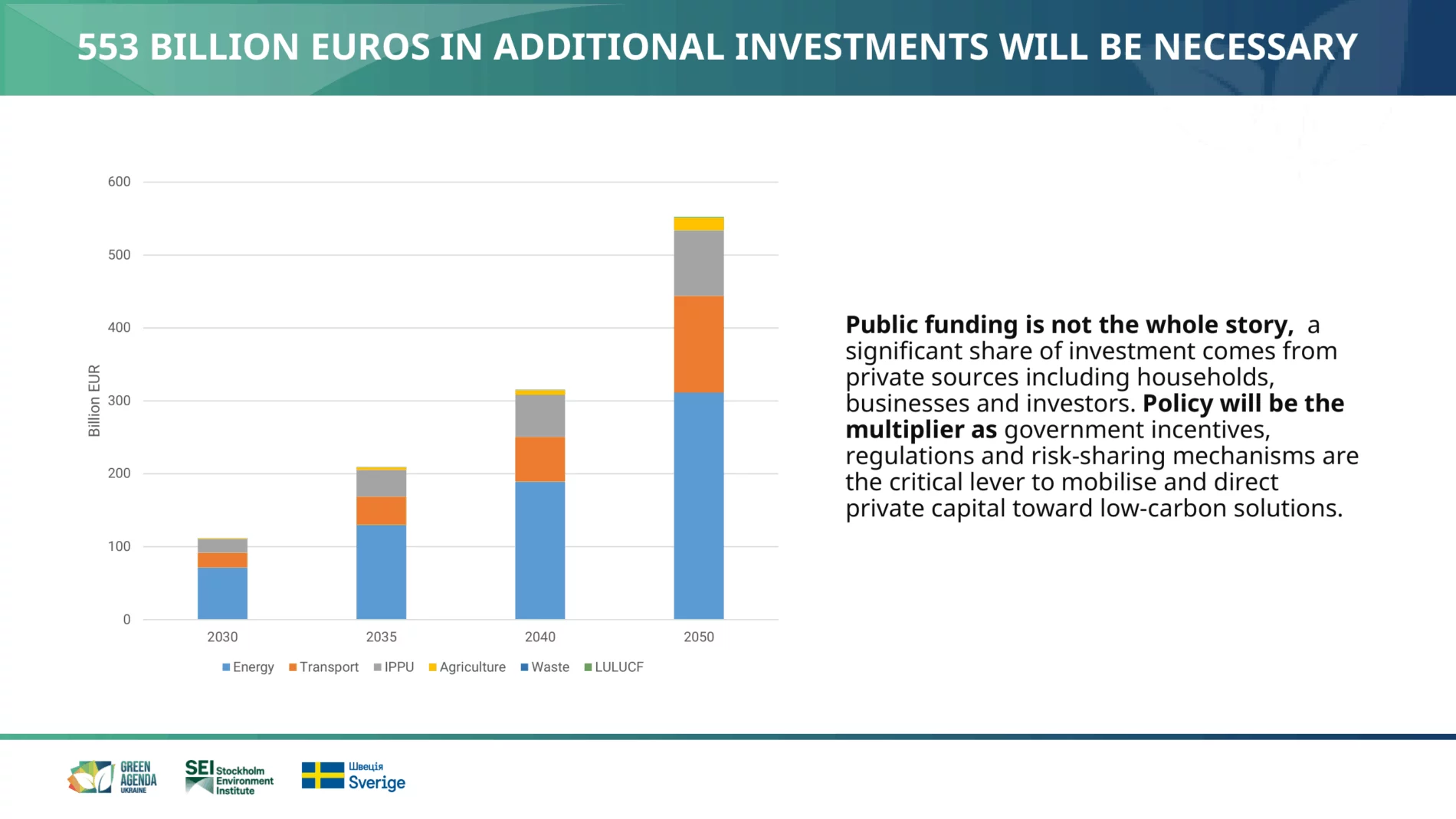
SEI has analysed the sectors that contribute most to Ukraine’s greenhouse gas emissions (energy, transport, buildings, industry, waste, agriculture, land use and forestry) and assessed their potential to transition to a clean economy. The largest investment needs are in the energy sector, at around EUR 311 billion, followed by transport at around EUR 133 billion and industry at around EUR 90 billion. These investments will, however, not only be needed from the public sector, but rather be split between public and private actors.
These figures stem from the Climate Neutrality Tool, developed by SEI for Ukraine as part of the Green Agenda for Armenia, Moldova and Ukraine project. The main partner in Ukraine is the Green Transition Office (GTO), an independent advisory body under Ukraine’s Ministry of Economy, Environment and Agriculture. The project is funded by Sida, the Swedish International Development Cooperation Agency. The tool contains 55 measures identified as among the most viable for reducing Ukraine’s emissions. It allows policymakers and experts to create and compare different scenarios in terms of emission reductions, investment needs, and GDP growth and new jobs created. It also estimates co-benefits such as cleaner air and improved public health, making it easier to understand which measures are most effective for emission reductions and what benefits they can bring to society and economy. For example, the co-benefits that come from improved public health and cleaner air as a result of a clean economy are estimated at nearly EUR 17 billion annually by 2050.
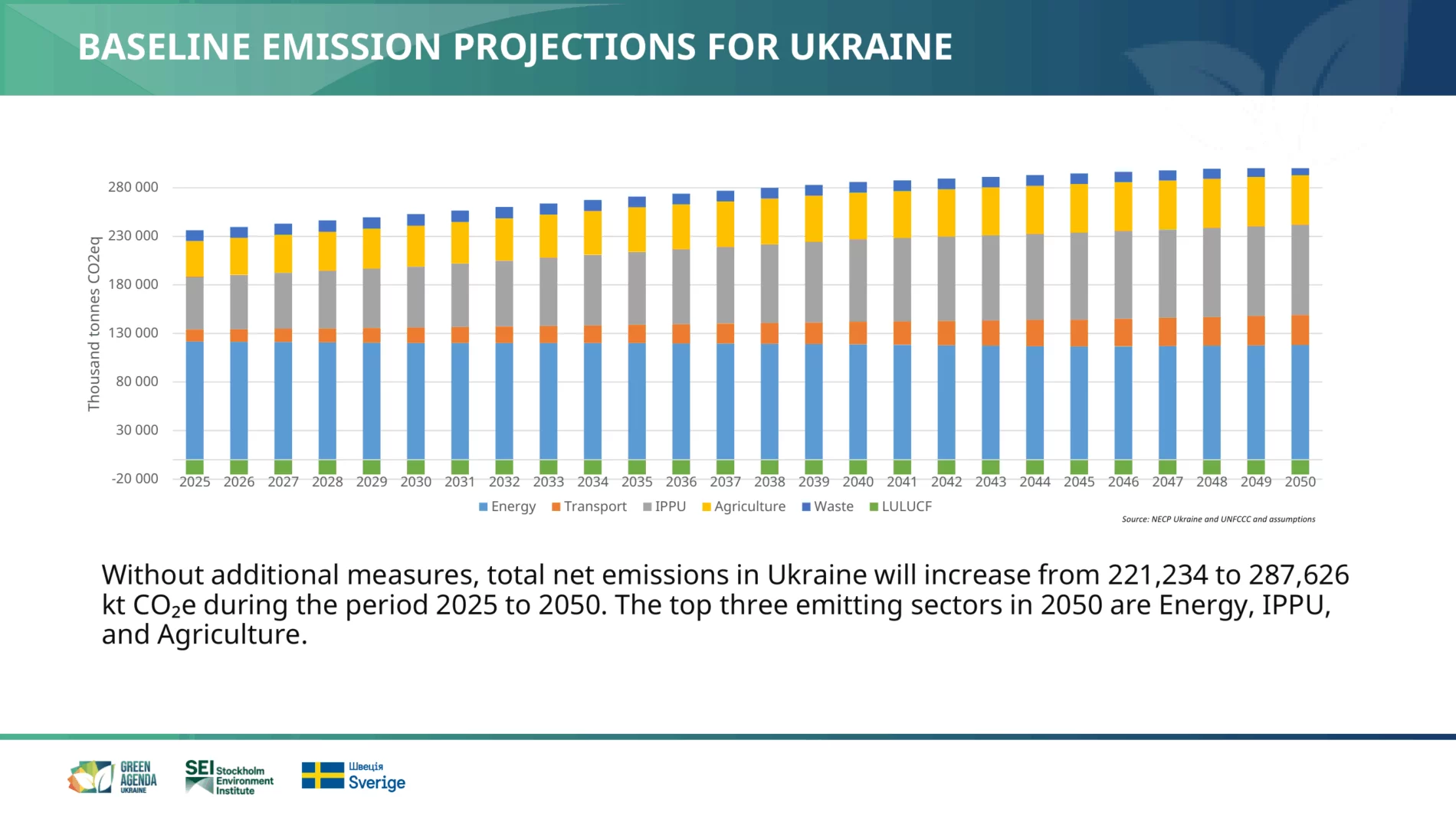
Baseline emission projections for Ukraine to 2050 without additional measures.
Source: NECP Ukraine, UNFCCC and SEI assumptions. Graphic: Green Agenda.
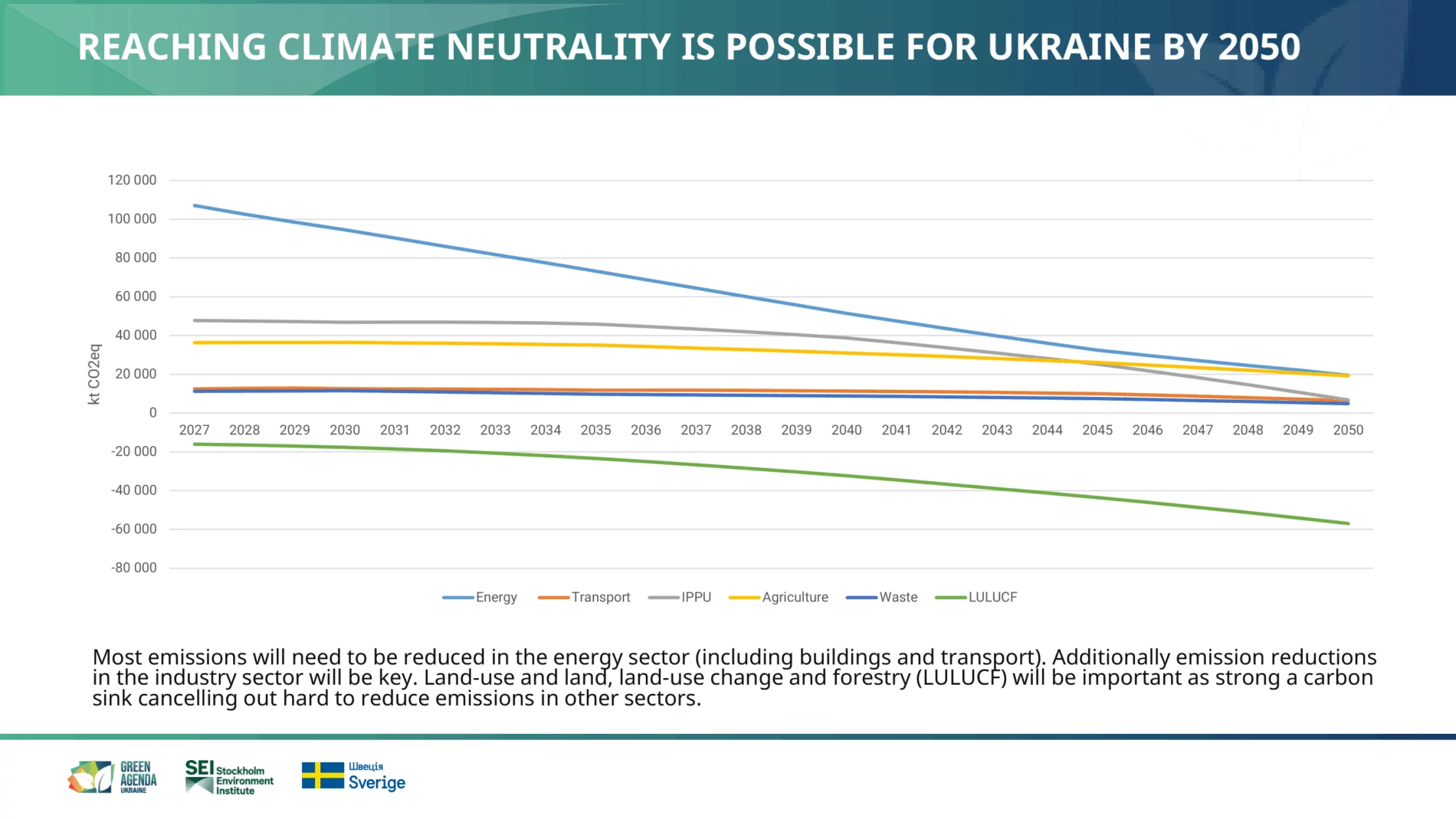
Scenario for reaching climate neutrality in Ukraine by 2050.
Source: NECP Ukraine, UNFCCC and SEI assumptions. Graphic: Green Agenda.
Rather than delivering a one-off analysis, SEI built a tool that Ukraine can operate independently: policymakers can update background data, adjust the pace, scale or timing of individual measures, and immediately see the effects on emissions, costs and economic outcomes.
“We developed a practical tool that enables Ukraine to continuously analyse and update its clean economy transition pathway. As new data emerge and policy priorities evolve, the government can easily rerun the model and make informed decisions based on the latest evidence,” said Gowtham Muthukumaran, Energy System Modelling Expert at SEI Tallinn.
Although clean technologies may require higher upfront investment, they are cheaper in the long run. Electrification of transport and energy-intensive processes can reduce operating and maintenance costs as more efficient systems replace costlier fossil-based solutions.
Breakdown of additional investment needs by sector: EUR 553 billion by 2050.
Source: NECP Ukraine, UNFCCC and SEI assumptions. Graphic: Green Agenda.
“With reconstruction needs at around EUR 506 billion over the next decade, Ukraine has its biggest chance to build a green, low-carbon economy that will be resilient and competitive in the longer term. If Ukraine invests in green transition today, it will avoid paying in the future for more expensive, more polluting and less competitive technological solutions, ” said Ganna Gladkykh, SEI Policy Fellow and Country Lead for the Green Agenda for Ukraine project.
SEI has transferred the Climate Neutrality Tool to Ukraine’s Green Transition Office and, in May, trained government officials in its use, equipping Ukrainian institutions with the analytical capabilities and expert knowledge needed to assess decarbonization pathways, plan green reconstruction, and support both Ukraine’s National Energy and Climate Plan (NECP) and its Long-Term Low-Carbon Development Strategy until 2050.
Participants of the energy and climate modelling training for policymakers, organized by SEI in Kyiv, May 2026.
Photo: Green Agenda.
“SEI’s Climate Neutrality Tool and other SEI tools, such as LEAP, will increase our capacity for supporting the Government of Ukraine in developing and implementing climate policies and achieving long-term net-zero targets. These tools also enable the evaluation and comparison of the effectiveness of various policies, thereby facilitating data-driven policymaking. We are working with SEI to ensure we are able to absorb the skills and continue the development of these models,” said Andriy Kitura, Head of the Green Transition Office.
The Green Transition Office and SEI are currently working together to carry out a detailed decarbonization analysis for key Ukrainian industries. A roadmap for the iron and steel sector is expected to be published by early autumn 2026.
In Stockholm: Ilona Kazaryan, Senior Communication and Impact Officer, SEI, [email protected]
In Kyiv: Olena Ermolenko, Communications Officer, Green Agenda, [email protected]
The SEI Climate Neutrality Tool makes it easier for policymakers and analysts to plan the national-level transition to net-zero greenhouse gas emissions. It enables climate targets to be translated into practical, evidence-based decisions by modelling sectoral mitigation measures, their emissions reductions, investment needs, and wider economic and social impacts.
Tool / This modelling tool helps to plan the national-level transition to net-zero greenhouse gas emissions.
Project / Green Agenda supports Armenia, Moldova and Ukraine in their efforts to achieve climate neutrality through green transition.
Tool / This modelling tool helps to plan the national-level transition to net-zero greenhouse gas emissions.
Perspective / Ukraine is emerging as the first real test for global climate finance, and reforms are needed in the country to enable effective investment from the EU.
Feature / As Ukraine progresses on its path to EU integration, a National Comprehensive Green Transition Assessment Report shows paths to green recovery and growth.