The Green Agenda project supports Armenia, Moldova and Ukraine in advancing an inclusive, sustainable and efficient green and just transition aligned with EU policy objectives and accession criteria. Through technical assistance, capacity building and regional exchange, the project helps make this transition environmentally effective, socially just and grounded in human rights.
The Green Agenda for Armenia, Moldova and Ukraine is a regional initiative funded by the Swedish International Development Cooperation Agency (Sida) and running from December 2022 to December 2027. The project supports the three countries in pursuing a green and just transition aligned with EU policy frameworks and accession goals. By addressing environmental challenges, strengthening climate action and supporting healthier, more resilient economies, it contributes to sustainable development and closer alignment with the EU.
The project focuses on three areas. First, it supports governments in developing and implementing green transition plans and environmental policies aligned with EU standards. This includes technical expertise, analytical tools and strategic guidance to help design practical roadmaps for decarbonization and sectoral transformation. Second, it strengthens public engagement by encouraging participation from civil society and the wider public, helping ensure that green reforms are transparent, inclusive and responsive to people’s needs. Third, it promotes regional cooperation by enabling Armenia, Moldova and Ukraine to share knowledge, tools and experience in addressing common green transition challenges.
The project also develops practical tools and analysis to support implementation. These include national assessment reports that identify policy gaps and opportunities for alignment with the EU, studies on public perceptions of environmental reform, and a climate neutrality modelling tool that helps policymakers test mitigation scenarios and assess their socio-economic impacts. Building on this work, the project is developing sectoral decarbonization roadmaps, green transition plans for priority sectors and country-specific implementation packages to turn strategic priorities into practical action and, where relevant, identify financing opportunities. Through technical assistance, capacity building and regional exchange, the project helps ensure that the green transition in these countries is not only environmentally effective, but also inclusive, equitable and grounded in human rights and social justice.
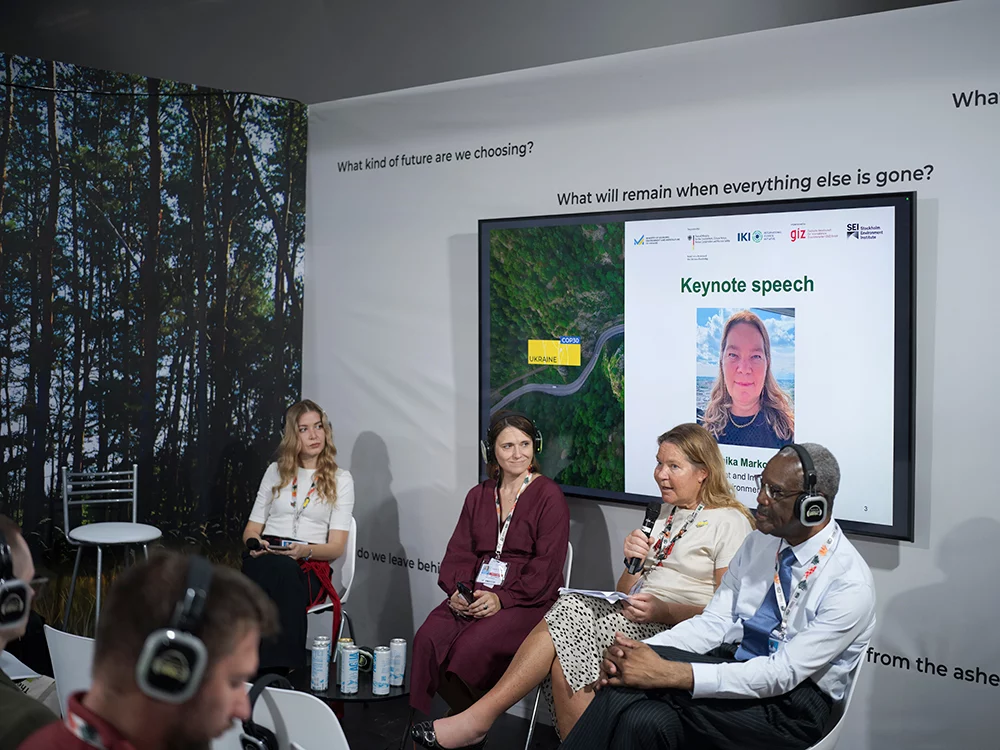
Annika Markovic (second from right) speaking at the Ukraine Pavilion session “NDC 3.0 in practice: Turning commitments into climate action,” 14 November 2025. From left: Aliona Rusnac, State Secretary, Ministry of Environment of Moldova; Rimma Kushtym, Moderator, IKI-Interface Project Ukraine, GIZ; Annika Markovic; and Frank Joshua, CEO, Climate Investment Partnership.
Photo: Andy Sewell for SEI, Stockholm Environment Institute
As part of its technical assistance to partner governments, the Green Agenda project is supporting the Ministry of Environment of Armenia in developing the country’s first comprehensive legal act on chemical substances.
Implemented in partnership with the Swedish Chemicals Agency and the American University of Armenia, the initiative was launched in Yerevan in summer 2025. It supports Armenia in aligning its chemicals management framework with international standards and the EU–Armenia Comprehensive and Enhanced Partnership Agreement.
This support will result in a legal and institutional gap analysis of existing legislation, an assessment of fragmentation across current laws, a regulatory impact assessment and a draft legal act. Together, these outputs mark an important step towards stronger environmental governance and EU-aligned chemicals regulation in Armenia. Read more about support for chemicals legislation in Armenia.
At the request of Moldova’s Ministry of Environment, the project is providing technical assistance to strengthen water resilience and resource efficiency through improved wastewater management, in line with Moldova’s EU accession priorities.
The work includes an assessment of wastewater reuse in agriculture, technical assessments of wastewater treatment facilities, irrigation scenarios, cost–benefit analyses, and legal and environmental reviews carried out in cooperation with Moldova’s Ministry of Environment and the Ministry of Agriculture and Food Industry.
One key finding is that Moldova has an opportunity to avoid outdated linear wastewater systems and instead develop climate-resilient, circular solutions that enable the reuse of treated wastewater and nutrients, supporting sustainable agriculture and long-term water security. Read more about wastewater reuse and water resilience in Moldova.
The project is strengthening evidence-based climate policy planning in Ukraine through the development of a national climate neutrality tool that helps decision-makers assess pathways to climate neutrality.
Using national statistics and greenhouse gas inventory methods, the model identifies key emission sources and shows where targeted interventions can achieve the greatest reductions. Developed with input from the Ministry of Economy of Ukraine, the tool supports scenario development and strategic discussion on climate targets and green transition planning.
It will be delivered to the Green Transition Office together with training and technical support to support its long-term use in climate and economic policymaking. Read more about SEI and the Green Transition Office collaboration in Ukraine.
Feature / SEI and Ukraine's Green Transition Office showcased how joint research is being turned into real climate policy and green recovery.
Feature / As Ukraine progresses on its path to EU integration, a National Comprehensive Green Transition Assessment Report shows paths to green recovery and growth.
Feature / The Green Agenda Armenia Conference 2025 marks the launch of a new study assessing Armenia's green transition and alignment with EU sustainability standards.
Feature / Aram Meymaryan, Armenia’s Deputy Minister of Environment, discusses the country's path towards climate neutrality by 2050 with European partnerships.
Feature / The launch of a new national assessment of Moldova's green transition readiness shows the country's strengths, challenges, and opportunities for growth.
Press release / Today, the "Green Agenda for Armenia, Georgia, Moldova and Ukraine" was launched in Kyiv, paving the way for future EU accession.
Press release / The project “Green Agenda for Armenia, Georgia, Moldova, and Ukraine” was launched in October 2023 to support Moldova’s green transition to climate neutrality.
Press release / Today, SEI and Sida, in collaboration with the Government of the Republic of Armenia, have officially initiated the Green Agenda project in Yerevan.
Other publication / This report benchmarks Armenia’s progress toward a green economy and EU alignment, assessing achievements and roadblocks in climate, energy, and biodiversity.
Other publication / The report benchmarks Ukraine’s readiness for a green transition across 12 major sectors, including energy, industry, transport, agriculture and digitalization.
Other publication / This report benchmarks Moldova’s progress toward a green economy and EU alignment, assessing achievements and roadblocks in relevant sectors.
Note: These reports are publications of the Green Agenda project and have not gone through SEI’s internal peer review process.
Project / This project supports Moldova’s alignment with EU water reuse standards, enhancing sustainable agriculture and climate resilience through wastewater reuse.
Project / The ESAP 2030+ project supports the development of a Bosnia and Herzegovina country-wide environmental strategy and action plan.
Perspective / Energiajulgeolek algab kohalikest omavalitsustest, rõhutab SEI Tallinna ekspert Erika Tšerkašina.
Project / UA-GRIDEXi projekti eesmärk on suurendada Ukraina energiavarustuse vastupidavust energiainfrastruktuuri vastu suunatud sõjaliste rünnakute valguses.