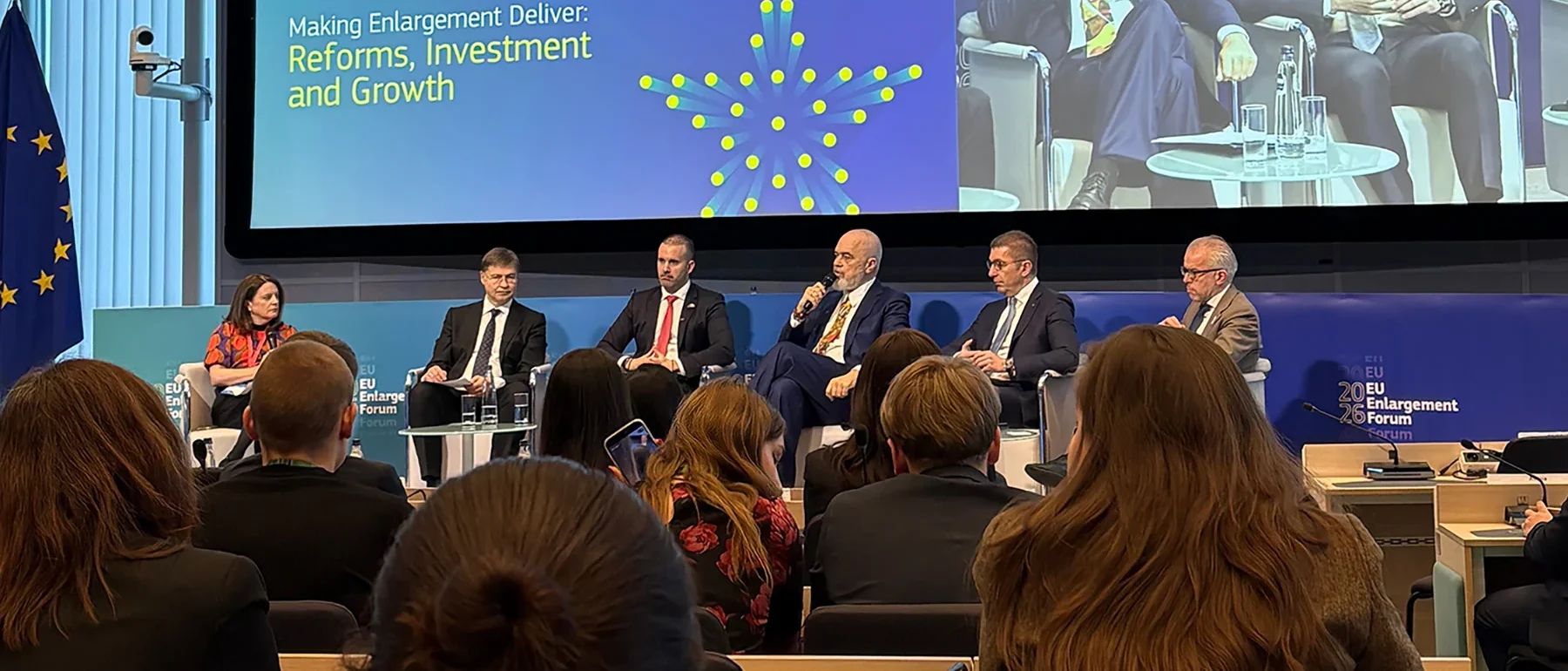
Last year’s EU Enlargement Forum was about balancing the merit-based approach against geopolitical pressure. This year’s put geopolitics and security in the driving seat. If security is now the frame for accession, climate and environment policies belong at its centre, not on its margins.
Less than two weeks before the Forum, the European Commission published the first roadmaps for the four frontrunners – Montenegro, Albania, Moldova and Ukraine. Montenegro could sign its accession treaty in June 2027 and become the EU’s 28th member in 2028, provided all 27 member states ratify it.
Commissioner for Enlargement Marta Kos named Russia as the main adversary, one that “wants to reverse the process of European unification.” Commission President Ursula von der Leyen recalled how the 2004 “big bang” enlargement strengthened European security, with Poland now central to Europe’s defence. Finland’s President Alexander Stubb went further: enlargement “is not a technical exercise about negotiating chapters or institutional reform. It is a strategic choice about the future shape of our continent.”
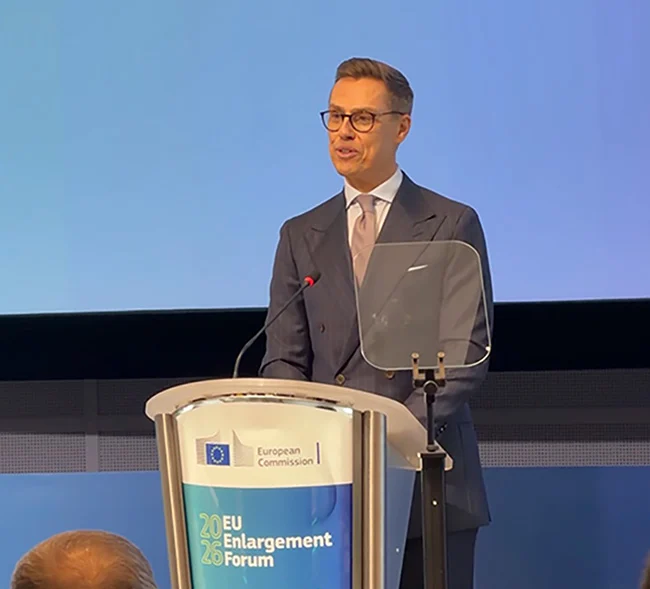
Finland's President Alexander Stubb speaking at the EU Enlargement Forum, 16 November 2026.
Photo: Amila Alidžanović / SEI.
He is not wrong about the strategic significance. But as SEI’s work supporting EU alignment in candidate countries shows, enlargement is still a technical process of opening and closing chapters, and the chapters on climate, environment, energy and agriculture are where much of the strategic case will be won or lost.
Food and water security, healthy ecosystems and resilient livelihoods keep societies stable and economies running. The green transition is also where the next economic race is being run. China already dominates the manufacture of solar panels, batteries and electric vehicles, and an EU seeking strategic autonomy cannot afford new members locked into yesterday’s energy systems. The same goes for the reconstruction of Ukraine, which can either rebuild the past or build for the future. Europe’s security case for enlargement is incomplete until it is seen through a green lens.
The green agenda spans several negotiating clusters, notably Green Agenda and Sustainable Connectivity, and Resources, Agriculture and Cohesion. Chapter 27 on environment and climate change is among the most demanding: it covers over 200 legal acts and requires major investment, institutional capacity and changes in how people and industries operate. It also covers civil protection, making it central to adaptation and disaster resilience as well as to cutting emissions.
Stubb noted that “trade, technology, energy, finance and supply chains have all become instruments of power.” In early 2026, Russia still supplied up to 90% of Serbia’s gas. Cutting that dependence is as much security policy as climate policy. Russia’s attacks on Ukraine’s energy infrastructure have also shown how vulnerable centralized generation is – spreading it across many smaller sites makes the system harder to knock out.
The EU’s Carbon Border Adjustment Mechanism (CBAM), fully in force since January 2026, has made carbon pricing a question of market access. Indicative border costs on electricity exports from Ukraine and the Western Balkans reach about EUR 75–80 per megawatt-hour, widely seen in the region as a penalty. For carbon-intensive sectors, the costs have arrived before the benefits – gradual integration in reverse. Without EU support, candidates risk locking in fossil-fuel dependence, and the EU risks being seen as a source of penalties rather than a trusted partner, weakening public support for accession.
For the green chapters, the security framing is both an opportunity and a risk. It can raise the status of energy, climate and resilience work long treated as merely technical. But labelling projects “strategic” or “urgent” can also become an excuse to fast-track critical raw material mines, energy infrastructure and defence-industry sites without proper environmental and social safeguards. And as defence budgets increase, they risk pulling resources and political attention away from environmental governance. Despite the urgency, there should be no shortcuts to the merit-based approach. Impact assessments, public consultation and inspections are accountability tools, and bypassing them invites the opaque deals and state capture that make countries easier to influence.
Treat green alignment as part of the merit and security case, not a separate technical track. Clean energy, climate-resilient farming, healthy ecosystems and functioning environmental governance make candidates stronger partners and help convince sceptical publics in member states that a new member is ready.
Keep supporting reforms after chapters close and make the transition just. The EU, member states and donors should keep supporting local authorities, emissions reporting and investment projects through accession and beyond, building capacity inside partner institutions so it lasts when projects end. Workers and households hit by coal closures and rising energy bills need protection, especially in coal-dependent candidates such as Bosnia and Herzegovina – otherwise the backlash will feed anti-EU narratives.
Make EU climate and enlargement policy pull in the same direction. CBAM should come with targeted support so that candidates are not treated like any other third country. Help with emissions trading systems, electricity market coupling and CBAM verification would support the reforms that reduce CBAM charges, making alignment a concrete benefit of the accession process.
Use green reforms to stay engaged where accession has stalled. In Georgia, cooperation on environment, climate and energy keeps technical ties alive and reform-minded partners in ministries, municipalities and civil society engaged. These ties leave less room for those who want to pull the country further away from Europe.
Enlargement is a strategic choice, but strategies set at summits are still delivered chapter by chapter by the civil servants, experts and partners working on reforms every day. Without robust green reforms, the security case for enlargement will not hold.
Feature / Safer school routes, clear pavements and more reliable buses: experts from BiH and Sweden on small steps towards more sustainable transport.
Event on 01 December / Join experts exploreing how science diplomacy plays a vital role in sustaining equitable and mutually beneficial partnerships between the African Union and EU.
Press release / Berget AI releases an open-source method for calculating carbon emissions of every individual AI request, developed with SEI, WattTime and Klimatkollen.