Additional information and graphics for media for the press release “Consumer markets and companies linked to habitat loss for rare species in Brazil’s savannah: new paper”, concerning the PNAS article “Linking global drivers of agricultural trade to on-the-ground impacts on biodiversity”, by Green et al.
Some of the Cerrado species included in the PNAS study are:
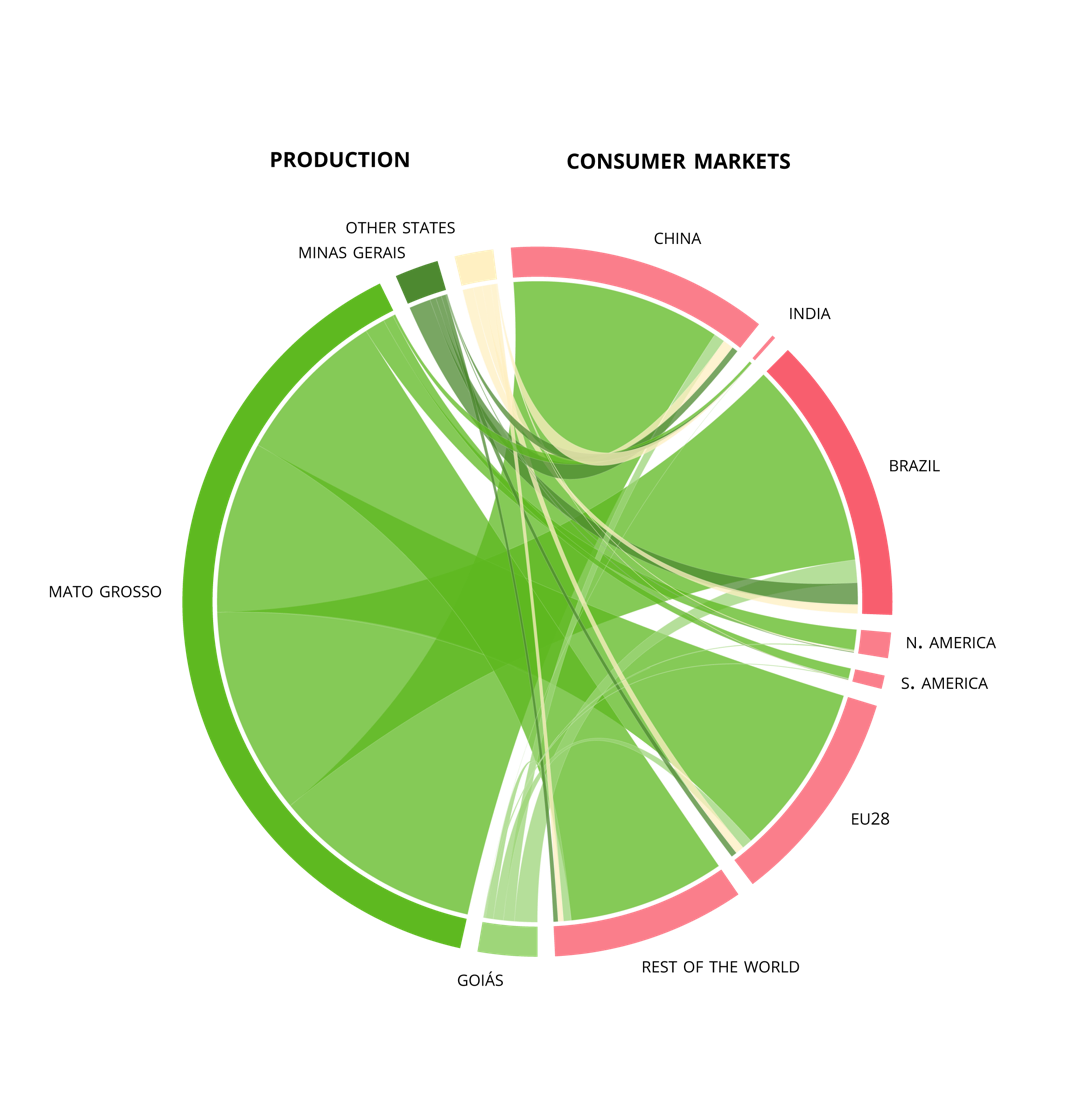
Chords show how soy expansion-related impacts on the Giant Anteater’s range in different states (on the lefthand side) are linked to soy products consumed in different markets (on the righthand side). Soy expansion is counted between 2000 and 2010; consumption patterns are for 2011. “Other states” are Bahia, Distrito Federal, Goiás, Maranhão, Mato Grosso, Mato Grosso do Sul, Minas Gerais, Piauí, Paraná, Rondônia, São Paulo and Tocantins.
Source: Stockholm Environment Institute. Calculated from methods described in “Linking global drivers of agricultural trade to on-the-ground impacts on biodiversity”. Figure based on a Flourish visualization, interactive version and source data.
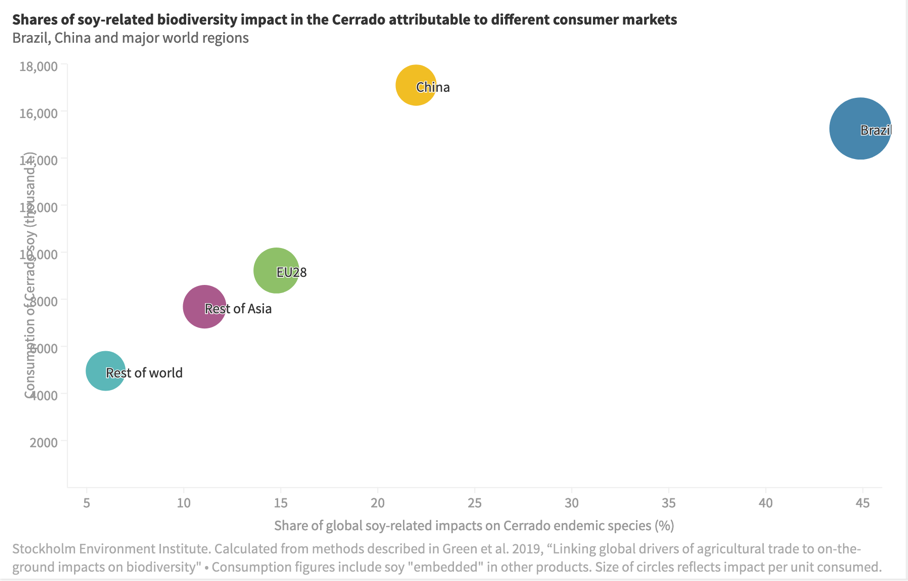
Brazil, China and major world regions. Interactive version and source data on Flourish.
Source: Stockholm Environment Institute. Calculated from methods described in “Linking global drivers of agricultural trade to on-the-ground impacts on biodiversity”. Consumption figures include soy “embedded” in other consumed products. Size of circles represents impact per unit consumed.
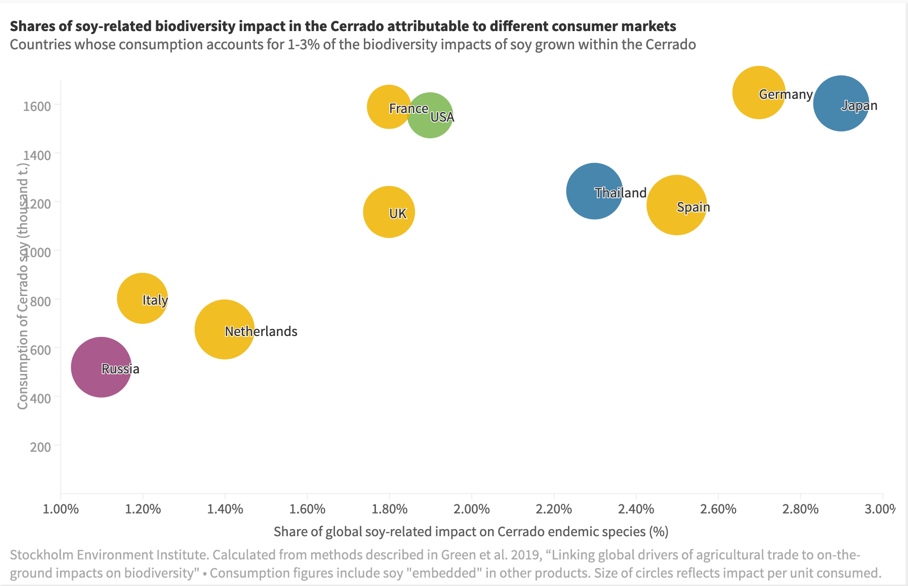
Countries whose consumption accounts for 1-3% of the biodiversity impacts of soy grown within the Cerrado. Interactive version and source data on Flourish.
Source: Stockholm Environment Institute. Calculated from methods described in “Linking global drivers of agricultural trade to on-the-ground impacts on biodiversity”. Consumption figures include soy “embedded” in other consumed products. Size of circles represents impact per unit consumed.