In October 2025, key circular economy forums in Malaysia and Taiwan saw critical discussions that revealed shared priorities across the Asia-Pacific region: unlocking innovative finance, moving beyond waste management, and harmonizing policies to accelerate a just transition.
October 2025 was one of the busiest months for the Circular Economy (CE) events in the Asia Pacific, a region rich in natural resources that is experiencing rapid economic growth and industrialization that has resulted in materials extraction, overconsumption, and massive waste generation. From the sub-national dialogue, “Accelerating Climate Action in Sarawak”, in Kuching, Malaysia, to the regional event “ASEAN Circular Economy Forum 2025” in Kuala Lumpur, Malaysia, and the “Asia Pacific Circular Economy Roundtable and Hotspot” in Taipei, Taiwan, SEI Asia engaged actively to better understand how the circular economy is evolving in the region, what are the gaps in implementation, and how SEI can support just transitions.
The first event, “Accelerating Climate Action in Sarawak” event was held in Kuching, Sarawak, Malaysia, from 07-08 October 2025. It showcased Sarawak’s thought leadership in driving its net-zero transition leading to COP 30 in Belém, Brazil. Through its “Waste to Wealth: Rethinking Resources in Circular Economy” dialogue, the event featured key models, tools, and policies that can reduce waste and enhance resource efficiency.
SEI contributed by showcasing ASEAN’s CE policy landscape and introducing incentives to accelerate the adoption of circularity across the region. This regional perspective complements practical on-the-ground examples presented by OCI TarraSus, and locally-led circular business from the Weida Group in the tire sector.
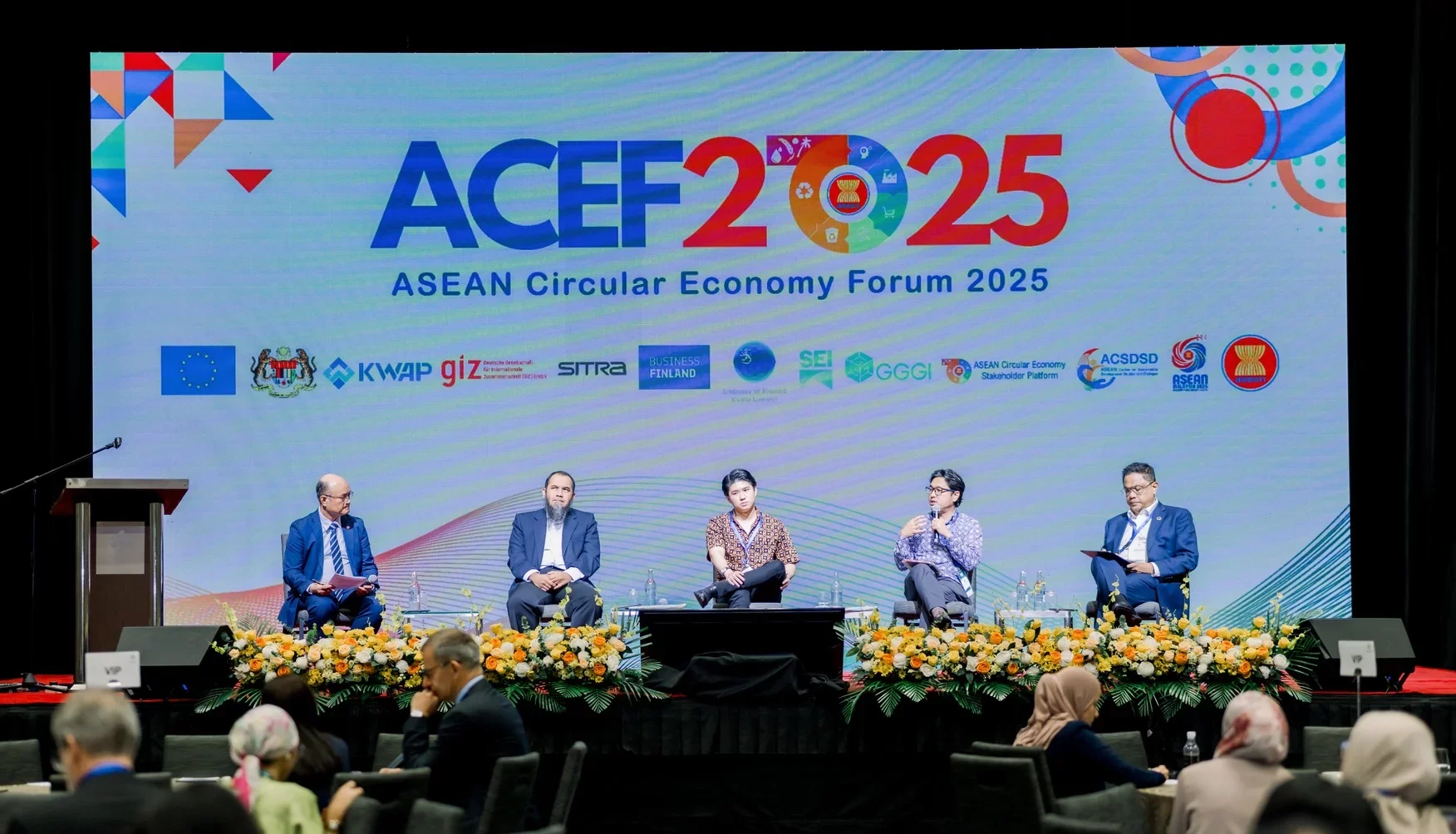
The ASEAN Circular Economy Forum (ACEF) 2025 held in Kuala Lumpur, Malaysia, from 16-18 October 2025, gathered key stakeholders in ASEAN circularity, including ministries, development and research organizations, private sector actors, finance entities and European Union (EU) representatives. As part of the SEI co-organized the second-day policy dialogue on “Enabling Circular Economy Acceleration through Policy Action, Resource Mobilization and Multi-Stakeholder Partnerships”. This year’s ACEF emphasized cross-sector collaborations as a driver of CE implementation, with skills development and innovative finance emerging as key enablers.
At the regional scale, the “Asia Pacific Circular Economy Roundtable and Hotspot” held in Taipei, Taiwan, from 20-23 October 2025, highlighted opportunities for circular collaboration and a closer look at Taiwan’s CE approach. Field trips and exchanges with Taiwanese government agencies showcased practical applications of circularity in policy, business models and community-driven solutions.
Although the three Circular Economy events were held in different locations and times, they shared key themes and lessons as outlined below.
ASEAN Circular Economy Forum 2025. Photo: ACEF 2025 committee.
Financing is widely recognized as an enabler for accelerating CE implementation in the Asia Pacific. Yet, persistent challenges remain. Many circular businesses are seen as novel and risky, and therefore do not meet the traditional, linear-focused assessment criteria set by financial institutions. As a result, circular small and medium enterprises (SMEs) face limits to access the finance they need.
Cross-sector solutions between governments, financial institutions, and the private sector is critical to transform financial institutions’ risk models and demonstrate the value of CE.
Some examples from the region show promising signs of progress:
Embedding CE financing within the green financing strategies will ensure the circular transition becomes an integral part of the national green growth strategies.
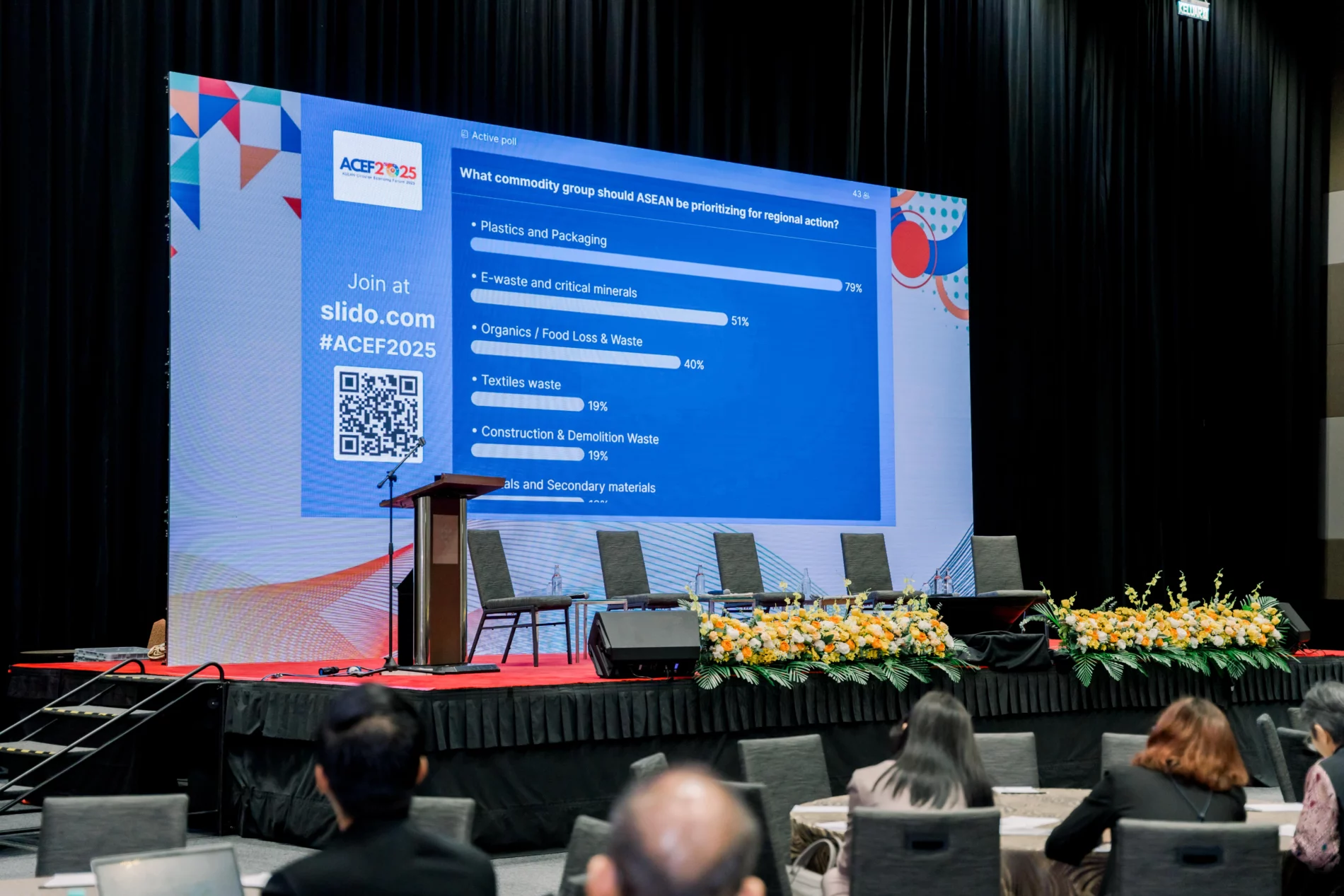
A Mentimeter survey conducted by SEI during ACEF 2025 showed that priorities within the Circular Economy remain narrowly focused on waste management and recycling. This result aligns with the “Waste to Wealth” dialogue, which highlighted waste recycling, especially in the recycled-tires business as an entry point for the circularity in Sarawak, Malaysia. Most of the CE policies in ASEAN countries also still revolve around this issue, such as Myanmar’s National Waste Management Strategy and Master Plan and Singapore’s Zero Waste Masterplan. However, limiting CE to only waste management constrains its potential.
Expanding efforts beyond waste management and recycling, and showcasing tangible business cases will inspire entrepreneurs and innovators to integrate circularity across various sectors.
National policies must also be geared towards incorporating circularity principles across all business value chains. Malaysia is a leading example with its Circular Economy Framework for the Manufacturing Sector that shows the integration of circularity across all stages of the manufacturing value chains, from design and production through distribution, use, collection, and recycling or new input.
Mentimeter survey. Photo: ACEF 2025 committee.
Fragmented policies and a lack of legislative reform remain barriers to CE implementation. CE policies often sit within various branches of government agencies that pull in different directions. Hence, policy harmonization and legislative reforms are needed to unify the actions and establish measurement standards.
For instance, Malaysia recently issued two CE policy frameworks: one for solid waste management and another for the manufacturing sector. It is yet to be seen how the currently drafted Circular Economy Act will accommodate these two separate policies.
Legislative reform is also needed regarding intellectual property rights (IPRs) and extended producer responsibility (EPR). A guarantee of IPRs will enable innovation and drive the circular transition. Stronger EPRs enforcement will leverage the shared commitment of the private sector and improve circularity monitoring and measurement.
The Circular Economy in the Asia-Pacific is still in its early stages. For ASEAN, a transition to the CE can increase the region’s resilience and foster sustainable growth by recovering substantive materials, generating revenue, and creating green jobs.
The three events have built momentum by serving as platforms for bringing a wide range of stakeholders for dialogue and learning. The challenge is to keep the momentum alive by translating these insights into shared commitments and tangible joint actions.
Through the launch of the two-year Transition to the Regional Circular Economy Project funded by the EU, SEI will work with ASEAN member states to put this momentum into practice, especially to support unified regional policy goals and enhanced policy alignment within ASEAN.
Project / This new project will support ASEAN’s shift to a circular, climate-neutral economy through policy, knowledge and capacity building.
Event on 28 October in Yerevan / Armenia faces waste disposal challenges alongside potential for resource recovery. We explore how to recover valuable resources and reduce pollution.
Media advisory / Experts from SEI will be at CBD COP17 in Yerevan from 19–30 October and are available for commentary and analysis.
Press release / New Trase data analysis highlights the need for stronger supply chain transparency as domestic demand grows and export data gaps widen.