This paper documents the generation of the Ecological Citizen(s) Preferable Futures Deck (PF Deck), tracing its conceptual grounding, design process and iterative refinement. The article positions the PF Deck as the outcome of a research-through-design journey that responds to ecological, social, and democratic crises.
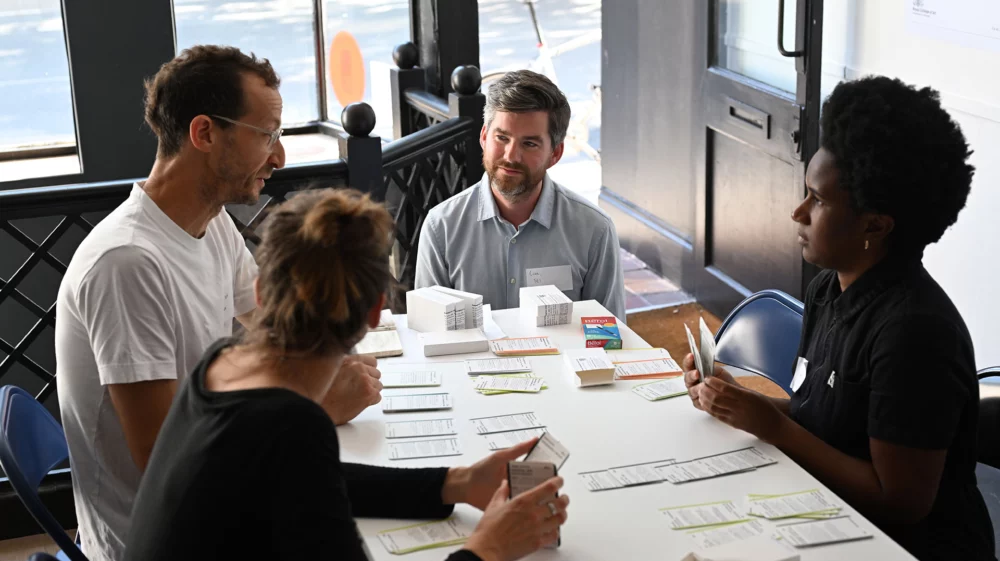
Participants play-tested the Ecological Citizen(s) Preferable Futures Deck as part of the development process.
Photo: Kate Green Photographer
Located at the intersection of participatory design, futures thinking, and ecological citizenship, the Preferable Futures (PF) Deck is a wellbeing intervention that operates through physical, mental, social, and environmental space. The deck sits at the intersection of participatory design, futures thinking and ecological citizenship.
The PF Deck is designed to cultivate reflection, conversation and imagination, and to inspire place-based action for individual and collective wellbeing for an ecologically ethical transition. Fundamental its ethos is a recognition that human and planetary health are tightly bound.
Tested through contexts like the London Design Festival, the Royal College of Art, and Falmouth University, the PF Deck has enabled values-based dialogue, systems literacy, and co-design of civic futures that are attuned to social and ecological flourishing.
The authors term this process “post-participatory intervention”: designers do not simply facilitate ‘good’ participation in predefined projects, but act as catalysts and conveners of ongoing, community-led practices that may continue and transform beyond the original design frame. The authors demonstrate how design interventions can function as an ecology and social well-being mediator. Their methodology sets out a post-participatory design process which combines a variety of knowledge frames to create an approach to designing for ecological and social wellbeing.
On a practical level, the PF Deck is a piloted toolkit with particular relevance for community organizers, educators, civil society organizations, local authorities, and policy-adjacent actors seeking to cultivate ecological citizenship in place-based ways. The deck enables the facilitation of community-led ecological and democratic transformation in the midst of climate, health, and social crises.
Project / The Ecological Citizen(s) project cultivates trans-disciplinary collaboration and research to enable a digital sustainable society for positive climate action.
Other publication / Introducing a new methodology for designers, technologists and citizens to engage with technologies in an ecologically interdependent world.
Other publication / Retrofitting can be about more than just energy efficiency; it can enhance nature connectedness, circularity and can heighten a sense of ecological citizenship.
Journal article / Explores how ecological citizenship is communicated, understood and implemented by stakeholders, and considers how to promote wider use of the practice.