The emerald ash borer beetle has caused the deaths of millions of ash trees around the world. In this paper, the authors provide the first surveillance map for the presence of the beetles in Great Britain. The system shows strong potential for deployment by government agencies and interested stakeholders. The mapping techniques could also be applied to other invasive species.
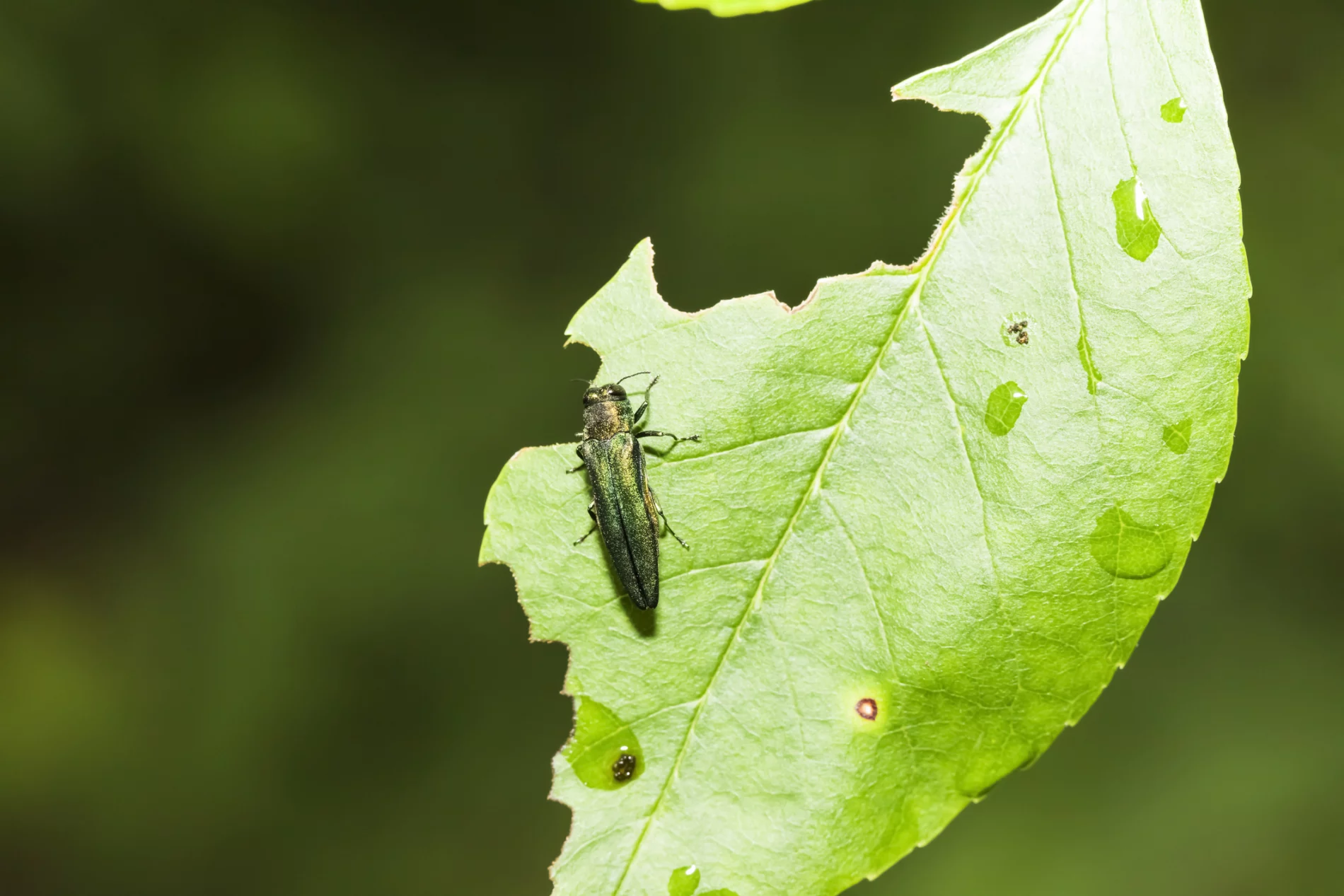
An emerald ash borer beetle (agrilus planipennis) feeding on ash leaves. Outside of the beetle's native range, it is one of the ash tree's most destructive pests.
One of the greatest threats to ash trees in Great Britain is the emerald ash borer beetle. From its native range in East Asia, the beetle has spread to Northern America, Russia, and Eastern Europe, causing major economic impacts and ecological impacts. The species is likely to have made these global journeys through infested packing materials, live trees and the timber trade. For this reason, developing robust early detection systems is vital for biosecure trade and for protecting the lives of ash trees in Great Britain.
In this paper, the authors addressed this threat through a combination of quantitative analysis and stakeholder workshops and interviews. This enabled them to develop a modelling framework and bring in sociological perspectives to better understand biosecurity implications of importing and moving firewood. The workshops explored landowners’ willingness to adopt early detection methods for the beetle.
Their research provides the first surveillance map for the presence of the emerald ash borer in Great Britain, with potential for deployment by government agencies and stakeholders concerned with biosecurity. The authors also highlighted the applicability of the framework for other invasive species.
Journal article / Researchers developed a method for quantifying the social and cultural values of treescapes, creating a composite measure which can be used by policymakers.
Journal article / The article explores how loopholes in Brazil’s Forest Code enable illegal deforestation in Mato Grosso’s soy sector and the need for full compliance to stop it.
Journal article / New mapping techniques indicate that deforestation related to rubber production is at least two to three times higher than previous estimates have suggested.