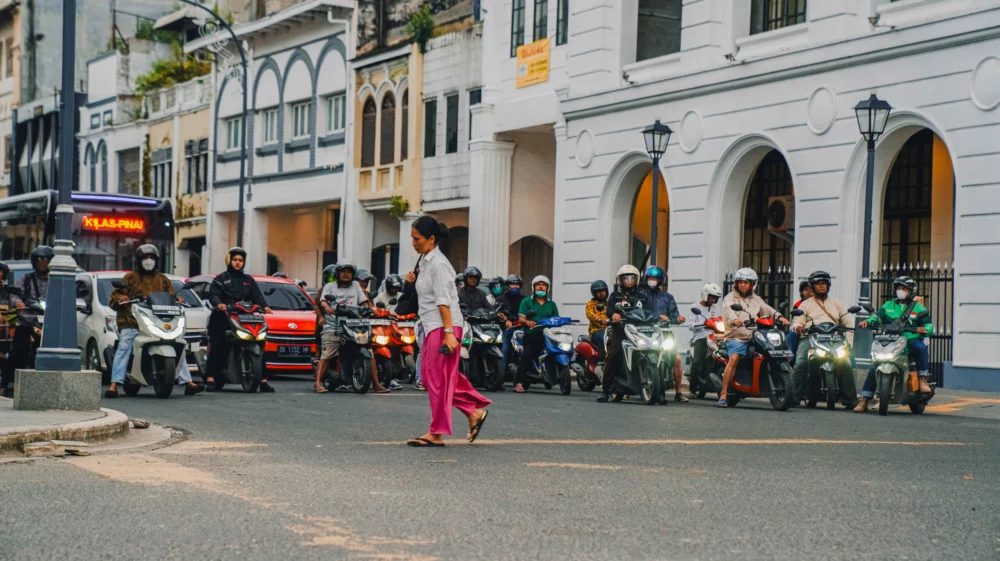
This brief summarizes a report by the UK Partnering for Accelerated Climate Transitions (UK PACT) project that examined how to advance non-motorized transport in Indonesia. The brief focuses on insights from a case study of Medan, Indonesia’s fourth-largest city. It provides background information on non-motorized transport in Indonesian cities; presents insights on that emerged from the case study; and makes six recommendations to boost active travel in its cities.
Jana Busch, Kate O'Reilly, Gary Haq / Published on 21 July 2025
Busch, J., O'Reilly, K., & Haq, G. (2025). Achieving Indonesia’s vision to expand and enhance active mobility in its cities. SEI brief. Stockholm Environment Institute. https://doi.org/10.51414/sei2025.023
By investing in needed infrastructure and adopting key policies, Indonesia can achieve its goal of increasing the use of non-motorized transport in urban areas to help tackle key challenges: road congestion, air pollution, and health issues associated with sedentary lifestyles.
A case study of Medan, Indonesia’s fourth-largest city, reveals the key barriers that urban areas must address for Indonesia to achieve the goals set out in its National Vision of Non-Motorized Transport Infrastructure, which aims to promote inclusive and sustainable urban mobility.
Infrastructure for active travel in Medan is inadequate, particularly for people with disabilities. Pedestrian and cycling networks are fragmented, and connections to essential locations such as schools and public spaces are poor.
Efforts to boost non-motorized transport have been hampered by infrastructure issues, inefficient budgeting, safety concerns, weak enforcement of related regulations, and low levels of public awareness about the benefits of active travel.
To achieve long-term goals to increase non-motorized transport, Indonesia must adopt a coordinated approach to upgrade infrastructure, enforce related policies and regulations, and provide financial incentives.
Read the brief / PDF / 1 MB
SEI brief / This policy brief provides guidance intended to help Indonesia secure adequate funding to underpin sustainable and inclusive low-carbon transportation options.
SEI brief / This SEI brief highlights how Indonesia can reduce greenhouse gas emissions and air pollution from road transportation, potentially leading to health benefits.
21 May 2025 / About Cities, Mitigation, Pollution, Public policy, Sustainable Development Goals and Transport
Feature / SEI’s project transformed a transit hub in Indonesia through community design, offering a replicable model for inclusive urban renewal.

24 April 2025 / About Adaptation, Cities, Innovation, Participation and Transport