part of Your guide to COP29
Start readingDid COP29 meet any expectations? What was agreed and what was left unsolved? What is on the table going into COP30 in Brazil? SEI delegates share their key COP29 takeaways and next-stage expectations.
After two weeks of intense negotiations, COP29 formally closed at 5:31 am AZT, Sunday 24 November 2024.
Almost 200 countries and over 90 national leaders gathered in Baku, Azerbaijan, to assess progress towards the Paris Agreement and agree to a new climate finance goal to underpin its implementation.
While a deal on climate finance was finally reached, many nations criticized the resulting text as “too little, too late”, falling far short of the USD 1.3 trillion annually some countries say is needed to address the climate crisis equitably or indeed effectively.
Climate finance was not the only item on the table. COP29 also set out to tackle Article 6 and carbon markets, accelerate “Global Stocktake” pledges agreed at COP28 including transitioning away from fossil fuels, and push forward national adaptation plans (NAPs) and the global goal on adaptation (GGA).
SEI contributed to over 30 events during the two-week conference, with experts on the ground sharing research knowledge and evidence of successful practice to help strengthen negotiations.
Securing a new climate finance goal to scale financial commitments, operationalize the Loss and Damage Fund and ensure mobilized finance reaches vulnerable communities to drive equitable climate action was arguably the main goal of the conference.
What was agreed? Did richer nations live up to their legal obligations to deliver on climate finance for countries who had done the least to cause climate change?
Though the numbers are large, the outcome of the new climate finance goal at this putative “Finance COP” appears weak. The new climate finance goal includes raising the original USD 100 billion goal decided in 2009 in Cancun to at least USD 300 billion per year by 2035, which falls far short of even the most conservative estimates of the needed finance. It “calls on all actors to work together to enable the scaling up of financing from … all sources to” USD 1.3 trillion per year. Yet, the language around accountability is extraordinarily vague.
For example, who is responsible for delivering this money? The text states that developed countries will “take the lead” on the USD 300 billion, which is proposed to come from a wide variety of sources and actors: public and private, multilateral and bilateral. The USD 1.3 trillion will involve “all actors” working together and will kick-start via a “Baku to Belém Roadmap to USD 1.3T”. The expectations for mobilizing private sector finance have never been greater, alongside the need for governments to reduce barriers to investments and send clear signals with public finance spending.
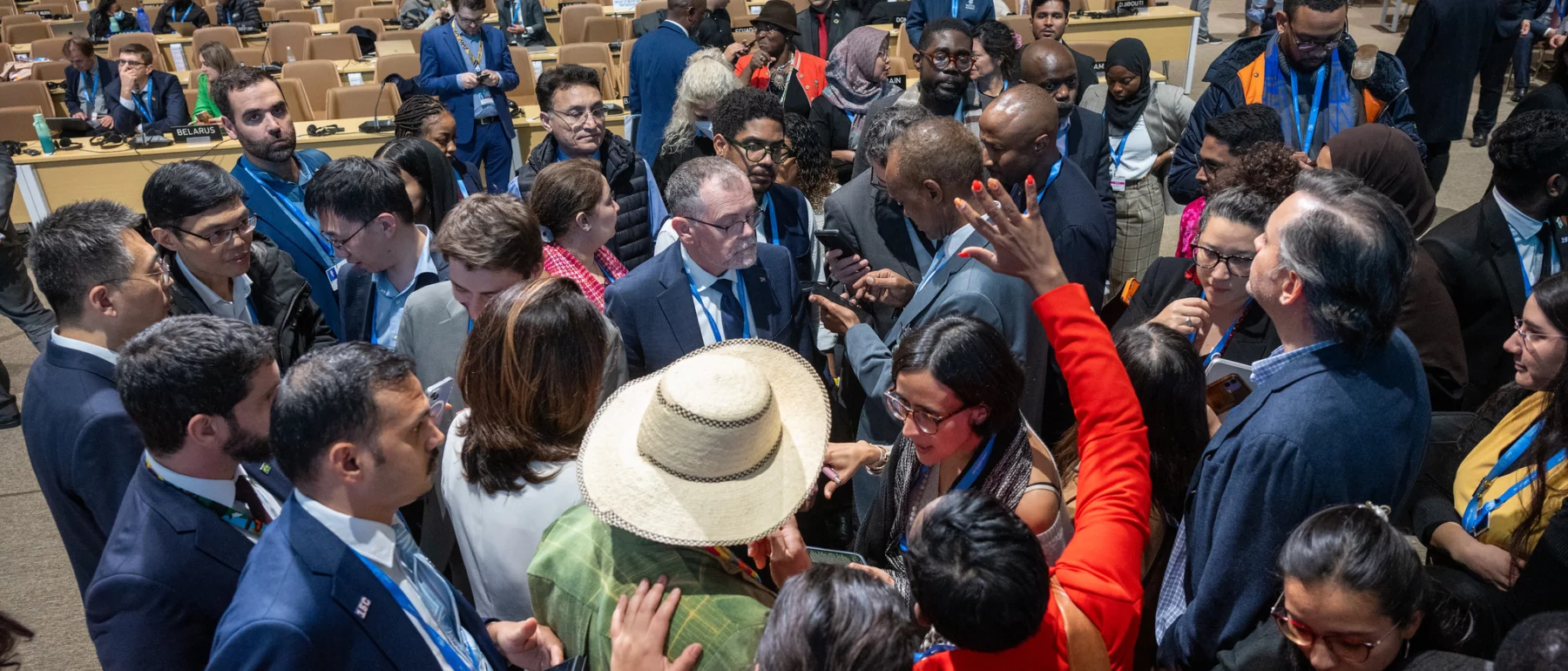
Many developing countries are outraged about a closed and mismanaged consultation process which they feel favoured rich economies. Several countries voiced opposition to the draft text in the closing plenary, with India opposing the adoption of the text in its entirety. Civil society organizations protested through the extra days of deliberations and have marked the goal a failure.
This outcome represents a deep-rooted stalemate. Developing countries did not budge on expanding the contributor base of countries who would fund the goal, though this question cannot be avoided forever. Developed countries additionally did not budge on concretizing their commitments, especially given the likely US withdrawal from the Paris Agreement and reduction in future contributions.
Though countries avoided explicit failure to reach agreement – which would have undermined confidence in the UNFCCC and the multilateral process – the result is a fundamentally unchanged and unclear landscape of international climate finance.
At COP29, the number of developers, companies large and small, lenders and investors from all over the world swarming around the Baku Olympic stadium, talking to development finance institutions and multilateral development banks and governments, is a sign that many deals were being initiated or made on the spot.
The seriousness of the business opportunity is inversely proportional to the noise made around it. It felt as though there were fewer bombastic pledges and statements made at COP29, but more deals being made; mostly on renewables, but also on other emerging sectors like sustainable transport, energy efficiency, industrial decarbonization, agriculture and nature.
The feeling is that the climate investment opportunity is is now extending to those beyond OECD countries, particularly in large emerging markets, but this will be difficult to prove until we see the numbers in the coming years. The various blended finance vehicles and guarantees announced and launched in Baku may have a chance to be put to good use. These include Norway’s new state guarantee scheme for renewable energy projects; a USD 1.48 billion blended finance platform called GAIA, hosted by Canada, the Green Climate Fund and MUFG bank to support high-impact climate adaptation and mitigation projects in developing countries; and the World Bank Group released a Letter of Authorisation (LoA) template in a move to de-risk the carbon credits market and improve the insurability of investments.
Raising the ambition for the new round of nationally determined contributions (NDCs) was one of the key goals at COP29. What progress was made during the conference? Considering the February 2025 submission deadline for updated national climate plans, did pledges show signs of being on track? What can be expected on this front in early 2025?
COP29 in Baku, coupled with the G20 summit in Brazil, really was the last major opportunity to increase peer pressure and raise accountability for ambitious NDCs 3.0, which countries must submit under the Paris Agreement early next year.
NDCs are the backbone of the Paris Agreement and the mechanism by which to deliver greenhouse gas emission cuts. The ideal outcome would have been a strong, unified statement by parties that reiterated commitments to stick to 1.5°C emission pathways and accelerate the transition away from fossil fuels, building on last year’s UAE consensus and Global Stocktake. According to UNEP, the world must achieve emission cuts of 57% by 2035, compared with 2019 emissions. In Baku, no such clear signal was sent.
While the tough negotiating environment did not engender a strong result, the UK and Brazil were two nations who did unveil progressive NDCs at COP29. The UK acted on scientific advice provided by its Climate Change Committee and pledged deep emissions cuts of 81% by 2035 alongside a roadmap of how to feasibly do this while supporting job creation and the economy, modestly improving on the 78% reduction previously announced by Boris Johnson’s government. Brazil announced its new updated climate plan, which aims to cut emissions between 59% and 67% from 2005 levels by 2035, mostly by relying on its carbon-storing forests.
These two examples – accompanied with promises made by the EU and other countries to submit NDCs consistent with limiting warming to 1.5 degrees – can serve as inspiration on how countries can win, and not loose with ambitious next-generation national climate plans.
However, drafting new NDCs is not enough. Delivery and accountability are key. We will keep a close eye on the Biennial Transparency Reports due at the end of this year, where countries report which policies and investments they are actually undertaking to reduce emissions.
See also SEI experts posts under ‘NCQG’ and ‘Methane’ tabs for more NDC relevant insights.
This year’s COP presidency, together with US and China, hosted an important methane and non-CO2 greenhouse gas summit. Evidence shows that practical actions in agriculture, sanitation and energy sectors can advance the Global Methane Pledge.
Yet, COP29 was relatively quiet on the broader issue of phasing out fossil fuels, which was included in the COP decision text for the first time just the year before. What happened? How were fossil fuels tackled at COP29?
Methane is the world’s second-largest contributor to global warming after CO2. It differs from CO2 in that it is a comparatively short-lived greenhouse gas. Most emissions, and therefore their warming effect in the atmosphere, occur during the first 20 years after being released, so it’s an impactful target for fast mitigation of global warming. However, evidence shows that global methane emissions have risen faster than ever during the past five years.
The main COP29 outcome following up on the 2021 Global Methane Pledge was the endorsement of the Declaration on Reducing Methane from Organic Waste, in which the 35 country signatories committed to include targets for reducing methane emissions from organic waste in their future NDCs. Acting on this approach provides sectors like agriculture, waste, and sanitation the opportunity to improve practice, innovate, and receive funding to implement solutions that reduce powerful methane emissions.
A challenge identified during the talks is the lack of a common definition of what “organic waste” really includes. This ambiguity becomes apparent in practice when examining the diverse approaches in recent national policies. Some countries focus on methane leaks from oil and gas infrastructure, others prioritize municipal solid waste landfills, some biodegradable waste, and only the European Commission includes wastewater treatment plants.
While the Declaration on Reducing Methane from Organic Waste marks a step forward on the path to net-zero emissions, the promise to include organic waste targets in upcoming NDCs relies on an essential factor: funding. Countries cannot achieve their NDC goals without adequate financial resources, and critics argue that the financial agreements made at COP29 fall short of what’s truly needed.
However, significant optimism surrounds the methane reduction targets, as experts have highlighted that reducing methane is the easiest and probably fastest way to reduce greenhouse gas emissions. As we look ahead to 2025 and to COP30, where the next iteration of NDCs (3.0) will be a central focus, the urgency for nations to receive robust policy guidance and consultancy support is greater than ever.
There was no decision taken on either the UAE Dialogue on implementing the Global Stocktake outcomes nor the UAE Just Transition Work Programme, and the two negotiating streams have been kicked to the Subsidiary Body meetings in Bonn next June. These two streams might otherwise have been home to language advancing the COP28 agreement on “transitioning away from fossil fuels in energy systems, in a just, orderly and equitable manner, accelerating action in this critical decade, so as to achieve net zero by 2050 in keeping with the science”.
It is not altogether surprising that no progress was made. Once again, fossil fuel industry lobbyists were present in full force at the negotiations, reportedly exceeding 1700 in number. More importantly, governments continue to earnestly support the expansion of fossil fuels, most evident in the fact that 2024 production of coal, oil and gas are each set to reach record levels this year.
This failure to make progress was undoubtedly linked to the disappointing outcome on finance. Developing countries rely on support to enable a transition to clean energy and away from fossil fuels. As the UN Secretary General made clear in his address leading up to COP29, “Developing countries urgently need serious support to accelerate the transition to clean energy and deal with the violent weather they are already facing. COP29 must agree a new finance goal that unlocks the trillions of dollars they need. And provides confidence it will be delivered.” This sentiment was echoed repeatedly by developing country delegates, not least by India in its trenchant critique of the finance decision, which it termed “nothing more than an optical illusion [that] will not address the enormity of the challenge we all face”.
Strengthening national adaptation plans (NAPs) was also in the spotlight, with an emphasis on increasing funding and collaboration for climate adaptation and providing targeted support to vulnerable regions.
What progress was made on these fronts, and how did they interact with the Global Goal on Adaptation? What lies ahead for adaptation at COP30?
The Global Goal on Adaptation (GGA), as articulated in the Paris Agreement, is intended to enhance adaptive capacity, strengthen resilience and reduce vulnerability to climate change while contributing to sustainable development and ensuring adequate adaptation to a changing climate. This is all to occur parallel to limiting global temperature increase to well below 2°C, while pursuing efforts to limit the increase to 1.5°C.
Let’s be clear. COP29 will leave a very small legacy in the pursuit of an adequate adaptation response. It failed to garner the kinds of advancements in adaptation action required to meaningfully advance the global goal on adaptation agreed almost a decade ago.
While a scattering of concessions agreed in the final days of the negotiations avoided a total abdication of responsibility in this regard – giving those in the adaptation community some tangible developments with which to engage and some direction for the year ahead – the institutionalization and advancement of adaptation under the UNFCCC remains weak. Meanwhile, the gulf between global agreements reached and the global action required continues to widen.
Ultimately, if the benchmark of progress on adaptation negotiations continues to be so narrowly defined – to procedural and incremental developments rather than substantive agreements that clearly advance adaptation ambition and action – the GGA will only ever exist on paper. Belém must represent a turning point from Baku in this regard.
Read more: Did COP29 advance the UNFCCC Global Goal on Adaptation?
COP29 failed to accelerate the sluggish pace of post-Paris adaptation negotiations, despite the IPCC’s urgent call in its 6th Assessment Report for greater ambition and faster action on adaptation.
Even with the potential for increased adaptation finance, the impact of funding will remain limited as long as NAPs are incoherent and unambitious, offering wish lists of desired actions rather than integrated, programmatic approaches.
Discussions in Baku centred on the need for finance to support the implementation of NAPs and on the importance of considering gender, age, Indigenous Peoples and local communities in NAP preparation and implementation. However, a decision could not be reached; a draft text including some 159 pairs of square brackets (indicating unresolved wording) will be revisited in Bonn in June 2025.
The fragmented nature of adaptation negotiations in Baku yielded little more than paper progress, perpetuating cycles of negotiation that delay implementation. The Global Goal on Adaptation (GGA) exemplifies this pattern of stagnation.
When initial efforts to operationalize the GGA proved fruitless, the Glasgow–Sharm el-Sheikh Work Programme was launched in 2021. Two years and eight workshops later, it resulted in the UAE Framework for Global Climate Resilience, which in turn launched the two-year UAE–Belém Work Programme to develop indicators for measuring adaptation progress.
COP29 continued this pattern of procedural diversion from action, reflecting a tendency to maintain the appearance of progress by deferring difficult decisions on technical issues where countries disagree. Parties established the Baku High-Level Dialogue on Adaptation to identify ways of enhancing the UAE Framework’s implementation and launched the Baku Adaptation Road Map to advance progress towards the GGA. The modalities for work under this road map will be negotiated further in 2025.
Meanwhile, the adaptation action needed to cope with our rapidly changing climate grows further from our reach.
As set out in the COP26 decision text (Decision 3/CP.26, para 2), countries convened at COP29 to advance the assessment of progress in the process to formulate and implement National Adaptation Plans (NAP).
Since the last assessment in 2018, there have been significant advances in adaptation planning and implementation. This pre-COP29 progress paved way for Baku’s NAP assessment to highlight challenges, barriers, gaps, and needs faced by developing countries in the design and implementation of NAPs to better understand what has and has not worked.
These insights did not materialise in Baku. Work was primarily procedural with much of the discussions focused on whether to use an informal note developed at SB60 as the basis for negotiations, with the COP Presidency’s co-facilitators ultimately directing their time towards producing a streamlined version of the informal note, which was met with further widespread dissatisfaction.
With time running out and views continuing to diverge across numerous issues, COP29 culminated in a six-page draft negotiating text on adaptation filled with unresolved issues to be tacked in 2025.
The new climate finance goal did not deliver an ambitious outcome for adaptation. Though some had hoped for a specific sub-goal for adaptation finance, the agreement retains weak language aiming for “balance.”
Though the goal acknowledges the need for adaptation funding to be public, grants-based, and concessional, it sets no concrete commitments. As a result, we can expect adaptation funding will to continue to lag behind that for mitigation, with a risk that a growing proportion of support comes in the form of non-concessional loans, potentially adding to the unsustainable debt burdens of some recipient countries.
The goal nevertheless represents progress in some ways for adaptation finance. It emphasizes the importance of exploring innovative instruments to scale up support, commits to tripling outflows from UNFCCC mechanisms (such as the Green Climate Fund and Adaptation Fund), urges increased funding for locally-led adaptation, and calls for efforts to enhance access for particularly vulnerable countries.
What was agreed, and how are carbon markets expected to operate?
After nine years of negotiations, COP29 saw the final pieces put in place for operationalizing Article 6 of the Paris Agreement, which recognizes the option for countries to voluntarily cooperate to reduce emissions via international carbon markets.
As in prior years, the negotiations in Baku were largely over technical matters. But the details matter for ensuring that carbon markets function in ways that are fair and equitable, and that advance global ambition on climate change.
If done correctly, international trading of “mitigation outcomes” could help countries collectively achieve their NDC targets more efficiently, making room for more ambitious targets in the future. Done incorrectly, and carbon markets could instead undermine ambition, leading to higher emissions than if countries had simply achieved their NDCs individually.
Many of the big questions – such as how to account for transfers of mitigation between countries in ways that avoid double-counting – were decided at prior COPs. In Baku, key decisions are covered in the formal documents (here and here) and included the following:
Much work remains to be done at the level of individual countries to fully realize the potential of Article 6, but with the agreement in Baku, all the major pieces at the international level are now – finally – in place.
Perspective / Katy Harris and Richard J.T. Klein argue that COP29 made modest gains, like the Baku Adaptation Road Map, but lacked the ambition needed for real progress.
Collection / Follow COP29’s priorities, including new climate finance goals and adaptation, with in-depth insights and updates from SEI experts.
Media advisory / On 29 October, SEI invites journalists to a press briefing where its leading experts will share their perspectives on the major themes shaping COP30.