This study investigates how Indigenous Peoples and other Traditional Communities in Western Bahia, Brazil, understand and practice sustainability in their daily lives.
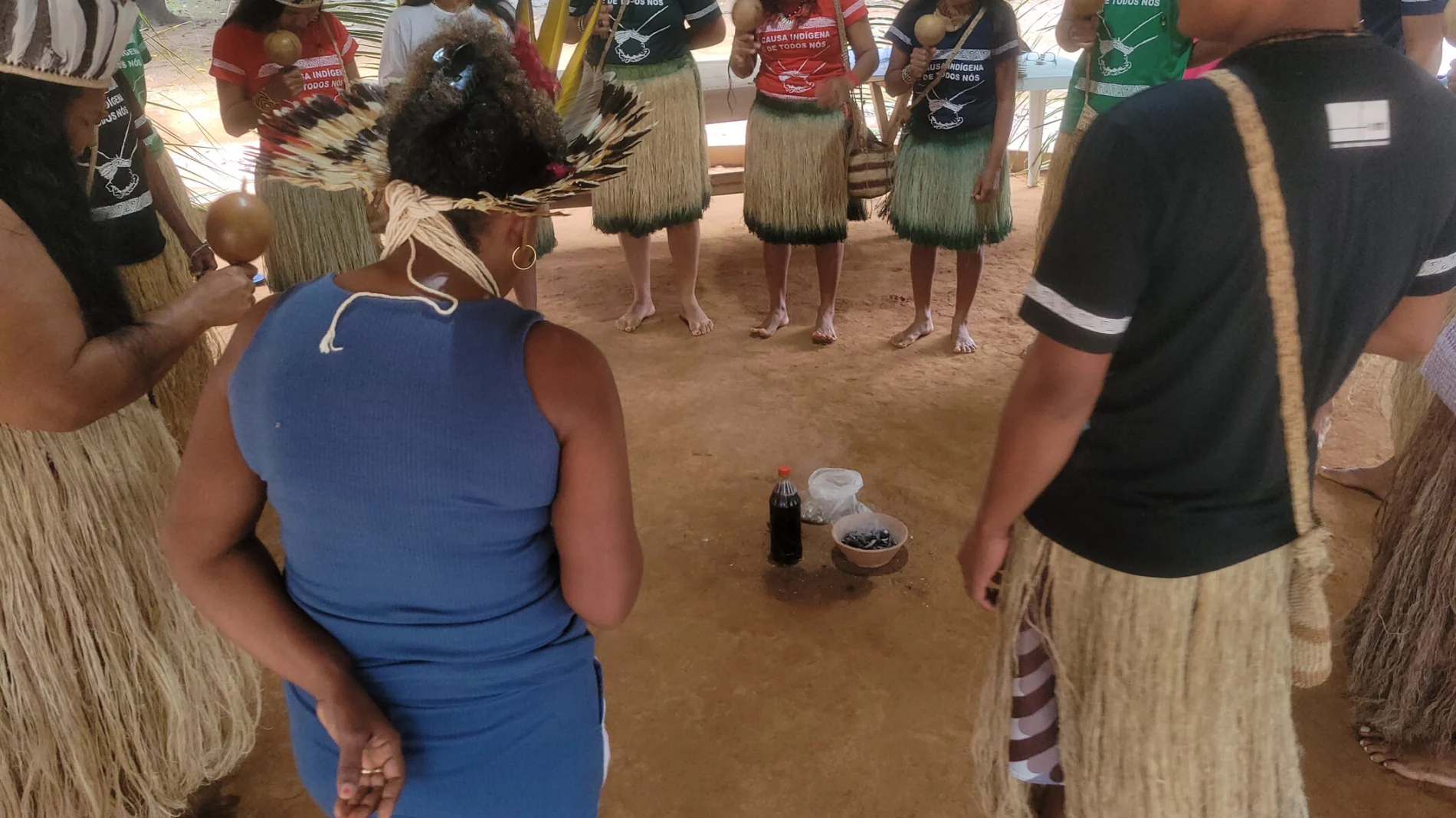
Indigenous Peoples’ workshop with prayers, songs, and a small ceremony dedicated to Jurema, the sacred drink.
Photo by Taís Sonetti-González, 2023. From Sonetti-González et al. (2025), People and Nature. Licensed under a Creative Commons CC BY license. https://doi.org/10.1002/pan3.70225
This study examines sustainable development from the cosmovisions of Indigenous Peoples and other Traditional Communities (IoTCs) in western Bahia, a region in the Brazilian savanna of the Cerrado. It adopts a feminist decolonial and post-development approach to address issues of epistemic violence.
Employing participatory arts-based research, this study incorporates poetic and thematic co-analysis using participant-voiced poetry. This approach centres on community voices and contextual narratives of co-production, as well as the presentation of findings.
This analysis shows that their understanding of sustainability is deeply rooted in cultural identity, spirituality and traditional practices such as family farming and artisanal fishing. These practices highlight their relational and community-oriented ways of living, deeply entangled with nature.
While the communities recognized the strategic value of the sustainable development goals (SDGs) for communicating their practices to a global audience, they found the framework insufficient in capturing the relational and context-specific dimensions central to their understanding of sustainability. This suggests the need for a reinterpretation of the SDGs.
This study introduces a new use of decolonial analyses to highlight the limitations of applying global, linear development models to diverse local contexts, using the case of the SDGs. It advocates for policies that recognize the pluriversal nature of sustainability, actively include marginalized perspectives and critically challenge epistemic hegemony.
By advocating for a re-inhabitation of the SDGs, this research highlights the importance of integrating relational and context-specific understandings of sustainability, ensuring that global frameworks respect and embrace diverse cosmovisions and practices.
Tool / Trase enables governments, companies and others to address the environmental impacts of supply chains.
Project / This project examines how public-private sector interactions can promote democratic, just and effective climate adaptation on the ground.
Journal article / Due to increasingly hybrid approaches in sustainability governance, researchers will need to attend to both chain and out-of-chain actors in their assessments.
Project / This project examines how biodiversity-based solutions can achieve change for coffee in Colombia and biocosmetics in Brazil.