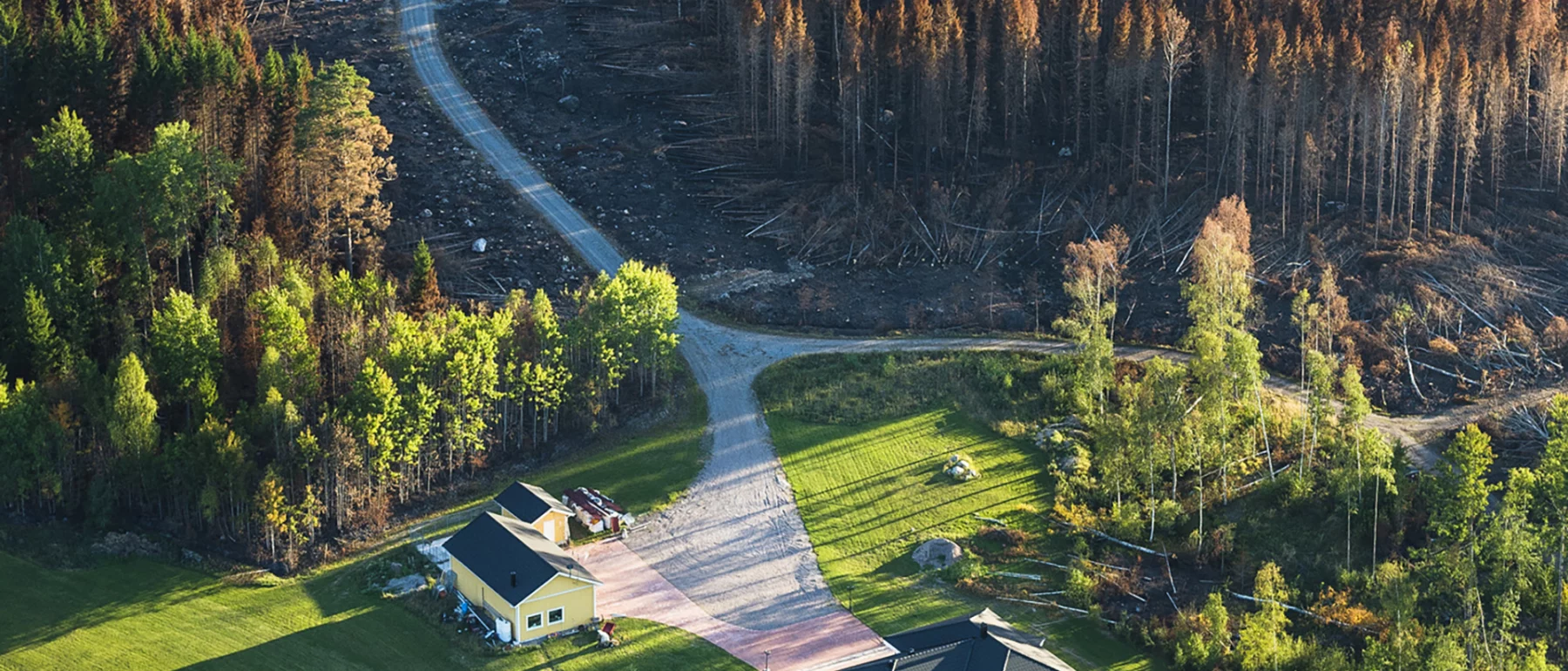
The largest wildfire in Sweden’s recent history affected nearby housing prices and time-on-market.
The literature on wildfires and residential property prices is limited and primarily focuses on events in North America. There is a lack of studies examining this relationship in Europe. With the largest forest area in the entire EU, understanding this impact is particularly relevant in a Swedish context.
The authors investigate how the largest wildfire in Sweden’s recent history, the 2014 wildfire in Västmanland County, affected nearby housing prices and time-on-market. Using a difference-in-differences method, they found a significant negative effect on housing prices. Their most conservative estimate indicates an approximate 2.7% reduction in final selling prices for post-fire sales located within 20 km of the wildfire area. However, the negative effect is even larger when defining the treated area as a 5 km (–10.1%) or 10 km (–8.9%) distance to the fire, and these results are confirmed by a repeated sales model that includes only single- and multi-family houses.
In a heterogeneity assessment with respect to the housing types, they found that the effects are mostly driven by the impact on single-family houses rather than apartments. For the former group, they found large negative and significant effects, while they failed to detect any significant one on apartments prices. The largest impact on prices occurs in the first months after the event and for those properties that are located along the trajectory of the wildfire’s smoke.
Journal article / The authors use the iSDG-Sweden system dynamics model to study the impacts and dynamics of combined degrowth policies in a high-income country.
SEI report / This report explores the value of - and offers guidance for - engaging citizens in governance to build climate-neutral, sustainable and resilient cities.
Feature / The BALTIPLAST project developed practical tools for municipalities to turn single-use plastic reduction ambitions into action.