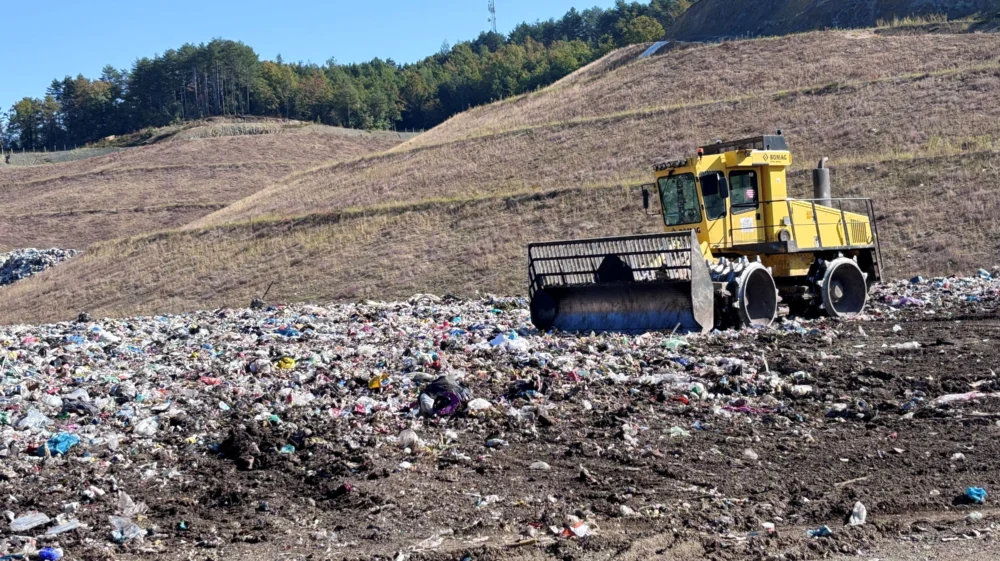
Municipalities can play a decisive role in reducing single-use plastics, with clear benefits for both the environment and public health. Yet many lack practical tools to turn circular economy ambitions into action. The BALTIPLAST project addresses this gap by providing tested tools to support strategic plastic reduction.
Plastic production and consumption in Europe have risen sharply in recent years. In 2022, each person in the EU generated 36.1 kilograms of plastic packaging waste on average, of which less than half was recycled (40.7%).
While plastic packaging offers convenience, its impacts are far-reaching. According to UNEP, between 19 and 23 million tonnes of plastic enter soils, rivers and oceans globally each year. Around 80% of marine litter is plastic. This pollution harms ecosystems, undermines livelihoods and food production, and affects human wellbeing.
Public awareness of plastic pollution is increasing, and expectations of businesses are rising. Companies face growing pressure from governments, regulators, consumers and investors to adopt more sustainable practices. Reducing dependence on single-use plastics can also bring direct benefits, including greater efficiency, lower costs and improved brand reputation.
Municipalities, as public buyers and service providers, are well placed to reduce plastic waste through public services, procurement, events and waste management. However, they often lack the tools to implement existing circular economy policies and ambitions.
The BALTIPLAST project, launched in 2023, brought together municipalities, researchers, non-governmental organizations and environmental specialists across the Baltic Sea region. Its aim was to turn plastic reduction from abstract goals into practical, locally applicable solutions.
SEI Tallinn led the development of strategic guidelines to help municipalities establish legal and policy frameworks for reducing plastic waste. Five municipalities in the Baltic Sea region piloted these guidelines by developing local strategies, action plans or regulations targeting single-use plastics.
“To succeed in reducing plastic waste, which is so deeply embedded into our daily lives, it’s essential to create a holistic framework of strategies, action plans, rules and regulations, but also to set measurable goals and allocate resources for specific actions,” describes Harri Moora, SEI Tallinn’s Senior Expert.
“Creating a successful strategic framework that supports the reduction of single-use plastics and plastic packaging requires involving decision-makers in the earliest stages. If we don’t have their support, it will be very difficult to implement plastic reduction initiatives.”
In parallel, partner municipalities tested soft solutions to reduce plastic use at source. These included the Plastic Inventory Tool, which helps organizations, schools, businesses and households measure their plastic use and identify reduction opportunities based on evidence rather than assumptions.
Technical pilots in three countries also demonstrated how improved collection and sorting systems can increase the quality of recycled plastic and support the circular economy. For example, near-infrared spectroscopy-based technology was used in recycling plants in Kaunas, Tallinn and Daugavpils, enabling faster and more precise identification and sorting of plastic waste at different scales.
An environmental assessment of the project confirmed that prevention measures and reuse systems can significantly reduce both plastic leakage and greenhouse gas emissions. Companies involved in the project reduced their carbon footprint by up to 51% per employee on average. Organizations also reported cost savings of 26-46% after implementing measures to reduce and avoid single-use plastics.
BALTIPLAST also invested in capacity-building by training local actors and embedding knowledge within municipalities. By the end of the project, BALTIPLAST had delivered a coherent set of tested, transferable solutions, supported by a digital platform and an educational kit for local authorities. These results show that reducing single-use plastics is achievable without compromising service quality – and that municipalities can lead this when equipped with the right tools, knowledge and collaborative frameworks.
“We cannot avoid plastic as a material completely, but we must use it wisely,” Moora adds. “Plastic pollution isn’t just an issue of littering, but plastic also impacts our health. That’s why we must reduce the use of single-use plastics. Scaling these approaches across more municipalities in the Baltic Sea region and beyond can help us create systemic change.”
Head of Unit, Senior Expert (Green and Circular Economic Transformations Unit)
SEI Tallinn
Project / BALTIPLAST project supported the prevention and reduction of single-use plastics and plastic packaging in the Baltic Sea Region.
Journal article / This research examines how the Folke Bernadotte Academy navigates competing demands for accountability and adaptive partner-oriented practices in peacebuilding.
Feature / What can a study on household waste in Bosnia and Herzegovina (BiH) teach us about driving change across the wider Western Balkans?
Journal article / This article maps consumer carbon footprints by urban density in Europe, revealing what drives the changes.