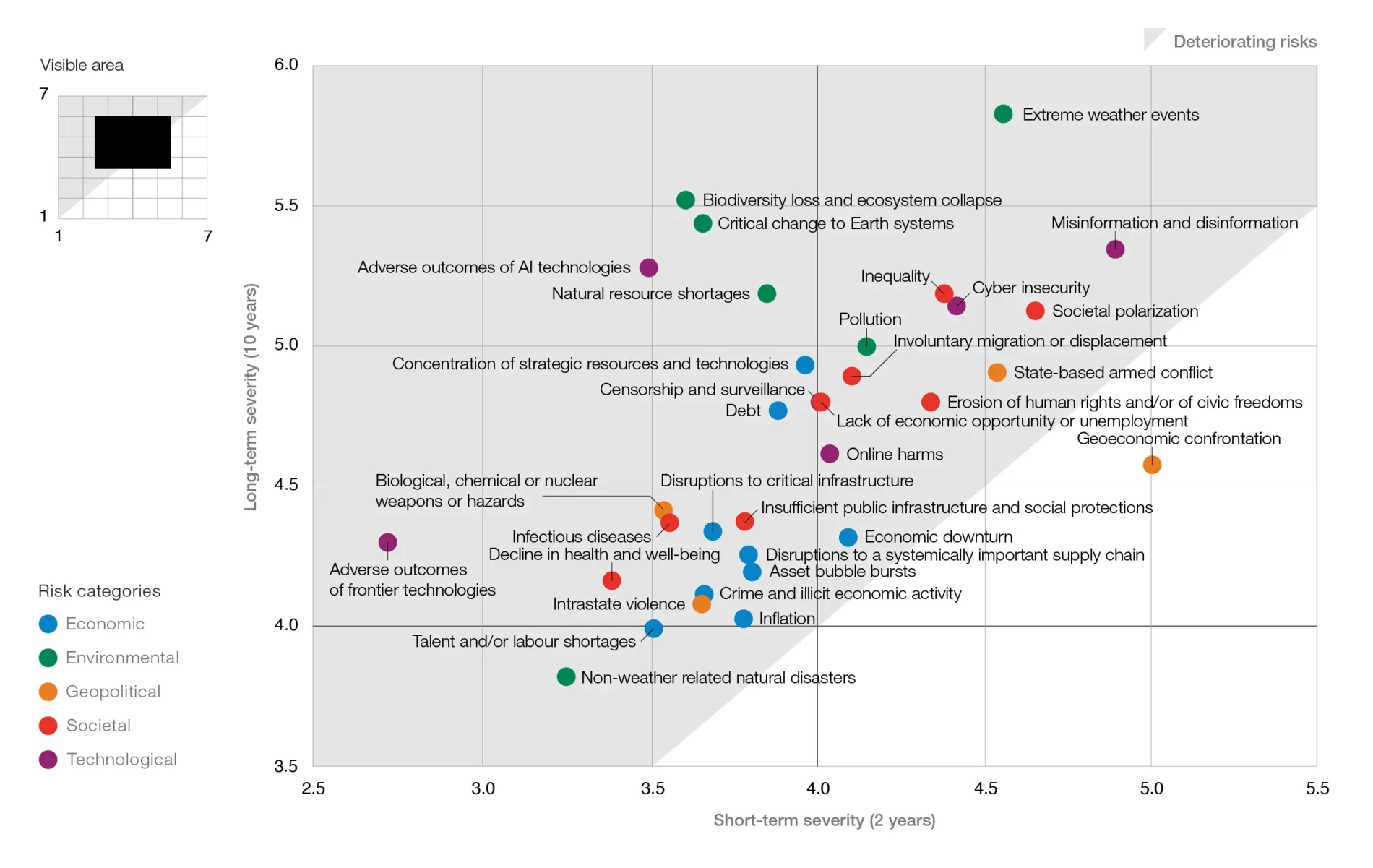
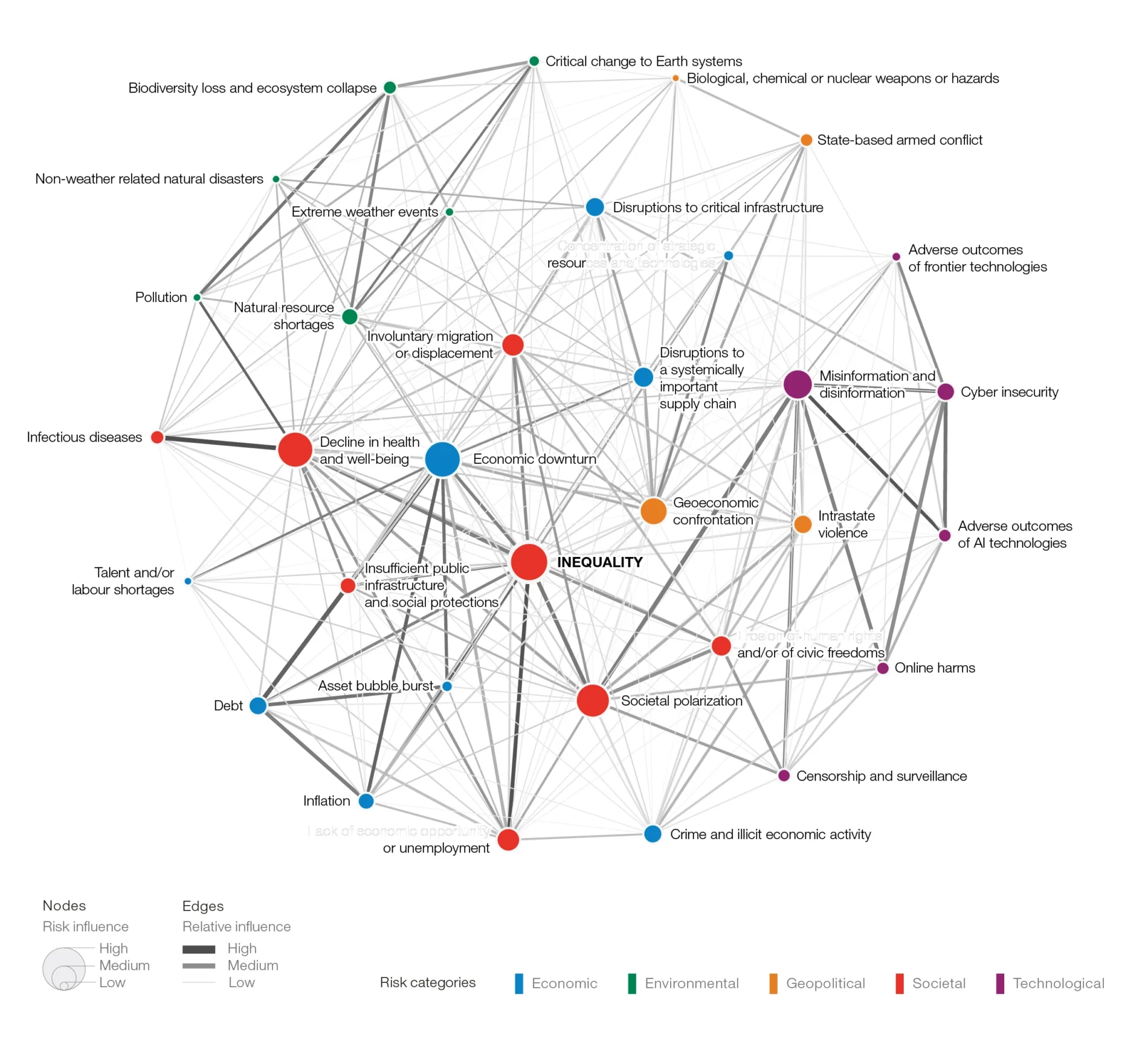
“Turbulent or stormy”: this is how over half of respondents to the World Economic Forum’s Global Risks Perception Survey characterize the outlook for the next decade (World Economic Forum, 2026). Insecurity and instability – whether geopolitical, economic or environmental in nature – are reshaping political priorities, policy landscapes and investment decisions. Extreme weather lies at the heart of this polycrisis – ranked the number one most severe global risk over the next 10 years (Figure 1; World Economic Forum, 2026). Indeed, Western Europe just recorded its hottest June–July period on record, with widespread drought and record-low soil moisture, diminishing crop yields and harvest outlooks (Joint Research Centre, 2026). The impacts of extreme weather events do not stay confined (Figure 2); they ripple outward to disrupt supply chains, critical infrastructure, movements of people, economic systems and more (World Economic Forum, 2026). Meanwhile, the retreat of multilateralism is eroding our collective capacity to meet these shared challenges (World Economic Forum, 2026).
Figure 1: Relative severity of global risks, short term (2 years) and long term (10 years).
Source: Global Risks Perception Survey 2025–2026 (World Economic Forum, 2026).
Figure 2: Global risks landscape: an interconnected map.
Source: Global Risks Perception Survey 2025–2026 (World Economic Forum, 2026).
The Nordics import much of their food from climate-vulnerable regions, a long-overlooked risk that the Swedish Food Agency (2026) now rates as “serious–critical” from 2041 onwards. This paper argues that preparedness actors in Sweden and the wider Nordics should treat cascading climate risks – that is, risks generated in one place by climate change impacts in another – as core to their mandate, particularly when they threaten Nordic food security (see methods note). Responses to such risks should consider but go beyond civil and crisis preparedness and security of supply to support the broader drive towards food systems transformation.
This paper is based on an extensive desk review of 56 sources of academic, grey and policy literature, covering food systems, preparedness and security topics across Swedish, Nordic and European levels, alongside insights generated by a stakeholder dialogue, with 22 external representatives, co-hosted by SEI and the Nordic Council of Ministers on 4 May 2026: Strengthening Nordic Preparedness and Protection for Cascading Climate Risks to Food Security. Claude (Opus 5.5, Anthropic) was used to help identify relevant literature, based on predefined scoping parameters set by the authors, and to a limited extent to improve the clarity and accessibility of some text. All sources were checked and screened by the authors, who take full responsibility for the accuracy, interpretation and citation of the content.
Actors span the public, private and civil society organizations responsible for anticipating and addressing disruptions to critical supply, including food. Nationally, these include the Swedish Civil Defence and Resilience Agency, the Swedish Board of Agriculture, the Swedish Food Agency and the Ministry of Defence, with county administrative boards and municipalities playing critical roles regionally. The private sector – agricultural cooperatives like Lantmännen, food processors, retailers and logistics providers – is equally central. But this paper also speaks to actors addressing the food system’s longer-term, structural vulnerabilities, not just its capacity to withstand acute shocks: climate adaptation bodies such as the Swedish Expert Council on Climate Adaptation and the Swedish Meteorological and Hydrological Institute; research and innovation actors like the Swedish University of Agricultural Sciences (SLU) and Formas; the Swedish Environmental Protection Agency; agricultural and trade policy actors such as the Ministry of Rural Affairs and Infrastructure and the Federation of Swedish Farmers; and, regionally and internationally, Nordic cooperation bodies and EU-level actors, who shape the broader environment within which Swedish preparedness operates.
The 2024 Karlstad Declaration, aimed at strengthening Nordic cooperation on security of supply, and the 2026 Partnership for Nordic Food Supply Security are promising steps forward. Threats that are both systemic and strategic – from COVID-19 to conflicts in Ukraine and Iran – are significantly reshaping Nordic perceptions of crisis preparedness and security of supply (Wigell et al., 2022). Common features of the “Nordic resilience approach” include a holistic, all-hazards model providing “capabilities to respond to multiple simultaneous disruptive events and their connected and cascading impacts” (Wigell et al., 2022, p. 13). Yet, as Sweden shows, it isn’t always easy to translate awareness into action. Cascading and transboundary risks feature prominently in Sweden’s latest national climate and vulnerability analysis, including their effects on the Swedish food system (Swedish Expert Council on Climate Adaptation, 2026). This forms part of a growing recognition of these risks in Swedish public policy, including within the Swedish Armed Forces (e.g., Swedish Expert Council on Climate Adaptation, 2022; Swedish Food Agency, 2026; Swedish Government, 2023). Yet, despite such advances, transboundary climate risks to food security are found to be less understood, less adapted to and less funded than most other risks in the analysis (Swedish Expert Council on Climate Adaptation, 2026).
Globally, climate change remains largely absent from discussions of contingency planning and strategic supply, and from treatments of food as critical infrastructure – fields still dominated by geopolitical and economic drivers. At the 2026 Munich Security Conference, Colombia’s Minister of Defence, Pedro Arnulfo Sánchez Suárez, noted that “…things that happen in one part of the world can affect the entire world” (Fritzhand, 2026). Yet, even where defence leaders openly acknowledge the threat, the links tying climate change to food and agriculture systems and, in turn, to national security rarely make it into security strategies (Fritzhand, 2026). As Sikorsky writes: “If resilience investments fail to account for climate risks and food system vulnerabilities, NATO countries risk reinforcing yesterday’s threats while remaining exposed to tomorrow’s shocks” (Sikorsky, 2026, p. 1). So, what needs to change and why?
The El Niño currently forming is set to be the strongest on record, heightening the risk of multiple breadbasket failures (BBC News, 2026; Sikorsky & Fritzhand, 2026). Meanwhile, geopolitical developments – in particular Iran’s closure of the Strait of Hormuz in response to the US-Israel war on Iran – are choking Gulf exports of fertilizer and natural gas, sending shockwaves through agricultural systems worldwide. These two compounding events mean that global food insecurity could peak just as global food aid hits a historic low (Sikorsky & Fritzhand, 2026). This example illustrates how climate hazards, such as a heightened El Niño, interact with other drivers of crisis to amplify and cascade their effects. As the Intergovernmental Panel on Climate Change (IPCC, 2023) notes, “multiple climate hazards will occur simultaneously, and multiple climatic and non-climatic risks will interact, resulting in compounding overall risk and risks cascading across sectors and regions” (p. 18). At each stage, environmental, economic, social and institutional vulnerabilities in the food system compound the net impact (FAO, 2015).
Agriculture ranks among the sectors most exposed to climate change (Lager & Benzie, 2022). Global markets function as “mechanisms of interdependence”: much of the food we eat, along with feed and fertilizer inputs, travels great distances before reaching supermarket shelves (Lager & Benzie, 2022). This exposes it to climate impacts at every stage – production, storage and distribution – including at 14 critical chokepoints on which global reliance is growing (Bailey & Wellesley, 2017). In routine disruptions, this means delays, food waste and higher prices; in a crisis, it can mean reduced food availability, price volatility, heightened malnutrition (especially among low-income and vulnerable groups) and distorted trade measures (Bezner Kerr et al., 2022; FAO, 2015). In both cases, there can be cascading effects for livelihoods and loss of income. The IPCC (2023) projects rising transboundary risk across the water, energy and food sectors. Global assessments describe transboundary climate risks to food security as “critical and mounting”, with geopolitical tensions likely to intensify as agricultural producers work to protect their market shares (Adams et al., 2021). This “imported exposure” often stems from extreme weather events in major breadbasket regions interacting with crop trade to substantially heighten risk (Hedlund & Diffenbaugh, 2026). By 2040, risk of annual crop failure is projected to rise two- to sixfold across Indian and European breadbaskets, with extreme weather already aggravating agricultural productivity and price volatility in Europe (Ellison et al., 2026).
Several Nordic countries depend heavily on imports to meet domestic demand for a wide range of food commodities, including fruit and vegetables, cereals, oilseeds and animal feed (Berninger et al., 2022; Jordbruksverket, 2024; Landbrug & Fødevarer, 2026; Landbruksdirektoratet, 2026). In Norway, domestic production supplies only 40–45% of the food energy consumed, and just 30–35% once imported feed is taken into account (Wilsher-Lohre et al., 2026). Sweden, with its open economy and position near the top of the global value chain, is highly dependent on climate-vulnerable regions of Brazil, Russia, India and China (Mikaelsson et al., 2025). Lager and Benzie (2022) argue that such dynamics “have existed in a statistical shadow, meaning their influence on our own climate vulnerability has not been appreciated, until now” (p. 3). The Swedish Food Agency (2026) reaches similar conclusions, rating the risk from transnational events to food distribution and meal services (followed closely by food processing and production) as “serious–critical” from 2041 onwards, with adaptation capacity (defined as the ability to prevent or manage climate-related impacts) ranging from “medium to very low”.
These dynamics carry serious security implications, both domestic – including human security and health concerns, particularly for low-income groups – and international. Global implications will be shaped by whether the Nordics’ allies and strategic competitors have the will and capacity to manage these dynamics, and how unilaterally they choose to respond. China, for instance, is strengthening its long-term food security – increasingly framed as a matter of economic stability and national security – through agricultural modernization, diversified food supply systems, growing interest in new protein sources and the acquisition of agricultural land overseas (NATO, 2024; Systemiq, 2026). In today’s fractured geopolitical landscape, early movers are likely to act decisively to safeguard their interests and even exploit the vulnerabilities of others. Equally, weak adaptive capacity in the world’s breadbaskets will generate impacts far beyond their borders, potentially fuelling unrest, destabilizing key partners, opening doors to interference by hostile actors and further weaponizing food production (Ellison et al., 2026).
The solutions are not straightforward. Diversification and substitution depend on the availability of alternatives – something that cascading climate risks threaten globally – and it is unclear whether Nordic purchasing power would be enough to secure priority access to scarce supplies (Lager & Benzie, 2022; Mikaelsson et al., 2025). Nor has the private sector got risk management in hand: a survey of 30 global businesses found only a minority had invested significantly in adaptation, and most did not see physical climate impacts as a major risk to their value chains (World Economic Forum, 2023). The global food system is only as resilient as its most vulnerable member – meaning resilience depends on shoring up capacity even where countries can least afford to invest in it themselves (Lager & Benzie, 2022). It is critical to invest in climate resilience internationally, while fully integrating climate change into food security discussions is essential domestically. Regionally, efforts to strengthen Nordic cooperation must continue: “Without a joint Nordic approach, the disruptive consequences of future crises and supply disturbances risk cascading throughout the whole region” (Wigell et al., 2022, p. 12).
For decades, food security in Sweden was essentially treated as a function of domestic production, markets and trade, rather than as a core component of civil preparedness and security of supply. In recent years, however, this has shifted, with a significant and growing national food preparedness agenda taking shape. The Swedish government’s 2024 report Food Preparedness for New Times charted this path forward, recommending stronger responsibilities across government, municipalities and households (Ministry of Rural Affairs and Infrastructure, 2024). Efforts have since accelerated, with substantial public investment in food and supply preparedness, including grain and agricultural input stockpiling as well as drinking water security. In just the past year, the government has adopted a new strategy for national security of supply (Ministry of Defence, 2026), proposed new food stockpiling legislation that would allow stocks to be established through agreements with private operators across the value chain (Prop. 2025/26:205, 2025) and tasked the Swedish Board of Agriculture with strengthening the robustness of the food system, particularly in northern Sweden (Ministry of Rural Affairs and Infrastructure, 2025a). Moreover, the 2025 Food Strategy 2.0 further integrates dimensions of agri-food system resilience and preparedness (Ministry of Rural Affairs and Infrastructure, 2025b).
These are significant steps, but they are still designed primarily to address disruption and crisis within Sweden’s borders rather than the deeper, transboundary vulnerabilities of a food system that is increasingly climate-exposed, characterized by “just-in-time” supply chains, and dependent on fragile global value chains. The 2026 strategy for security of supply explicitly calls for supply-chain analysis, early warning systems, contingency planning, critical stockpiling, public–private cooperation and closer collaboration within the Nordic region and with the EU and NATO (Ministry of Defence, 2026). Yet climate-driven disruptions elsewhere in the world are not treated as a central organizing principle of preparedness and adaptation efforts; they have instead tended to remain in the background of the analysis. The national strategy and roadmap for climate adaptation exemplifies this: it acknowledges transboundary climate risks to the agri-food sector but does not engage with them substantively (Swedish Government, 2023). This constitutes a real limitation: stocks cannot indefinitely offset compounding, transboundary failures across producing regions, transport routes or agricultural input markets.
Relatedly, the increasing vulnerabilities of other Nordic food systems to transboundary climate risks are, with some exceptions, often overlooked or under-addressed in national and cross-country policies and business practices. The issue has surfaced, for instance, in reporting by the Icelandic Meteorological Office and Norway’s second white paper on climate adaptation (Mikaelsson et al., 2025). National climate risk assessments and adaptation plans elsewhere in the Nordics have thus yet to fully grapple with these issues, though Finland’s 2030 National Climate Change Adaptation Plan (NAP 2030) is a promising exception, explicitly recognizing transboundary climate risk as a concern for national security of supply (Finnish Government, 2024).
The 2024 Karlstad Declaration, too, recognizes the need for cross-border Nordic cooperation (including the mapping of trade flows, strengthened logistics chains, protection of production capacity and stronger engagement with private actors) and acknowledges climate adaptation as important to the Nordic regional preparedness agenda (Mikaelsson et al., 2025). Even so, the risks resulting from transboundary and cascading climate impacts remain largely tangential and loosely defined in the Declaration, particularly within the countries and regions on which Nordic food systems heavily depend (Mikaelsson et al., 2025). Key barriers to integrating systemic climate risks such as these into policy and business strategy include diffuse risk ownership within and across countries, policy gaps, limited business preparedness, weak cross-country cooperation and decentralized, siloed approaches to adaptation (Mikaelsson et al., 2025). As the Nordic evidence reviewed in this brief broadly indicates (see methodology, Footnote 1), public, private and civil preparedness for transboundary climate risks appears limited and uneven across the region.
The broader enabling environment at EU and NATO level offers grounds for cautious optimism – on paper, if not yet in practice. The 2021 EU Adaptation Strategy was a front-runner in explicitly recognizing the transboundary nature of climate risk, framing international resilience building as “not only a matter of solidarity, but also of open strategic autonomy and self-interest” for the EU and its member states (Adaptation Without Borders, 2021). The EU’s forthcoming Integrated Framework for European Climate Resilience and Risk Management holds even greater potential, with its emphasis on resilience-by-design. In the food realm, the EU’s Vision for Agriculture and Food (2025) sets a strategic roadmap for the preparedness and risk-proofing of the agri-food sector for 2025–2029 and beyond (European Commission, 2025a).
Additional sectoral avenues for ensuring Europe’s protein self-sufficiency and the resilience of the livestock sector resilience are set out in the recently adopted EU Protein Plan and EU Livestock Strategy (2026), alongside the European Water Resilience Strategy (2025), offering a gateway for acting on the water-food-climate-security nexus (European Commission, 2025b, 2026a, 2026b). In addition, the European Food Security Crisis Mechanism (EFSCM) will remain central to cross-country and cross-stakeholder coordination to strengthen collective responses. NATO’s baseline resilience requirements are also a potential lever: all Nordic countries are NATO members, and the baseline already includes food and water security provisions. Using this framework to draw more explicit attention to climate risk in food supply chains could offer a useful entry point – one that supports an integrated NATO resilience agenda linking climate change, national security and food systems as interconnected security challenges.
While preparedness is increasingly embedded across EU strategies and programmes, the extent to which rhetoric carries through into action will ultimately depend on national implementation – an area in which the Nordic countries are well placed to lead. Stockpiling, domestic production capacity and contingency plans are necessary, but such an agenda risks merely buffering a vulnerable food system rather than addressing its underlying vulnerabilities. Sweden therefore needs to connect its emerging supply-preparedness architecture to climate adaptation – placing transboundary climate risk, agricultural policy, trade policy and broader agri-food system transformation at its centre – and to do so in close cooperation with its Nordic partners. The goal should not only be to withstand the next disruption, but to ensure that investments made for short-term security of supply concurrently reduce exposure to cascading climate risks, now and in the future.
Climate change impacts on food security and nutrition are driven both by the scale of climate effects and by underlying food system vulnerabilities that intensify impacts across the cascade (FAO, 2015). Crisis preparedness can reduce exposure to these impacts, but it doesn’t address the structural drivers of vulnerability built into today’s food systems by monocultures, high-input agriculture, dependence on imported feed from vulnerable regions, and unsustainable, unhealthy consumption patterns. Long-term food security therefore depends on the transformation of food systems as the foundation of preparedness. Unless preparedness action transforms production, consumption and supply chains, it risks reinforcing the very fragilities it is meant to manage (Beijer Institute, 2024).
Food systems in Sweden and other Nordic countries therefore face a dual transition: improving sustainability while strengthening preparedness (Mistra Food Futures, 2024). Treating these as separate agendas risks building preparedness within a broken system, compounding long-term risk. What is needed instead is an integrated resilience approach – one that links climate (mitigation and adaptation), food and security policy – so that short-term measures reinforce structural transformation rather than work against it (Mistra Food Futures, 2024; Sikorsky, 2026). This integrated approach should also raise the political priority of long-term preparedness, resilience building and food system transformation, while carefully navigating the role security and defence actors are best placed to play. The transition also needs to be just, and –ensure resilience-building measures reduce rather than redistribute the risk and that smallholder farmers worldwide don’t bear the brunt of risk-averting measures.
Transformational adaptation is central to this shift. Incremental measures – such as changing crop varieties or expanding irrigation – play an important short-term role but often fail to address systemic vulnerabilities and can create lock-ins that raise long-term costs and limit future options. Transformational adaptation, by contrast, targets root causes: it takes a systems view and rethinks the role each actor, from farm to fork, should play in the transition. It demands visionary thinking, systems change and behavioural shifts, but holds real potential to deliver lasting resilience and reduce reliance on repeated emergency interventions (European Scientific Advisory Board on Climate Change, 2026b). Sweden, and the wider Nordics, should explore the role of transformational adaptation in strengthening food systems both domestically and internationally, working collaboratively with international development cooperation partners to strengthen smallholder farmer livelihoods and community resilience while securing imports.
Protein diversification is one of the critical levers in this transformation. Europe’s current agricultural model is heavily oriented towards livestock production, which is highly dependent on imported feed inputs and fertilizers, exposing importing member states to significant risk. Two-thirds of Europe’s high-protein animal feed – mainly soy – is imported from just three countries: Brazil, Argentina and the US. This is an inherently unsustainable model: livestock production, itself a high-emissions sector responsible for more than 65% of the EU’s agricultural greenhouse gas emissions and a major source of nitrogen pollution, remains highly vulnerable to climate-driven disruptions in feed supply chains (European Environment Agency, 2026). By 2050, an estimated 60% of the EU’s soybean imports will come from areas with high or very high vulnerability to drought, posing substantial risks to the future of the EU’s animal-feed supplies (Ercin et al., 2021). National analyses for Sweden, and for Norway (in the case of aquaculture), raise similarly stark warnings (Lager, 2025; Lager & Benzie, 2022).
While diversifying and localizing protein supply can strengthen the resilience and security of European food systems, rebalancing livestock production and consumption patterns will also be key to further de-risking European agriculture (European Environment Agency, 2026). Plant‑based food systems tend to be more resilient to climate risk and support a more stable food supply; reducing livestock consumption eases pressure on land and water and supports more diversified, climate‑resilient agriculture (European Scientific Advisory Board on Climate Change, 2026a). Locally adapted feed and food crops – such as legumes, including sweet lupins in the Nordics – can reduce import dependency, build resilience to external shocks and contribute positively to climate and environmental goals (Axfoundation, 2020). By shaping production patterns and policy priorities, dietary shifts can play a key role in transformational adaptation strategies, while alignment with the Planetary Health Diet offers a clear, evidence-based pathway for the Nordics and beyond (European Scientific Advisory Board on Climate Change, 2026a; Rockström et al., 2025). However, achieving such dietary shifts depends on creating enabling food environments that make sustainable and healthy choices easy, affordable and appealing for consumers.
A strong business case supports investment in resilient agri-food systems, with the Munich Security Conference (MSC) Food Security Task Force recognizing that “investments in less concentrated, diversified, and adaptive supply chains can reduce volatility, lower systemic risk, and create economic opportunities”. Studies by the Food and Agriculture Organization of the United Nations (FAO) show a 7:1 benefit-to-cost ratio for anticipatory action, meaning that the costs required for ad hoc emergency aid, health care and the military to deal with the spillover effects of hunger are much higher than those of transforming agri-food systems for the benefit of all (FAO, 2025; MSC Food Security Task Force, 2026).
Preparedness actors in Sweden and the wider Nordics should integrate cascading climate risk into planning for the geopolitical, economic and security threats facing Nordic food systems. While significant work is underway to strengthen civil and crisis preparedness, security of supply and strategic reserves that collectively address critical short-term food security concerns, those making decisions on preparedness must also focus on actions that future-proof a food systems transformation:
Adams, K. M., Benzie, M., Croft, S., & Sadowski, S. (2021). Climate change, trade, and global food security: A global assessment of transboundary climate risks in agricultural commodity flows. SEI report. Stockholm Environment Institute. https://doi.org/10.51414/sei2021.009
Adaptation Without Borders. (2021, November 19). Adaptation Without Borders launches collaboration with DG CLIMA to scale up international action on cross-border climate risks. https://adaptationwithoutborders.org/knowledge-base/adaptation-without-borders-4/
Axfoundation. (2020). Sötlupin – den nordiska sojan? https://ax-images.b-cdn.net/uploads/2025/07/Sotlupin-%E2%80%93-den-nordiska-sojan_Axfoundation.pdf
Bailey, R., & Wellesley, L. (2017). Chokepoints and vulnerabilities in global food trade. Chatham House, the Royal Institute of International Affairs. https://www.chathamhouse.org/sites/default/files/publications/research/2017-06-27-chokepoints-vulnerabilities-global-food-trade-bailey-wellesley-final.pdf
BBC News. (2026, August 21). El Niño set to be “strongest in living memory,” says Met Office. https://www.bbc.com/weather/articles/c3ekg93vjz9o
Beijer Institute. (2024). A sustainable food system transition is part of crises preparedness. https://beijer.kva.se/news-item/a-sustainable-food-system-transition-is-part-of-crises-prepardness/
Berninger, K., Lager, F., Botnen Holm, T., Tynkkynen, O., Klein, R. J. T., Aall, C., Dristig, A., Määttä, H., & Perrels, A. (2022). Nordic perspectives on transboundary climate risk: Current knowledge and pathways for action (TemaNord 2022:531). Nordic Council of Ministers. https://doi.org/10.6027/temanord2022-531
Bezner Kerr, R., Hasegawa, T., Lasco, L., Bhatt, I., Deryng, D., Farrell, A., Gurney-Smith, H., Ju, H., Lluch-Cota, S., Meza, F., Nelson, G., Neufeldt, H., & Thornton, P. (2022). Food, fibre, and other ecosystem products. In Climate Change 2022: Impacts, Adaptation and Vulnerability. Contribution of Working Group II to the Sixth Assessment Report of the Intergovernmental Panel on Climate Change (pp. 713–906). Cambridge University Press. https://doi.org/10.1017/9781009325844.007
Ellison, T., Fritzhand, N., Naegele, D. A., & Caparas, M. (2026). Feeding resilience: Global breadbaskets: Food system resilience as a strategic imperative. The Council on Strategic Risks and the Woodwell Climate Research Center. https://councilonstrategicrisks.org/wp-content/uploads/2026/06/FR-Global-Breadbaskets.pdf
Ercin, E., Veldkamp, T. I. E., & Hunink, J. (2021). Cross-border climate vulnerabilities of the European Union to drought. Nature Communications, 12(1), 3322. https://doi.org/10.1038/s41467-021-23584-0
European Commission. (2025a). A Vision for Agriculture and Food: Shaping together an attractive farming and agri-food sector for future generations. https://eur-lex.europa.eu/legal-content/EN/TXT/PDF/?uri=CELEX:52025DC0075
European Commission. (2025b). European Water Resilience Strategy. https://eur-lex.europa.eu/legal-content/EN/TXT/PDF/?uri=CELEX:52025DC0280
European Commission. (2026a). Action Plan for resilience, strategic autonomy and sustainability of the EU protein system. https://eur-lex.europa.eu/legal-content/EN/TXT/PDF/?uri=CELEX:52026DC0355
European Commission. (2026b). EU strategy on livestock. https://eur-lex.europa.eu/resource.html?uri=cellar:c62fe23e-7a13-11f1-bf5e-01aa75ed71a1.0001.02/DOC_1&format=PDF
European Environment Agency. (2026). Protein diversification—Strategic risks and opportunities for sustainable food systems (EEA report 05/2026). European Environment Agency. https://doi.org/10.2800/9156778
European Scientific Advisory Board on Climate Change. (2026a). Climate adaptation and mitigation in the agri-food system – Recommendations for coherent EU policies. https://doi.org/10.2800/3706315
European Scientific Advisory Board on Climate Change. (2026b). Strengthening resilience to climate change—Recommendations for an effective EU adaptation policy framework. European Scientific Advisory Board on Climate Change. https://doi.org/10.2800/6761189
FAO. (2015). Climate change and food security: Risks and responses. Food and Agriculture Organization of the United Nations. https://openknowledge.fao.org/server/api/core/bitstreams/a4fd8ac5-4582-4a66-91b0-55abf642a400/content
FAO. (2025). FAO’s new Global Emergency and Resilience Appeal seeks $2.5 billion to support 100 million people in 54 countries. Newsroom. http://www.fao.org/newsroom/detail/fao-s-new-global-emergency-and-resilience-appeal-seeks–2.5-billion-to-support-100-million-people-in-54-countries/en
Finnish Government. (2024). Government Report on Finland’s National Climate Change Adaptation Plan until 2030: Wellbeing, safety and security in a changing climate (2024:11). https://julkaisut.valtioneuvosto.fi/server/api/core/bitstreams/d90bbaa8-2d83-4aee-91f3-baf83b536f14/content
Fritzhand, N. (2026, February 26). Event summary: Food on the frontlines? Evaluating the future of defense in an unstable climate (Munich Security Conference 2026). https://councilonstrategicrisks.org/2026/02/26/event-summary-food-on-the-frontlines-evaluating-the-future-of-defense-in-an-unstable-climate-munich-security-conference-2026/
Hedlund, J., & Diffenbaugh, N. S. (2026). Extreme climate events and transboundary effects of global crop trade. Environmental Research: Climate, 5(1), 015020. https://doi.org/10.1088/2752-5295/ae390b
IPCC. (2023). Summary for policymakers. In Climate Change 2022 – Impacts, Adaptation and Vulnerability: Working Group II Contribution to the Sixth Assessment Report of the Intergovernmental Panel on Climate Change (pp. 3–34). Cambridge University Press. https://doi.org/10.1017/9781009325844.001
Joint Research Centre. (2026, August 12). Worsening drought and record heat grip Europe, fuelling extraordinary wildfires and extremely low river flows. https://joint-research-centre.ec.europa.eu/jrc-news-and-updates/worsening-drought-and-record-heat-grip-europe-fuelling-extraordinary-wildfires-and-extremely-low-2026-08-12_en
Jordbruksverket. (2024). På tal om jordbruk och fiske – fördjupning om aktuella frågor: Hur stor andel av svensk matkonsumtion skulle kunna täckas av livsmedel producerade i Sverige? [Agriculture and fisheries in focus – in-depth analysis of current issues: How much of Swedish food consumption could be covered by food produced in Sweden?]. Swedish Board of Agriculture. https://jordbruksverket.se/download/18.224634c81900509cce84f98/1718192143943/Pa-tal-om-jordbruk-och-fiske-2024.pdf
Lager, F. (2025). Cross-border and cascading climate risk in Norwegian food systems: A data summary report. Stockholm Environment Institute. https://www.vestforsk.no/en/publication/cross-border-and-cascading-climate-risk-norwegian-food-systems-data-summary-report
Lager, F., & Benzie, M. (2022). New risk horizons: Sweden’s exposure to climate risk via international trade. Stockholm Environment Institute. https://doi.org/10.51414/sei2022.033
Landbrug & Fødevarer. (2026). Selvforsyningsgrader i Norden [Self-sufficiency rates in the Nordic countries] (Analyse 1). Danish Agriculture & Food Council. https://lf.dk/media/kjvigdhy/analyse-selvforsyningsgrader-i-norden.pdf
Landbruksdirektoratet. (2026). Norsk landbruk – tall og fakta [Norwegian agriculture – facts and figures]. Norwegian Agriculture Agency. Retrieved 13 October 2026, from https://www.landbruksdirektoratet.no/nb/norsk-landbruk-tall-og-fakta
Mikaelsson, M. A., Harris, K., Kappe, K., & Klein, R. J. T. (2025). Who is responsible for addressing transboundary climate risks to Nordic trade and food security? Nordic Council of Ministers. https://doi.org/10.6027/nord2025-008
Ministry of Defence. (2026). Nationell strategi för försörjningsberedskap—För totalförsvarsperioden 2025–2030. Government Office, Sweden. https://www.regeringen.se/contentassets/0364f3db81cf4fb6be69c3042403ff4b/nationell-strategi-for-forsorjningsberedskap.pdf
Ministry of Rural Affairs and Infrastructure. (2024). Livsmedelsberedskap för en ny tid (SOU 2024:8). Statens Offentliga Utredningar. http://regeringen.se/contentassets/fc08dfb51d014b3996b719005beb146f/livsmedelsberedskap-for-en-ny-tid-sou-20248.pdf
Ministry of Rural Affairs and Infrastructure. (2025a). Ändring av regleringsbrev för budgetåret 2025 avseende Statens jordbruksverk. Government Decision 2025-07-10, LI2025/01194. https://www.regeringen.se/contentassets/a9df6e5f35104a37884f7a98e377d393/andring-av-regleringsbrev-for-budgetaret-2025-avseende-statens-jordbruksverk.pdf
Ministry of Rural Affairs and Infrastructure. (2025b). Livsmedelsstrategin 2.0. Government Office, Sweden. https://www.regeringen.se/contentassets/77b9be17a33f4d8a804512d4aceea517/livsmedelsstrategin-2.0.pdf
Mistra Food Futures. (2024). Improved preparedness with respect to food can be achieved through sustainable and resilient food systems – examples from Sweden. https://mistrafoodfutures.se/app/uploads/2024/06/Policybrief-Sustainable-food-preparedness-18-mars-24.pdf
MSC Food Security Task Force. (2026). Resilience of food systems as forward defense. https://www.cimmyt.org/content/uploads/2026/02/MSC-2026-Joint-Statement-_consensus.pdf
NATO. (2024). The Secretary General’s report: Climate change and security impact assessment (3rd ed.). North Atlantic Treaty Organization (NATO). https://www.nato.int/content/dam/nato/legacy-wcm/media_pdf/2024/7/pdf/240709-Climate-Security-Impact.pdf
Prop. 2025/26:205. (2025). Beredskapslager i livsmedelskedjan. Swedish Government. https://www.regeringen.se/contentassets/1fb269cd906b4a4daa741f8f29449e23/beredskapslager-i-livsmedelskedjan-prop.-2025_26_205.pdf
Rockström, J., Thilsted, S. H., Willett, W. C., Gordon, L. J., Herrero, M., Hicks, C. C., Mason-D’Croz, D., Rao, N., Springmann, M., Wright, E. C., Agustina, R., Bajaj, S., Bunge, A. C., Carducci, B., Conti, C., Covic, N., Fanzo, J., Forouhi, N. G., Gibson, M. F., … DeClerck, F. (2025). The EAT–Lancet Commission on healthy, sustainable, and just food systems. The Lancet, 406(10512), 1625–1700. https://doi.org/10.1016/S0140-6736(25)01201-2
Sikorsky, E. (2026). Stability multipliers: Food security, climate change, and the future of NATO resilience [Edited by Francesco Femia]. The Center for Climate and Security, an institute of the Council on Strategic Risks.
Sikorsky, E., & Fritzhand, N. (2026, March 20). Feeding resilience: The conflict, climate, and food nexus of the war in Iran. Council on Strategic Risks. https://councilonstrategicrisks.org/2026/03/20/feeding-resilience-the-conflict-climate-and-food-nexus-of-the-war-in-iran/
Swedish Expert Council on Climate Adaptation. (2022). Första rapporten från Nationella expertrådet för klimatanpassning. Swedish Expert Council on Climate Adaptation. http://klimatanpassningsradet.se/download/18.18f5a56618fc9f08e8344e56/1718356293414/Rapport%20fr%C3%A5n%20Nationella%20expertr%C3%A5det%20f%C3%B6r%20klimatanpassning%202022.pdf
Swedish Expert Council on Climate Adaptation. (2026). Nationell klimat- och sårbarhetsanalys. Swedish Expert Council on Climate Adaptation. https://klimatanpassningsradet.se/download/18.2f600dad19e8ca88633b59/1782370794278/NKSA_hela.pdf
Swedish Food Agency. (2026). Klimat- och sårbarhetsanalys för Livsmedelsverket (L – 2026 nr 04). Swedish Food Agency. https://www.livsmedelsverket.se/496b5d/globalassets/publikationsdatabas/rapporter/2026/l-2026-nr-04—klimat–och-sarbarhetsanalys-for-livsmedelsverket.pdf
Swedish Government. (2023). Regeringens skrivelse 2023/24:97—Nationell strategi och regeringens handlingsplan för klimatanpassning. Swedish Government. https://www.regeringen.se/contentassets/981309b513244d3eb987e0cf8ff69e37/nationell-strategi-och-regeringens-handlingsplan-for-klimatanpassning-skr.-20232497.pdf
Systemiq. (2026). China’s food future: Consultation paper: How China’s food-security strategy could reshape global agricultural commodity supply chains. https://www.systemiq.earth/wp-content/uploads/2026/04/Chinas-Food-Future-Report.pdf
Wigell, M., Hägglund, M., Fjäder, C., Hakala, E., Ketola, J., & Mikkola, H. (2022). Nordic resilience: Strengthening cooperation on security of supply and crisis preparedness (FIIA Report No. 70). Finnish Institute of International Affairs. http://www.fiia.fi/wp-content/uploads/2022/09/report70_nordic-resilience_strengthening-cooperation-on-security-of-supply-and-crisis-preparedness.pdf
Wilsher-Lohre, S., Svennerud, M., Mittenzwei, K., & Færaas, V. W. (2026). Selvforsyningsgrad – sammenligning av norske og internasjonale beregninger [Food self-sufficiency rate: Comparison of Norwegian and international calculations] (NIBIO Rapport 12(46)). Norwegian Institute of Bioeconomy Research. https://doi.org/10.21350/x4vr-rx35
World Economic Forum. (2023). Taking stock of business efforts to adapt to climate change [WEF White Paper]. World Economic Forum. https://www3.weforum.org/docs/WEF_Taking_Stock_of_Business_Efforts_to_Adapt_to_Climate_Change_2023.pdf
World Economic Forum. (2026). The Global Risks Report 2026 (Insight Report 21st Edition). World Economic Forum (WEF). https://www.weforum.org/publications/global-risks-report-2026/
Perspective / This perspective explores three key trends that became increasingly prominent over the course of the Mistra Geopolitics programme, running 2017-2025.
Perspective / Geopolitics and sustainability are boiling up together, and one of the world's most calm and stable regions, the Nordics, will be a hotspot.
Past event / SEI’s Fedra Vanhuyse will keynote at NordicSIF 2025 on climate finance.