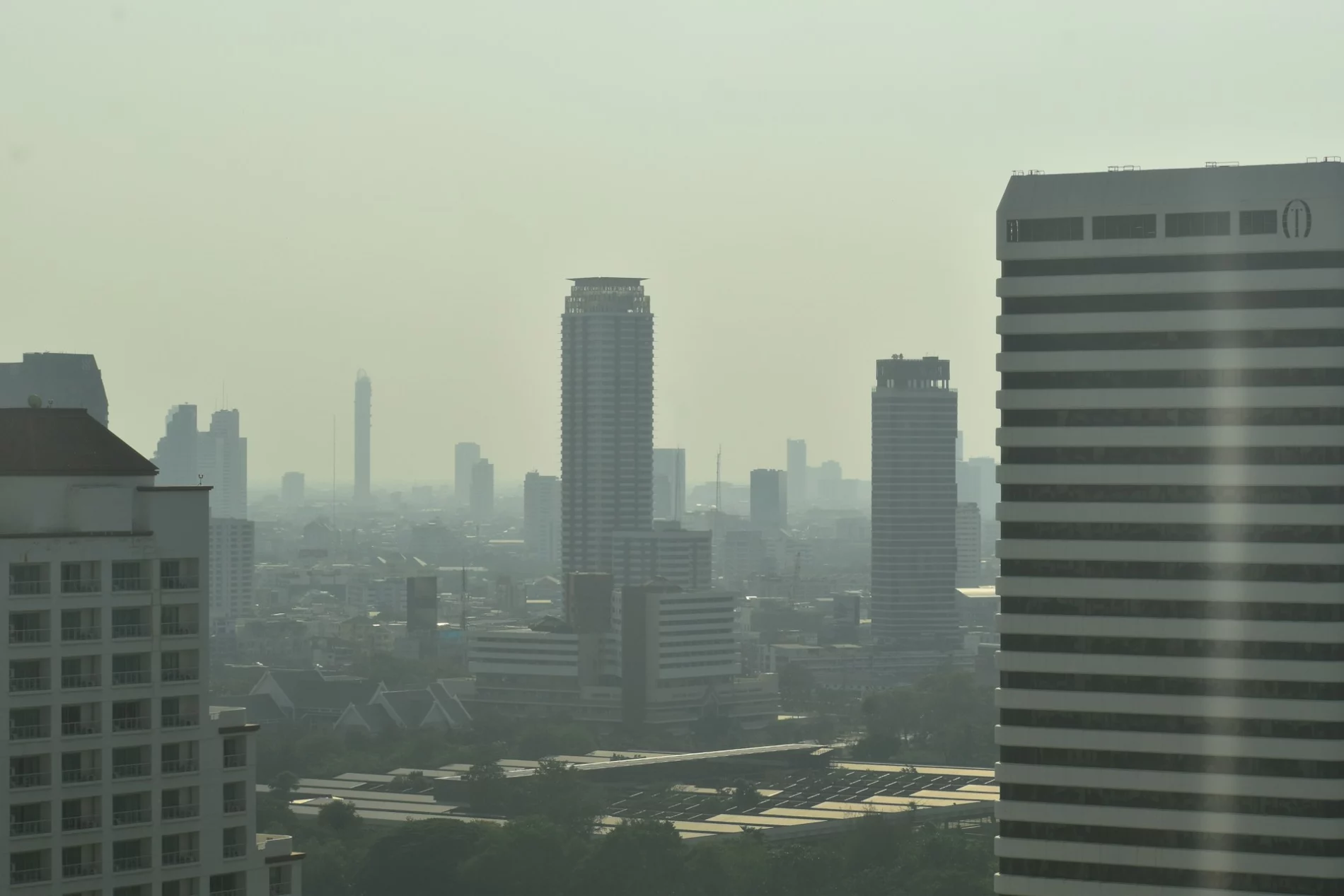
A small group of volunteers is challenging Thailand’s powerful industries with the country’s first citizen-drafted Clean Air Bill. Their seven-year battle against toxic air is now reaching a critical point in parliament.
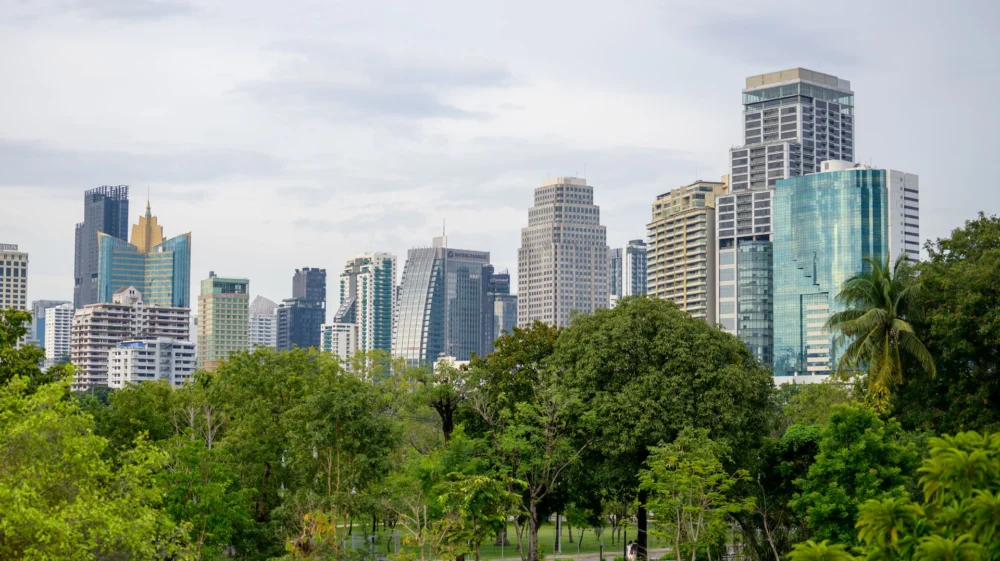
Photo: Desiree M / Unsplash.
At an International Women’s Day gathering on an unusually windy Saturday in March, protesters wear home-made paper lungs around their necks, delivering an unmistakable message to Thailand’s lawmakers: women, alongside others, are dying from the toxic air they breathe daily. It’s not fair and it certainly doesn’t have to be this way, says Weenarin Lulitanonda, a senior consultant at the World Bank, who calls Bangkok home. But getting that message to resonate with those in power and polluting industries themselves is an uphill battle.
It’s one Weenarin began fighting in 2018 when pollution was only a fringe conversation. The dozens of studies that have since been produced showing the state of Thailand’s poor air quality and the detrimental impacts on people’s health as well as the environment, were only murmurs. The issue was not yet a top priority for the government; clinics treating people for illnesses related to toxic fumes were yet to be established; and the public had not yet taken their widespread outrage online.
Weenarin was confused by the inaction on what she saw as a glaringly obvious health issue. She began to read all literature on the issue, learning that the country’s pollution levels, which today are known to regularly be double levels dubbed safe by the World Health Organization, peak between January and May as agricultural burning layers on top of industrial and traffic emissions.
During this same period, Weenarin started suffering from persistent headaches; something she attributed to running outside. A dream to participate in the 2018 Paris marathon was quickly dashed in favour of prioritising her health. “I don’t want to die because of this,” she told HaRDstories, explaining that she now no longer runs.
Instead, all her spare time is dedicated to what she calls “the war for clean air”. This is why she stands outside the United Nations headquarters in Bangkok on a Saturday, brandishing a placard that calls out big polluters and politicians while rallying her fellow clean air warriors.
What began as one woman’s health concern has evolved into Thailand’s first coordinated challenge to air pollution – and to powerful industrial interests in a country where economic priorities often overshadow public health. Now, after years of grassroots organising, the group’s citizen-drafted legislation is closer than ever to a breakthrough that could save thousands of lives annually.
The problem, initially, was a lack of public data on the country’s air pollutants, especially PM2.5 – fine particulate matter that is so small it can penetrate deep into the lungs, said Weenarin. “We initially took the angle of bringing in more low cost sensors to have enough data points because you can’t manage what you don’t know,” she explained. “PM2.5 is only in the vocabulary of most people over the last six years,” she said. The government did not include its PM2.5 data in the World Air Quality Index or form a national action plan until October, 2018.
Today, data still shows that Thailand’s PM2.5 levels pose a moderate risk to people’s health, shaving around two years off life expectancy; pollution can be linked to heart and lung disease, cancers and strokes. It also contributes to global warming, further straining an environment the world is trying to keep from warming above 1.5°C. Yet less than three percent of climate change resources go toward maintaining clean air.
For change to happen, polluters need economic incentives to reduce emissions and switch to greener energy. Legislation could drive such action, which is why alongside the push for more localised data, Kanongnij suggested Thai CAN draft a Clean Air Act. “This is an absolutely necessary condition to get policy and action on air pollution,” said Hasenkopf from the Energy Policy Institute in Chicago.
To table legislation though, Thai CAN needed over 10,000 signatures of support – a process that took two years since signatures had to be collected on paper rather than online during the COVID-19 pandemic when people mostly stayed home.
In 2021, after Kanongnij had spent hours drafting the bill from scratch and consulting with local groups – including farmers who are often accused of contributing the most to poor air quality – Thai CAN submitted it to parliament. Six other drafts were submitted from stakeholders such as the Chamber of Commerce and the cabinet.
After two years of little movement, a committee of 39 people was eventually formed – 13 representing Thai CAN – tasked with merging the seven drafts into one. All aim to lower emissions and improve air quality, but Thai CAN wants a bill that prioritises civil society voices, creates a government body with funding from a “polluters pay principle,” offers economic incentives for companies transitioning to greener operations, addresses transboundary haze from neighbouring countries, and educates the public to drive local action. It’s an ambitious blueprint for transforming how Thailand addresses its air pollution crisis.
The current Pollution Control Department serves mainly in a monitoring capacity and lacks enforcement power, said Diane Archer, senior research fellow at the Stockholm Environment Institute, a non-profit research institute.
Having a single law that brings together all the aspects of regulations around air pollution and that creates a single entity that will have enforcement power is something really important to be able to take concrete and effective action across the board on air pollution.
Diane Archer, Senior Research Fellow at SEI Asia
The committee, now a year into deliberations, is on track to produce a consolidated bill in 2025. It will then face review by MPs, potentially move to the senate and public consultation, before finally – and hopefully – receiving royal approval.
SEI podcast / This episode sheds light on Thailand's groundbreaking legislation to empower citizens in the battle against air pollution.
Event on 28 October in Yerevan / Armenia faces waste disposal challenges alongside potential for resource recovery. We explore how to recover valuable resources and reduce pollution.
Feature / At the Bangkok Climate Action Week 2026, SEI Asia will showcase research and build pathways for climate action through science, dialogue, and engagement.