Editor’s choice
Editor’s choice
Analyses of the social and environmental ‘footprints’ of consumption use national or regional data, often ignoring huge differences in local conditions. The SEI-PCS model, applied here to Brazilian soy, traces commodities back to the sub-national level, allowing for more precise and policy-relevant analysis.
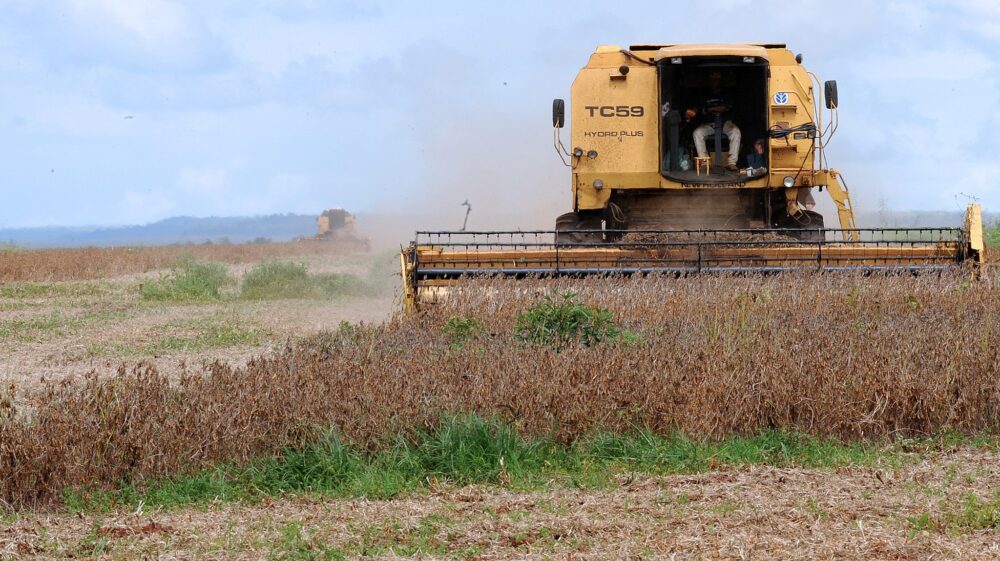
Soy field in Brazil.
Photo: “Norte do Paraná” by Otávio Nogueira, CC BY 2.0
Global trade has transformed economies all around the world, boosting development and raising incomes through export revenue: US$736 billion for South and Central America alone in 2013, according to the World Trade Organization – along with US$602 billion to Africa, and US$6.3 trillion to Asia.
Yet trade has also brought negative impacts, from deforestation and biodiversity loss, to pollution, water scarcity and displacement of vulnerable communities. Aiming to avoid these impacts, consumers, businesses and governments now invest considerable resources to increase the sustainability of supply chains.
But how do you solve a problem when you can’t quite put your finger on it?
Most analyses of the impacts of consumption of traded commodities use only national or aggregated data, says Javier Godar, a research fellow at SEI in Stockholm. “That means that when you calculate the water footprint of U.S. corn, for example, or the deforestation impact of Brazilian soy, you get national averages that may mask huge differences across states or regions. That’s not very helpful for governments trying to design effective policies, or for businesses or consumers trying to source products sustainably.”
Aiming to fill this knowledge gap, Godar and colleagues developed the SEI-PCS model (Spatially Explicit Information on Production to Consumption Systems), which connects detailed production data at sub-national scales (e.g. municipalities or provinces) with information on international trade and domestic flows of goods.
The model, published in the journal Ecological Economics, makes it possible to downscale country-to-country trade analyses, to pinpoint where the beef, soy, or any other commodity consumed by a country comes from. Local-scale data on water use, deforestation, biodiversity, poverty, etc. can then be used to determine the social and environmental impacts of that country’s consumption.
“This fine-scale understanding of links between producers and consumers is crucial because it can uncover entry points for policy-makers and other supply-chain actors to increase sustainability,” Godar says. “It can also show us trade-offs: trying to avoid deforestation risks, for example, we might source a product from an area that is water-stressed, has land use conflicts, or has conditions that require a lot of chemical inputs.”
A case study of Brazilian soy using SEI-PCS highlights those differences and trade-offs. It shows that while from 2001 to 2011, China sourced its soy mainly from established agricultural areas, EU consumption has shifted more sharply from those areas towards the southern and western Cerrado, and recently into the forested agricultural frontiers in the northern Cerrado and eastern Amazon.
This means that although Chinese consumption of Brazilian soy is double that of the EU, impacts on deforestation or biodiversity per tonne consumed may be higher in the EU. The Nordic countries have narrowed their sourcing even more, now buying almost exclusively from providers of certified soy in the state of Mato Grosso, which straddles the Amazon and Cerrado biomes.
“We need to understand the various local social and environmental dynamics in the regions of production to assess where is best to source our consumption and how to tailor incentives for more sustainable production in different areas,” says Godar. “For example, the EU has been pivotal in supporting the Amazon soy moratorium, but that may have simply shifted impacts to the Cerrado, which is the most biodiverse wet savannah in the world, and hugely important for ecological processes in the Amazon. We need better incentives and policies to ensure sustainable production in the Cerrado as well.”
SEI-PCS was developed as part of NORD-STAR, the Nordic Centre of Excellence for Strategic Adaptation Research, a consortium focused on sustainable adaptation both to climate change impacts, and to unintended consequences of climate policy. Martin Persson, co-author of the Ecological Economics article and an assistant professor in the Department of Energy & Environment at Chalmers University of Technology, in Gothenburg, Sweden, says the tool could help Nordic countries better target and refine their policies.
“When we adopt climate change mitigation and adaptation measures, we want to make sure they do not have impacts that potentially cancel out the positive effects,” says Persson. “The SEI-PCS model may help us avoid this. Our case study also shows that we don’t have to settle for national-level footprint analyses; we have the data and tools to make far more detailed assessments of the impacts of our consumption.”
Godar says he expects SEI-PCS to be useful to policy-makers, businesses and civil society in both consuming and producing countries. They can verify producers’ claims about sustainability, and avoid high-risk areas without shunning entire countries. Governments in consuming countries can craft more tailored policies and compensate for externalities associated with their consumption. Producing countries, meanwhile, can use these analyses to develop policies based on territorial performance monitoring, working with supply-chain actors.
SEI is presenting the results to Brazilian government officials, researchers and civil society, and expects future collaborations to grow from the work. SEI will also continue developing the tool – and analyses for other countries – as part of a major new SEI Initiative on Producer to Consumer Sustainability.
Read the article in Ecological Economics (external link to journal)
Journal article / Using a multiregional input-output (MRIO) model to link Brazilian sub-national agricultural production and associated impacts to regional final consumption.
Feature / SEI's Karin André has been appointed to the Water Centre Steering Committee at KTH Royal Institute of Technology.
Event on 21 July / Join Nigeria's Climate and Clean Air Action Framework launch for Transport Businesses, featuring tools to reduce emissions and access climate finance.