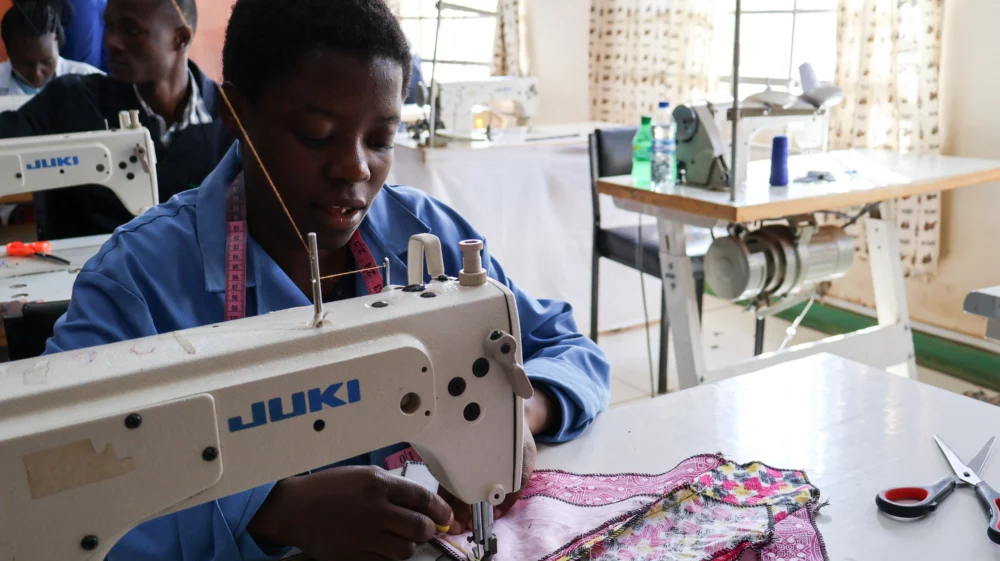
Partnership with textile and garment producer Rivatex in Kenya reached a milestone in 2024, positioning it as a leader in sustainable manufacturing. The work builds on the Estonian UPMADE upcycling model, which empowers local factories and designers to create sustainable and circular garments and fabrics.
Each year, the fashion industry produces around 90 million tons of textile waste – equivalent to a rubbish truck full of clothes being dumped in a landfill every second. Furthermore, it is projected that the industry will account for approximately 25% of the world’s carbon budget by 2050.
In Europe, SEI has a long track record of applied research to reduce waste, especially in circular economy initiatives where projects like the pan-Baltic study on post-consumer textiles and Estonia’s textile recycling system have set new standards for sustainability.
But the global textile supply chain is highly interconnected, so the research team in Tallinn understood the need to expand their focus and work with countries in Asia and Africa that produce textiles consumed in higher income countries.
More than 10 years ago, SEI began collaborating with Reet Aus, an Estonian designer known for her commitment to sustainability, to develop the UPMADE model – an innovative approach to textile upcycling. UPMADE delivers an effective means to repurpose leftover materials from the production process to create new garments. The approach not only reduces textile waste but also saves water and energy that are otherwise used in the production of virgin materials. UPMADE has been adopted by textile manufacturers in Bangladesh, India, and Europe.
Building on this success, a recent project in Kenya has transferred the UPMADE model to the local textile industry.
The roots of the project lie in a longstanding partnership with the Estonian Academy of Arts. Reet Aus, a senior researcher at the academy, spent time living in Kenya and linked up with a professor from Moi University to develop the project.
The enterprise was a good fit with SEI’s aims to expand its research on circular systems outside of Europe, and SEI got on board with Moi University and the Estonian Academy of Arts to partner with Rivatex, one of Kenya’s largest textile factories, to adapt the UPMADE model to local production processes.
Kenya has long struggled with both pre-consumer waste and even more with post-consumer textile waste from higher-income countries. In addition to the waste problem, second-hand textiles from abroad have undermined the local textile industry.
Initial assessments at Rivatex revealed that 25–40% of textiles used in garment manufacturing is wasted, with around half of it suitable for upcycling. SEI worked with factory staff to integrate upcycling techniques, design sample garments, and implement waste transparency measures. The project also trained 55 seamstresses and five designers, equipping them with practical skills to reduce waste and improve circular product design.
A vital milestone was Rivatex’s certification under the UPMADE system in 2024, positioning the factory as a leader in sustainable manufacturing. The certification not only helps Rivatex cut waste but also adds value to its products and enhances its competitiveness.
Kenya’s moves towards circular practices also demonstrates the importance of global partnerships in addressing textile industry challenges. SEI and partners organized workshops between Kenyan and European stakeholders, bringing Kenyan representatives to policy events in Estonia to share knowledge and showcase the potential of circular textiles in Africa.
Although Kenya’s textile policies trail Europe’s regulatory frameworks, SEI’s work is helping to close this gap by building local capacity. Partnerships with Moi University ensure that future textile professionals are skilled in sustainable practices, creating a foundation for long-term change.
SEI’s collaboration with Rivatex and other stakeholders shows how circular economy principles can be adapted to local contexts to reduce waste, increase resource efficiency and support economic development. The lessons learned in Kenya provide a blueprint for scaling these efforts across Africa, where sustainable practices in textiles could have far-reaching benefits.
I believe that in the next 20 years, with projects like this one, Kenya will learn how to handle textile waste. This means that for every material we use, Kenya will be at the forefront of utilizing all materials effectively. There will be no waste at the Dandora dumpsite, no clothes thrown into the Nairobi River, and the water from fabric dyeing will be pretreated. It’s an exciting moment as we move toward sustainable textile production, where people, society, and the industry as a whole will thrive economically.
– Professor Josphat Igadwa Mwasiagi, DEng, MKIM, Moi University, Kenya
Other publication / This report presents key findings from the mapping of textile waste and fabric leftovers at Rivatex, a textile factory based in Eldoret, Kenya.
Other publication / This report demonstrates how the textile waste and leftovers from the Rivatex factory can be effectively repurposed into new, circular and marketable products.
Project / The main objective of the project is to implement a value-added upcycling strategy within the Kenyan garment and textile industry.
Feature / SEI Tallinn and partners are transferring value-added upcycling method UPMADE to support the deployment of circular solutions in textile production.
SEI annual report / Reflect on a year of change and collaboration as SEI set the course for sustainability through 2030.
Perspective / Biochar looks simple, but its role is not.