At the Sarajevo Energy and Climate Week 2024, the BiH SuTra programme brought together key stakeholders to explore how Bosnia and Herzegovina can effectively navigate its sustainable transition, focusing on achieving EU sustainability goals and improving the lives of citizens in coal-dependent regions.
Sustainable Transition of Bosnia and Herzegovina (BiH SuTra) aims to enhance the country’s approach to sustainable transition by strengthening national and local capacities to efficiently and effectively implement environmental policies. The programme is designed to support BiH in its journey toward the EU’s long-term sustainability goals and the EU accession process. By fostering the creation and execution of local transition measures, BiH SuTra strives to improve living conditions for citizens, particularly those in coal-dependent regions, as the country transitions toward a sustainable future.
The Sustainable Transition of Bosnia and Herzegovina (BiH SuTra) programme, funded by the Swedish International Development Cooperation Agency (Sida) and implemented by SEI, played an active role at the Sarajevo Energy and Climate Week (SECW) 2024, a regional conference focused on addressing the critical challenges of energy and climate in Bosnia and Herzegovina (BiH).
At SECW 2024, BiH SuTra used its platform to engage thought leaders, activists and stakeholders in meaningful discussions about how BiH can navigate the path toward a just and inclusive transition.
One of the highlights of SECW was a side event hosted by BiH SuTra titled “BiH Sustainable Transition: World Café & Swedish Fika.” The event offered participants the opportunity to discuss the pressing challenges of BiH’s sustainable transition over coffee and traditional Swedish treats, commonly known as “Swedish fika”.
The session provided a platform to showcase BiH SuTra’s achievements over the past year while facilitating powerful discussions around the future of sustainable development in BiH.
Some of the key takeaways from the session included:
In a unique twist, Bosnian artist Midhat Kapetanović created a live visual representation of the session’s key points. This visual summary helped capture the collective insights and presented them in an accessible way to the audience.
Bosnian artist Midhat Kapetanović created a live visual representation of the session’s key points.
Photo: Jasmin Agovic.
A central theme of SECW 2024 was the importance of stakeholder engagement in achieving a just transition. A panel organized by the World Bank focused on creating a fair transition process, particularly for local communities and pilot projects. Saša Solujić, BiH SuTra programme manager, participated as a panelist, offering valuable insights on the significance of stakeholder engagement in the transition process.
Solujić highlighted that the concept of a just transition has historical roots dating back to the 1970s when environmental regulations began gaining traction. She emphasized several critical factors needed to ensure a just and inclusive transition:
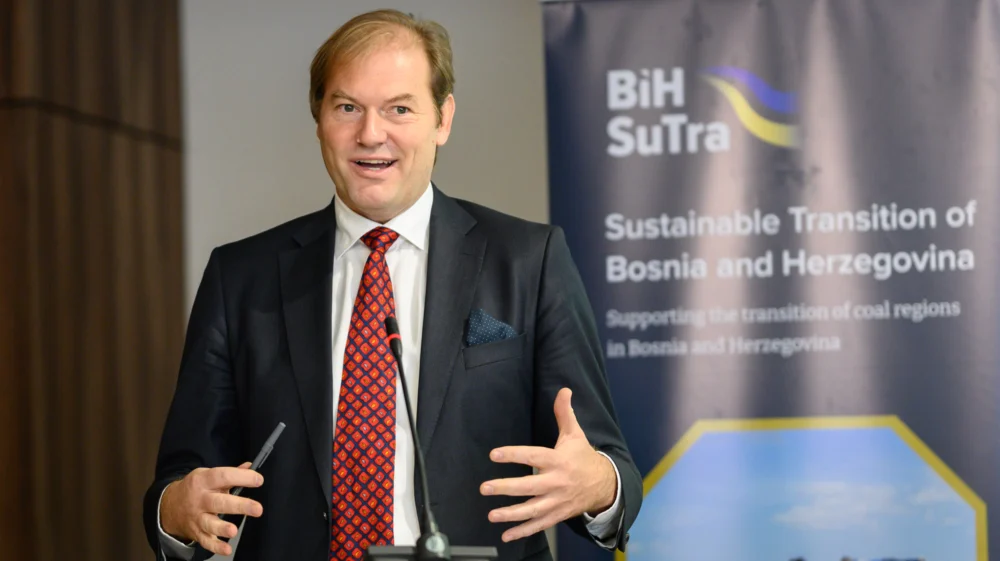
Sustainable mobility is a critical component of the broader transition to decarbonization. Bernardas Padegimas, team lead of the environmental policy and strategy team at SEI Headquarters, participated in the SECW panel on “Strategic approach to the development of e-mobility in the private and public sectors with a focus on transport decarbonization”.
Bernardas Padegimas, SEI environmental policy and strategy team lead SEI participating mobility-related panel at SECW.
Photo: Jasmin Agovic.
During the discussion, Padegimas emphasized Sweden’s leadership in electric vehicle (EV) adoption and its support for BiH’s efforts to advance e-mobility. Sweden is on track to fully electrify its public transport by 2030, with cities like Stockholm already implementing electric bus fleets.
Padegimas highlighted the potential for BiH to follow a similar path through knowledge exchange with Sweden and neighbouring Slovenia. Sweden remains committed to supporting BiH’s decarbonization efforts through investments in EV infrastructure, public transport electrification and the integration of smart grid technologies. These efforts are crucial to ensuring that BiH can meet its sustainable mobility targets and reduce its carbon footprint.
Sarajevo Energy and Climate Week 2024 provided a valuable platform for the BiH SuTra programme to engage with key stakeholders and partners in shaping a just and inclusive energy transition in BiH. The event underscored the importance of local engagement, continuous planning and social inclusion as key drivers of the sustainable transition process. As BiH SuTra continues to build on these foundational elements, it remains committed to ensuring that the transition is just, inclusive and beneficial to all citizens.


Project / BiH SuTra aims to improve local capacities to implement efficiently and effectively environmental and sustainable transition policies in BiH.
Feature / SEI launched the programme Sustainable Transition of Bosnia and Herzegovina this week in Sarajevo.
SEI report / This report describes the approach used to mainstream GESEP considerations into an environmental strategy and action plan in Bosnia and Herzegovina.
Feature / Understanding global megatrends and utilizing foresight methods are crucial for planning sustainable transitions.