part of Change stories
Start readingSEI is helping define strategies for a shift to renewable energy in La Guajira – a region vital to Colombia’s plans to scale up wind energy production – delivering insights cited by the Ministry of Mines and Energy in its Just Energy Transition Roadmap.
In the quest for renewable energy solutions, the road to social acceptance requires more than just innovative technology – it demands a deep understanding of local contexts.
In 2023 and 2024, SEI ran a project to identify the factors that influence or impede social acceptance of wind energy projects in La Guajira, and develop a set of policy recommendations for planning and develop targeted recommendations to help successfully plan and implement the projects.
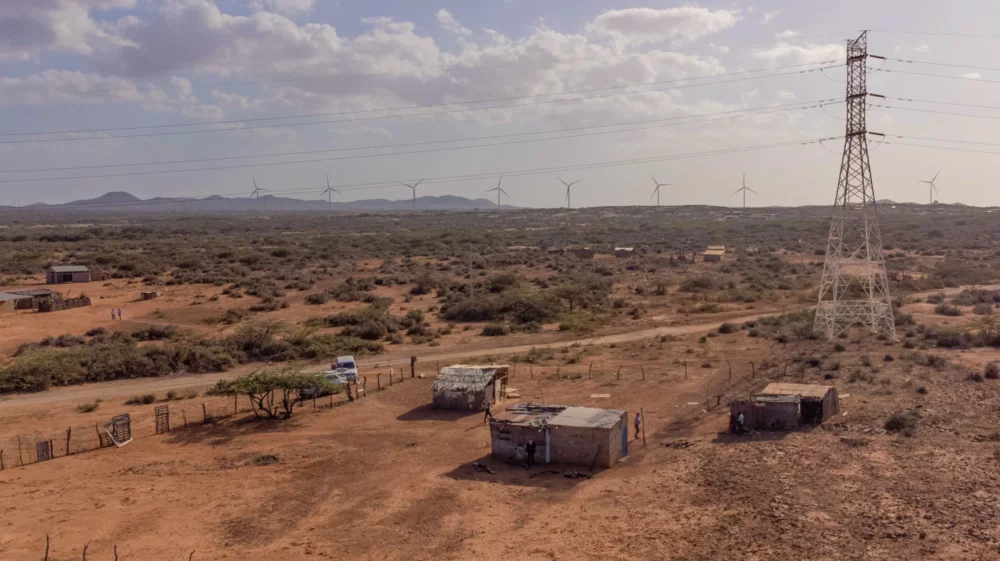
The La Guajira region is vital to Colombia’s plans to scale up wind energy production because of its world-class and largely untapped wind resources. Colombia’s first wind farm was built in La Guajira in 2004. Its second was opened nearby 17 years later, and now 31 new wind farms are projected to be built in the next three years, along with new overhead high-voltage power lines and other necessary infrastructure.
Combined with other initiatives in an early planning stage, more than 40 wind farms are expected to operate by 2034, representing an installed capacity of more than 8000 megawatts (MW), more than 40% of Colombia’s current installed capacity.
However, most of the planned wind parks are slated to be developed in the collective lands of the Wayuu Indigenous Peoples, which means there are important issues to be addressed in securing a social license to develop and operate these projects.
During the project the research team conducted an extensive literature review, visited communities near wind park locations, organized workshops with members of Indigenous communities, conducted interviews with industry associations and key developers, and met with local, regional, and national government representatives.
The research and broad consultations generated findings that were shared and debated during forums cohosted with the University of La Guajira, with representatives from the Ministry of Mines and Energy, the Wayuu Indigenous People, and delegates from the private sector, non-governmental organizations (NGOs), educators, and students.
The research team built on this successful outreach and held direct talks with members of the La Guajira Departmental Assembly. These discussions allowed the team to make the case for the value of their research and outreach in successfully enacting regulations on wind farm development.
Many of the things that work well in our community happen because we manage them together, we dream together. That’s why we should always be taken into account when starting a project. Understanding and accepting it from an intercultural perspective is vital.
Ana González, member of the Wayuu Indigenous people
Citing SEI’s work, the Assembly ultimately issued Proposition No. 023 of 2023 (in Spanish), which establishes a minimum standard for benefit-sharing from large-scale renewable energy projects with local communities. The proposition (translated from the Spanish) states “Research by institutions such as Stockholm Environment Institute has identified the need to achieve a fair and equitable distribution of benefits to communities, greater access to information about both the projects and local communities, and to reflect on the role and scope of community advisors.”
The proposition also recognizes the need to regulate the role of community advisors, including specific capacity-building requirements, to increase confidence in these important intermediaries between the private sector and local communities.
The SEI team was also able to arrange high-level meetings with representatives from the Ministry of Mines and Energy, the Office of Environmental and Social Affairs, the Just Energy Transition Team, Institute for Planning and Promotion of Energy Solutions for Non-Interconnected Areas (IPSE), the National Mining Agency, and the National Hydrocarbons Agency. These conversations provided invaluable input to the final report from the project, Enabling Factors for the Social Acceptance of Wind Projects in La Guajira, published in early 2024.
The publication of the report came at an ideal time to influence the Just Energy Transition Roadmap, prepared by the Ministry of Mines and Energy and published in September 2024.
The roadmap cites SEI’s research, highlighting its relevance for the planning of sustainable and equitable renewable energy projects, particularly its recommendations for inclusive decision-making, equitable distribution of benefits, and respect for Indigenous rights and culture.
At a range of scales and with a variety of actors SEI research is now being woven into the fabric of just energy transition planning in Colombia.
Project / This project aims to steer renewable energy development in La Guajira towards more equitable and socially beneficial paths.
Program / This programme aims to build a collaborative platform to accelerate renewable energy deployment in La Guajira.
Tool / Anajia Guajira is a mapping and communication platform to foster a just transition to renewable energy in La Guajira, Colombia.
Feature / Trase identifies the leading coffee trading companies and estimate where traders and markets source coffee from within key coffee-producing countries.
Press release / SEI researchers publish analysis on whether “rights of rivers” initiatives have led to environmental protections.