For 15 years, SEI has worked with partners and nations to reduce emissions of methane, a highly potent, short-lived greenhouse gas. SEI’s work has shown that reducing methane offers one of the most cost-effective and fastest strategies to aid efforts to limit global temperature rise. SEI’s work both paved the way for the Global Methane Pledge and is helping advance its implementation.
SEI is working with signatory countries to meet commitments to the pledge by developing action plans, roadmaps and funding strategies to reduce emissions and, at the same time, achieve key sustainable development and public health benefits. This effort is part of a wider body of work on integrated strategies to reduce greenhouse gases, short-lived climate pollutants (SLCPs) and air pollutants.
SEI has worked on climate and clean air assessments since 2009. In 2011, SEI’s work with UNEP and other partners showed that lowering short-lived climate forcers/pollutants, in combination with ambitious carbon dioxide mitigation, can drastically reduce global warming in the near term. The research led to the formation of the Climate and Clean Air Coalition (CCAC), an international coalition of countries and non-state partners.
SEI has since partnered with the CCAC on 30 projects and initiatives, including providing direct support to 25 countries. A key focus has been on methane, which, despite being one of the most potent of greenhouse gases, has not been a focus of countries’ NDCs.
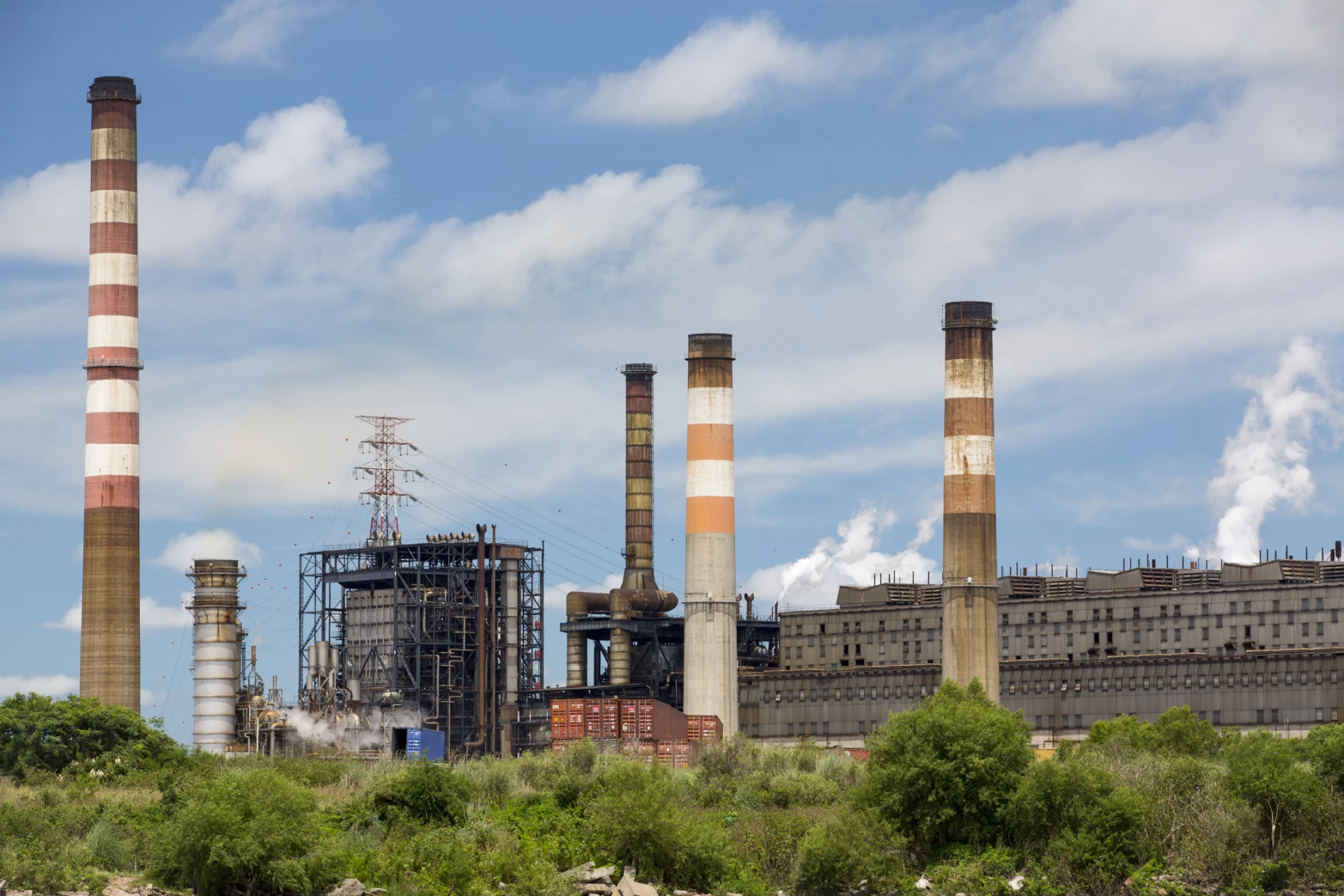
A power station in Buenos Aires, seen from the Costanera Sur nature reserve on the banks of the River Plate.
Photo: Ashley Cooper / Getty Images.
Founded in 2012, the Climate and Clean Air Coalition (CCAC) is a voluntary partnership that brings together over 160 governments, intergovernmental organizations and NGOs. It focuses on reducing short-lived climate pollutants (SLCPs) such as methane, black carbon, hydrofluorocarbons (HFCs), and tropospheric ozone to help limit both global warming and air pollution. The CCAC funds targeted mitigation actions in over 70 countries, supporting projects and promoting national policies to address SLCPs. Its efforts align with the Paris Agreement, focusing on near-term emissions reduction, improved air quality and human health, and multiple environmental benefits.
In 2020, SEI co-authored the Global Methane Assessment, which provided scientific analysis of the important role of reducing methane in achieving the Paris Agreement. The work paved the way for the Global Methane Pledge. Launched in 2021, the pledge has been signed by 159 countries. It commits signatories to reduce their methane emissions by 30% of 2020 levels by 2030.
The pledge raised awareness about methane and encouraged global action, but it did not specify contributions that countries and methane-emitting sectors should make. SEI research has since highlighted that much remains to be done to achieve the goals of the pledge.
To accelerate actions, SEI and the CCAC are working with countries to show how the Global Methane Pledge can be achieved and emphasize that countries’ pledge commitments are also opportunities for achieving development goals.
SEI is helping countries develop roadmaps and funding strategies to turn commitments into actions. Working with the CCAC and the US State Department, SEI contributed to the development of the Methane Roadmap Action Programme (M-RAP), an initiative that helps countries define and implement mitigation actions. As part of this effort, SEI developed a set of guidelines and a template to create such roadmaps. This template includes key “building blocks” that outline steps a country can take to reduce methane emissions.
SEI’s work with thirteen countries (Argentina, Brazil, Cote d’Ivoire, the Dominican Republic, Ghana, Mali, Pakistan, the Philippines, Mali, the Republic of Guinea, Togo, Uganda, and Zimbabwe) led to 10 new national plans and roadmaps aimed at reducing methane and other SLCP emissions and improving air quality.
SEI is also training national actors to use the LEAP-IBC tool to undertake multiple benefit analyses to understand the climate change, human health and development benefits of reducing other SLCPs, such as black carbon. See a country example in the graph below, showing how suggested policy measures can reduce, in this case, methane emissions. SEI has also developed and trained key actors to use its AgHealth tool to increase the capacity of countries to better understand and quantify emissions from agriculture, waste and sanitation. To date, SEI has held over 60 trainings on five continents to use SEI-developed tools to enhance countries’ ability to estimate, understand and act to reduce methane and other SLCPs.
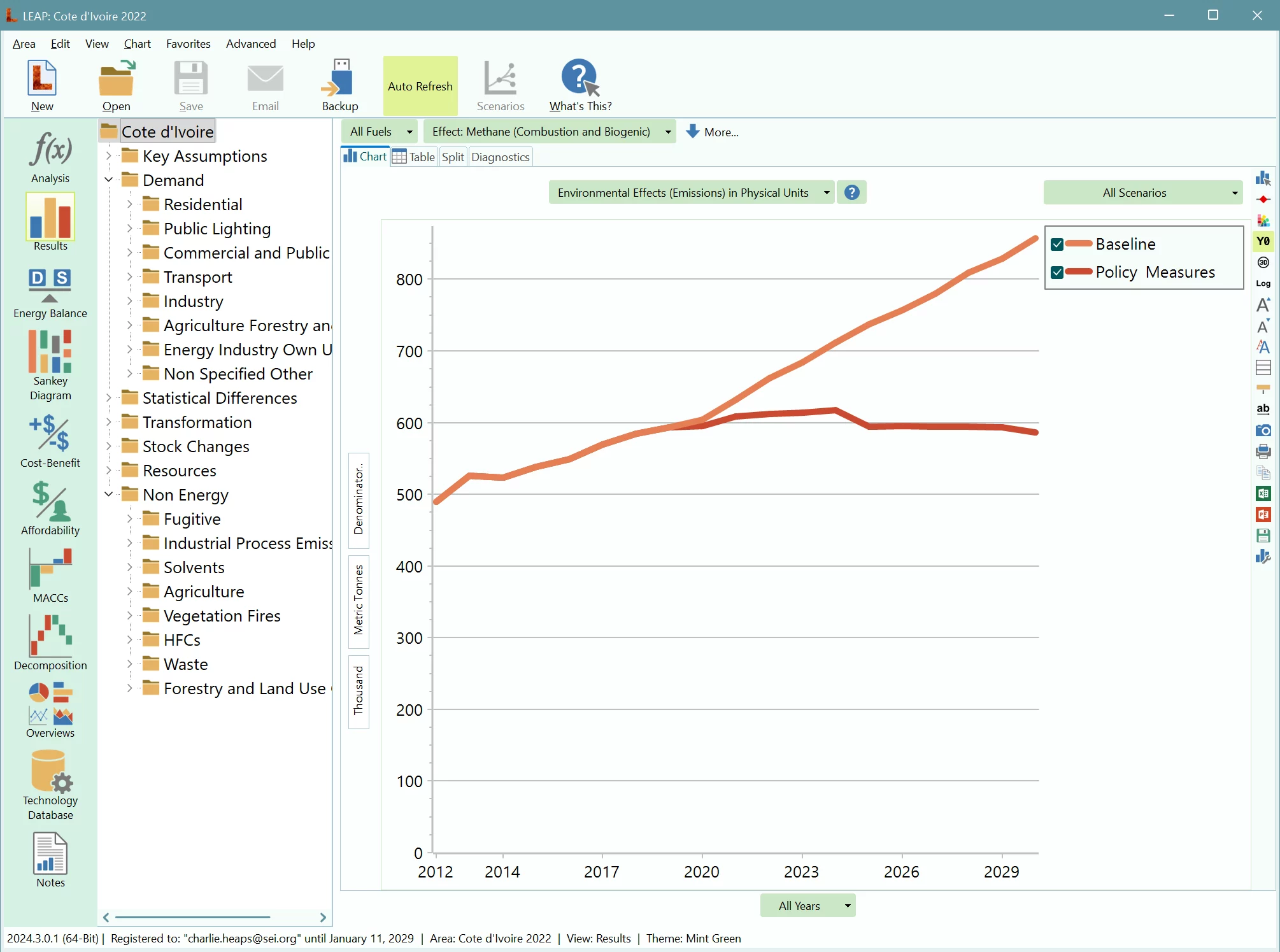
This data is taken from the LEAP-IBC tool, and the graph indicates total emissions in a baseline scenario vs. the policies scenario in Cote d’Ivoire. The policies scenario leads to a significant reduction in methane (avoiding about 271 thousand tonnes of methane in 2030 vs. the baseline scenario). Methane emissions in 2030 do still increase however vs. the base year (2012): by about 97 thousand tonnes.
SEI is supporting the World Bank in its efforts to cut methane emissions from their projects. SEI is providing scientific and policy advice to identify measures that can help achieve the aims of the World Bank’s Methane for Development (CH4D) initiative to reduce 10 million tons of methane across its investments in agriculture, waste and sanitation (see Section 5.2).
Graphic: Mia Shu, SEI.
Recognize and address a priority niche that has been overlooked or underexplored in an otherwise crowded field: Action on methane is underrepresented in climate change mitigation planning compared to action on carbon dioxide. In developing the Global Methane Assessment, we contributed to making a clear argument as to why more action on methane is necessary, and the multiple benefits that this action can have. In providing support to countries to operationalize their commitment to the Global Methane Pledge, we have worked to help identify priority actions. Importantly, all this work has been conducted in ways that add to efforts to contain climate change, rather than being used as an alternative or replacement for the urgent and necessary work to reduce carbon dioxide. This requires careful, consistent messaging (i.e. actions to reduce methane cannot replace actions to reduce carbon dioxide), avoiding competition between initiatives on methane and carbon dioxide, having difficult conversations sensitively (e.g. balancing the benefits of reducing methane from fossil fuel production with the need to phase down fossil fuel production), and encouraging the development of robust target-setting and monitoring systems (e.g. establishing separate methane and carbon dioxide targets, monitoring them separately, avoiding the use of aggregate metrics where emissions are reported as carbon dioxide equivalents).
It is hard to predict the outcomes from your work: Many factors come into play in climate, sustainability and environmental work in general. Because our projects are often relatively small and coordinated by a government agency (such as a ministry of environment that is not the most powerful of agencies), high turnover of staff and changes in government or of the person serving department minister can significantly affect results. We took steps to address these potential impacts by, for example, embedding some key principles within our projects, building capacity of local staff and teams, ensuring all project materials are owned by the ministry of environment, and partnering with local universities and research organizations. These steps help ensure that even when the primary project goal is not achieved, there is a greater chance of useful things happening after the project ends.
A key SEI asset is its unusual combination: conducting research on key issues and providing capacity building to help advance related policy actions. Many academic groups undertake similar fundamental research on air pollution and climate change, and other organizations provide similar services to governments on climate change and air pollution planning. Our advantage is that we straddle both arenas. When we present arguments to governments about why to act on methane, we can share our own research that supports this argument. This builds our credibility. It also increases the confidence of partners for us to provide capacity building to their teams. In addition, by supporting project partners to publish outputs from our work as scientific papers, this increases the credibility of the work done in specific countries.
“Using SEI tools, we can quantify the benefits of action in a compelling way. For example, we can show the number of deaths from air pollution exposure that can be avoided by taking actions to reduce methane emissions. Analysis that makes these connections evident is essential in building a coalition of support for these mitigation actions because suddenly we’re not talking about an environmental problem or climate change problem. We’re talking about a health problem, and we’re getting the ministry of health involved.” – Chris Malley, Senior Research Fellow
SEI research shows the NDCs submitted up to 2022 included 476 methane-related actions that contribute to meeting the Global Methane Pledge. Our work with countries has identified numerous co-benefits of mitigating methane, including reducing illness and deaths from air pollution, decreasing crop yield losses, and conserving biodiverse forests.
This long-term change story, developed by SEI’s Project Communications and Impact Division in close collaboration with the research experts, is extracted from SEI’s Annual results report 2024 (p. 20), which highlights key achievements in relation to the goals and priorities of the SEI Strategy. The report is shared with SEI’s core funders, the SEI Board, and is used to support learning across the institute.
Tool / The Low Emissions Analysis Platform (LEAP) is a powerful, versatile system for energy planning and climate change mitigation assessment.
Explore SEI’s annual results, including targeted outcomes and impactful initiatives driving global sustainability.
Feature / SEI co-authored the Global Methane Assessment report published by the United Nations Environment Programme (UNEP) and Climate & Clean Air Coalition (CCAC).
Project / SEI and CCAC support Brazil's Ministry of Environment and Climate Change in developing a National Plan on SLCP to combat climate change and air pollution.