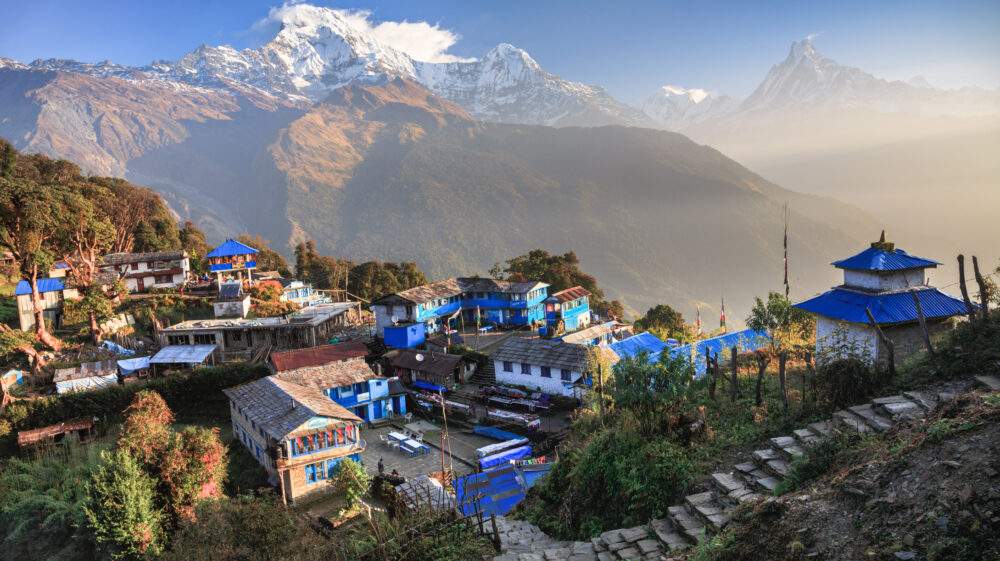
Mariam Devidze, a climate change and biodiversity specialist with the UN Environment Programme, hiked near the Shkhara glacier in Georgia in 2025. Here, she reflects on her experience and the urgency of global climate action and glacier preservation by imagining what the glacier might say if it could speak. Her perspective is part of an occasional series by the Adaptation at Altitude program to mark the UN’s International Year of Glaciers’ Preservation.
I am part of the Caucasus mountain system, the mountainous crossroads of Europe and Asia. Rising 5,203 meters above sea level, I stand among the highest peaks of this magnificent range. My name is Shkhara.
I stand in the Upper Svaneti, in Georgia, homeland of the Svan people, whose language, customs, and traditions have shaped this place for centuries. From here, I can see the brave, defensive towers of Chazhashi/Ushguli village, designated a World Heritage site by the UN Educational, Scientific and Cultural Organization. These towers, and much of what I have witnessed over time, tell the story of a community that has long protected this land – and us, the glaciers and mountains.
In the Svan language, Shkhara, means “nine”. I like my name because it is symbolic: I am crowned by nine beautiful peaks. In tales, my peaks are called Tskhrataviani, the nine-headed giant. Yes, mountains and glaciers can be frightening. We hold power.
An Ushguli village at the foot of Mt. Shkhara, Upper Svaneti, Georgia.
Photo: Alan_Tow.
But we are also givers, I am the source of the Enguri River, one of the region’s most powerful rivers. Its waters sustain communities, ecosystems, and the country’s largest hydropower plant, supplying electricity across Georgia.
We are deeply connected, the Svans and Georgians in general, my sister peaks and I, and the unique biodiversity we host. People come to me from across Georgia and from distant mountain ranges to hike, climb, ski, photograph, and learn. My richness lies in the ecosystem I provide and the life I support. I offer shelter, food and water to vulnerable and rare species: the Caucasian tur, brown bear, chamois, wolf, bearded vulture, Caucasian snowcock, golden eagle, and wallcreeper.
So many depend on me, but our relationship is under strain. Climate change is driving my accelerated melt. My snow and ice, once steady and abundant, are now fragile. Over the last 40 years, I have retreated by roughly 400 meters. Many glaciers in the eastern Caucasus have already vanished. On average, glaciers across the region have lost nearly a quarter of their glacierized area. Recent research comparing mountain ranges worldwide shows that we Caucasus glaciers are among the most sensitive to warming, responding rapidly and dramatically to rising temperatures.
The Shkhara glacier.
All things have life cycles, but I was never meant to disappear. I was meant to provide water and help life thrive. When melting accelerates, peak water discharge brings floods, and people call me and rivers dangerous – and they are accurate. But it is not danger I want to bring. Downstream communities need to adapt and become more resilient to this risk, with the help of those who make laws and decisions.
I want to continue feeding the Enguri River, sustaining communities and wildlife; and showing the beauty of my snow and ice, so people can wander and enjoy my white slopes. But I cannot endure this pace of warming, and Georgia alone cannot save me. That is why I am writing this message to you. I do it on behalf of all Caucasus and other glaciers across the world. I hope that my words can melt your warm human hearts to take action, so that our cold glacier hearts don’t melt.
Mariam Devidze in the Caucuses.
Photo: Courtesy of the author.
Mariam Devidze is a climate change and biodiversity specialist with the UN Environment Programme (UNEP). Working with the Mountain Team at UNEP, she supports mountain communities in the South Caucasus in adapting to the impacts of climate change and strengthening regional mountain governance. She has conducted studies on a range of issues, including the impacts of climate change on women in Georgia, climate-induced migration, and adaptation finance.
The views expressed in this perspective are personal reflections of the author and do not necessarily represent those of UNEP.
This piece was originally published by Adaptation at Altitude.
Program / The Adaptation at Altitude program seeks to help mountain communities adapt to climate change.
Feature / In this feature, Margalita Arabidze discusses the economic benefits of aligning Georgia's climate strategy to international and European standards.
Project / This project is undertaking an analysis of international climate finance flows from 2010–2019 in nine East European countries.
Event on 10 November / In this third CS Co-labs discussion session we will explore what equitable collaboration looks like in Citizen Science projects.