part of The Paris Agreement 10 years later
Start readingSenior Research Fellow Sara Vigil, recalling experiences from the conference where the Paris Agreement was reached 10 years ago, reflects on the disconnect between global climate negotiations and issues that matter to voters.
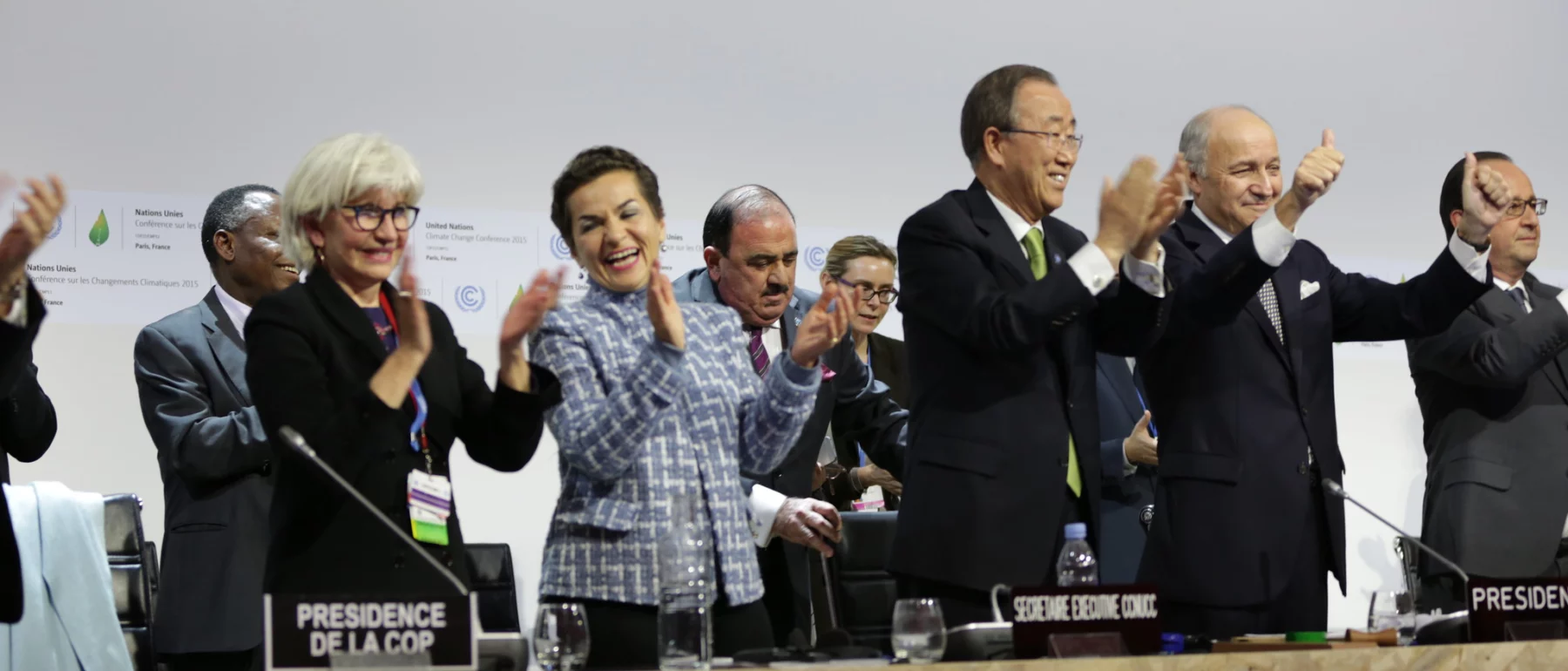
I still remember very vividly the corridors of Le Bourget exhibition centre in Paris in 2015. The long days, the chats with colleagues, and a strange sense that we might be part of something historic. That was my first UN Climate Conference, and I was there as part of the Advisory Group on Climate Change and Human Mobility, advocating for migration to be part of the Paris Agreement. The final day, waiting for the release of the agreement text, was nerve wracking. I remember doing a word search on the final version and finding “displacement related to the adverse impacts of climate change” in the text. But when I searched for human rights, I found it only in the preamble, in a single, cautious line urging parties to “respect, promote and consider their obligations on human rights… including the rights of migrants”. Just a few lines below, the agreement noted “the importance for some of the concept of climate justice”. That phrasing, the caveat of “for some”, stays with me. Even in a moment of global unity, justice was negotiable.
A year later in Marrakech, the mood had shifted. The climate conference felt slick and corporate, lined with fossil-fuel logos at the entrance providing a visual reminder of who still calls the shots. And then, in the middle of the negotiations, came US election night. I remember standing with colleagues, teary eyes fixed on screens, as the winner was announced: Donald Trump, who promised to pull out of the Paris Agreement, had won, an outcome no one there had really expected. In that moment, and more vividly today, I realized how detached the UN climate negotiating process (and many of us around it) had become from the real political pulse of the world. We had been speaking to each other, not to society. This taught me that facts and negotiations alone will never be enough if they don’t connect to people’s real struggles and fears. Each climate conference since has had moments of progress, but the same underlying power dynamics keep reappearing.
Now, 10 years after Paris, the world finds itself in a place many of us once again did not imagine would reemerge – and, perhaps, precisely because the lessons of disconnection between global talks and people’s daily realities were never truly learned. Once more, Trump is President of the US. Once more climate scepticism is in the mainstream. Once more, there is a retreat from multilateralism, and a pull toward isolation and fear. I again see a powerful reminder that climate change is not only an environmental or technical issue but the most political matter of our time. After all, politics will determine whether most of humanity can live on this planet with any sense of justice or stability.
This past decade has made one thing clear to me: the climate crisis is fought not only in negotiation halls or in workshops where we speak to the convinced, but in elections, parliaments, and streets. To win these campaigns, climate work must connect back to the real struggles of everyday people – to the matters that affect their jobs, their homes, their communities, their financial wherewithal, and the capacity for a just transition to deliver for those left behind. Otherwise, there is a vacuum that populists can fill with denial, division, and hate.
Technology will play an important role in delivering solutions, but it cannot fix societal disconnection or distrust. By contrast, technology has so far become a new channel that amplifies these. 2025 should be a wake-up call for anyone who still believes that technocratic optimism can survive without political courage.
The Paris Agreement did change the way the world talks about climate action. It brought all countries to the table and made climate ambition a political expectation rather than a niche issue. It also created a framework that allowed new actors to engage. Those were real achievements. But it’s impossible to ignore the gap between rhetoric and results. Emissions are still rising, and the communities most affected by climate impacts are still the least represented in decisions about their future. This year’s UN Climate Conference in Belém brought the contradictions of the last decade into sharp focus. The Amazon, celebrated as the lungs of the planet, is also a frontier of extraction and new “green” enclosures. Land and green grabs, often justified in the name of climate solutions, are still uprooting the very communities that protect vital ecosystems. These dynamics are not separate from the climate agenda; they are its fault lines. The questions of climate justice in a green transition are basic ones: Who will be displaced? Who will be compensated? Who will profit?
The task ahead is to help people make connections, so that the issues that truly shape their future are the ones that also determine their votes. Our movement must show that the fight for climate justice is inseparable from the fight for safety, for land, for decent work, for wellbeing, and for dignity. In negotiations that so often feel like battles over words, it helps to remember that what’s really at stake is how, and for whom, the world changes.
This is perspective is part of a series by SEI researchers worldwide marking the 10th anniversary of the Paris Agreement by examining the lessons from its first decade and the implications for the next.
Feature / SEI US introduces a new research program focused on climate forecasting and capacity building.
Feature / At the Bangkok Climate Action Week 2026, SEI Asia will showcase research and build pathways for climate action through science, dialogue, and engagement.
Feature / Key messages from the second Joint Steering Committee (JSC) meeting on water-related collaboration between ONWR and SEI Asia on 20 August 2026