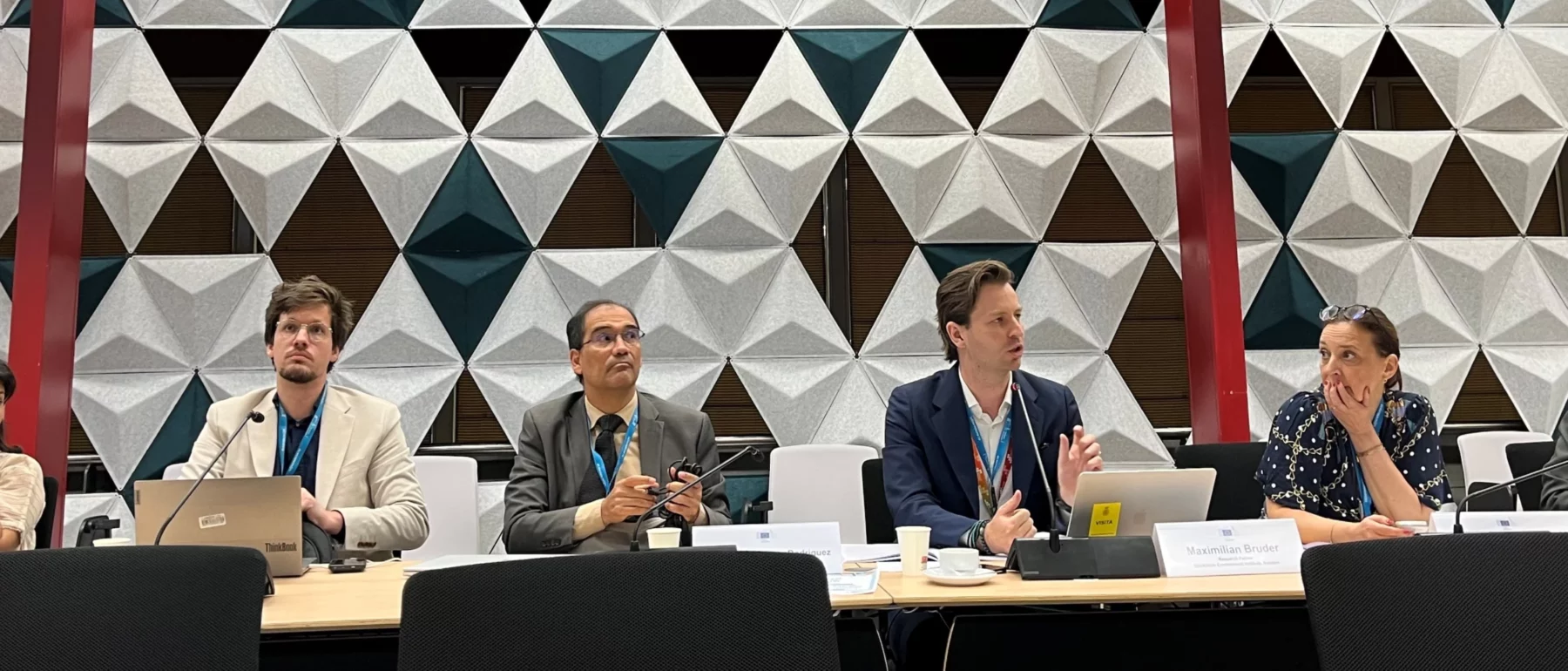
On the heels of the recent international conference on financing for development conference in Seville, SEI’s Maximilian Bruder and Carly Evaeus see a possible blueprint for mobilizing sustainable finance at scale in the face of challenging times.
In late June, more than 15 000 delegates – including more than 60 Heads of State – assembled in Seville, Spain, for the Fourth International Conference on Financing for Development (FfD4). It was, in many respects, an inauspicious time. Heatwaves contributed to the warmest June on record in western Europe. Official development assistance (ODA), already down by 9% in 2024, is expected to plunge by as much as 17% in 2025, according to forecasts by the Organisation for Economic Co-operation and Development (OECD). The global debt crisis has hit an all-time “high,” with an estimated 3.4 billion people now living in countries that spend more on debt servicing than on health or education, according to a new UN Trade and Development (UNCTAD) report.
Against this backdrop – amplified by the official closure of the US Agency for International Development (USAID), and the US’ decision to abandon these once-per-decade negotiations and discussions – the mood might have been expected to be dark.
Instead, pragmatic optimism was in the air. As Deputy UN Secretary-General Amina Mohammed reminded participants, “The show goes on.”
In the run‑up to the conference, negotiators finalized the Compromiso de Sevilla, intended to be the cornerstone of a renewed global framework for financing sustainable development. To put things into historical context, the 2015 Addis Ababa Action Agenda (AAAA) outlined what needed doing. By contrast, the Compromiso focuses more on how. For example, consider these four agreed-upon measures:
Perhaps the most pervasive theme was private finance. There was an emerging consensus that capital is not the bottleneck, but viable, investment-ready projects are. This led to renewed interest in building “pipelines” by using three interlocking enablers:
These points are foundational for us in SEI’s Finance for Sustainable Development Program, which focuses on identifying what works in a specific context – and understanding why. In line with this approach, SEI contributed to a side event hosted by the European Commission’s Joint Research Centre (JRC). At that session, we presented the findings from our recent research, which underlines the complexity of de-risking renewable energy projects in order to make them viable for private finance.
Several points stood out to us. Amid discussions about targeted strategies for mobilizing private capital, there seems to be no shortage of capital itself. The appetite for investing in sustainable development – even in higher-risk, low-income contexts – is real.
At the same time, viable projects are scarce. Competition for these few viable projects is intense – not only among private investors, but also among MDBs and development finance institutions.
The conference moved the climate finance conversation forward, from a generic “climate” category to distinguishing three key areas: mitigation; adaptation; and loss and damage. This specificity matters as each domain demands tailored financing instruments and approaches, each coming with individual challenges and opportunities.
Though interest in Nature-based Solutions (NbS) is growing, many countries and investors struggle to see how biodiversity protection can become investable. That’s why concrete initiatives stand out. Examples include the Tiger Landscapes Investment Fund of the UN Development Programme (UNDP) and the USD 250 million Amazon Guarantee by the Swedish International Development Cooperation Agency (Sida) with the Inter-American Development Bank (IBD). They are early, hopeful signs that nature is slowly starting to find its way into what has long been an elusive finance pipeline.
The Sevilla Platform for Action, devised at the Conference to track more than 130 pledges to deliver tangible finance, will play a part in revealing how these promises play out, but it’s already clear that the path from negotiation halls to real-world impact will be challenging.
We left Seville with a spark of hope and something of a blueprint for how to mobilize sustainable finance where it is needed, and at scale. Times are challenging. But Seville showed us that the sector hasn’t given up.
This perspective was originally published in the International Institute for Sustainable Development SDG Knowledge Hub.
One-SEI program / Our mission is to help accelerate the allocation of capital to sustainable economic activities.
Perspective / SEI's Charlotte Wagner and Jonathan Green highlight an overlooked issue at the 2024 High-Level Political Forum: pollution's impact on small fisheries.
Perspective / SEI's Cleo Verkuijl calls for a comprehensive approach to food system reform that supports climate, public health, animal welfare and ecosystems all at once.
Past event / SSFC is organizing a seminar on climate action in developing countries with sustainable finance specialists, private sector experts and Swedish policymakers.