Swedish public transport leads the sustainable transition, with an early shift to fossil-free fuels, but challenges arise post-pandemic with increased costs and decreased ridership. How can we ensure a successful transition while ensuring increased public transport resilience in the face of disruptions?
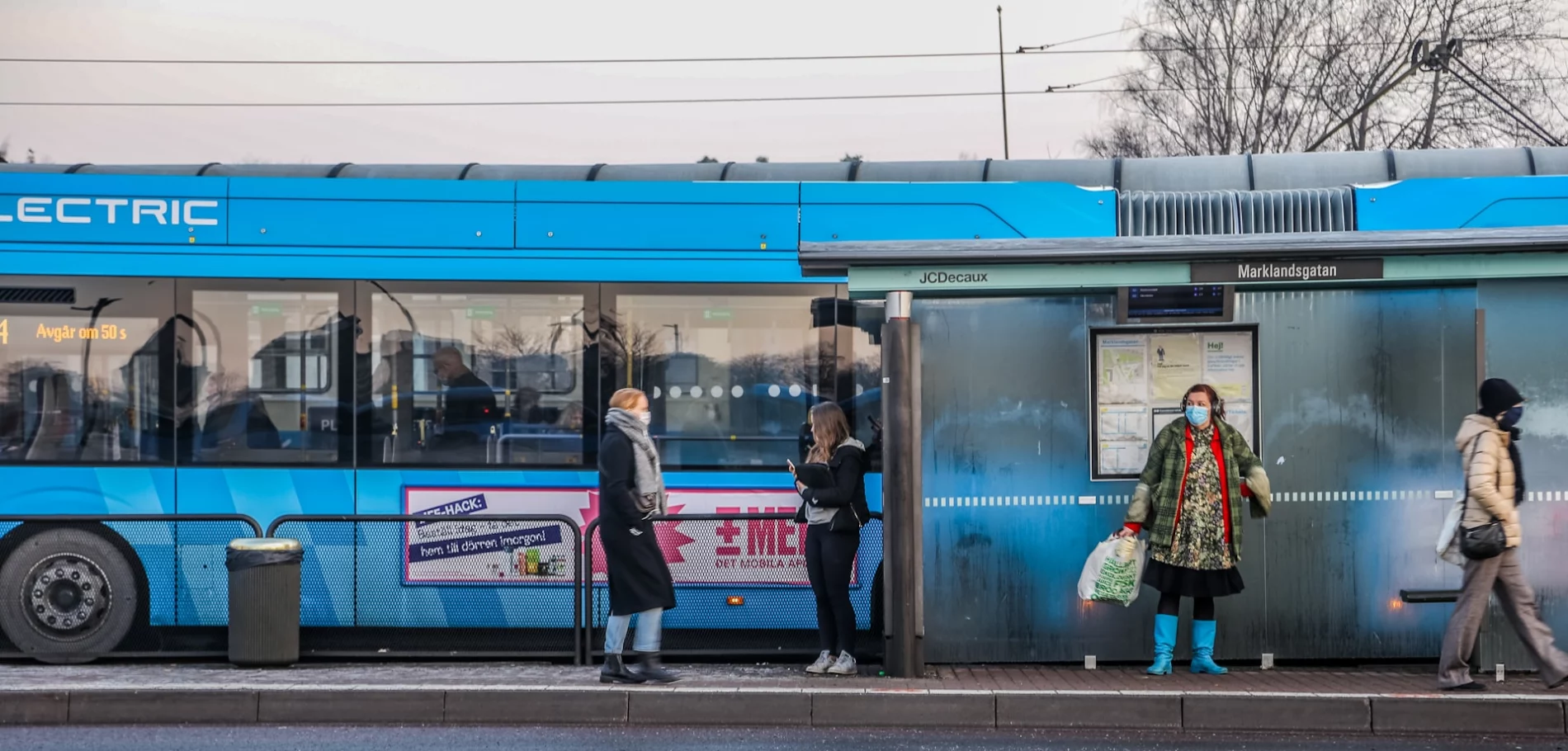
Electric bus at Marklandsgatan bus stop, Gothenburg, Sweden.
Photo: Unsplash / Peter Kellfur.
The public transport sector was among the first to introduce fossil-free fuels in Sweden already in the 90s. Currently, the focus is on electrifying the bus fleet, and the sector’s target of 40% motor-driven trips on public transport by 2030. However, there are challenges to this transition.How can public transport become more resilient to disruptions caused by new technologies and transport habit shifts? This project systematically analyzes resilience aspects in public transport, encompassing both engineering (robustness and adaptability) and socio-ecological resilience (flexibility and agility).
Technological trends like electrification, digitalization, and automation, along with post-pandemic market disruptions, motivates new approaches and knowledge creation. Our research emphasizes the synergies between resilient energy and public transport systems, and engages stakeholders to assess integration risks and benefits. We aim for results relevant to public transport authorities, operators, national agencies, trade organizations, and industry actors invested in sustainable public transport.
We focus on solutions applied in Sweden and around the world, and how regional public transport authorities should develop resilience strategies for services and functions that should be protected as-is, as well as the ones that should be changed as part of a sustainable recovery from disruptions. We also analyze investments to better understand whether historic trajectories are in line with resilience priorities and what changes will be needed under the light of a just energy transition.
More specifically, the following questions are thus central to the research:
The project is funded by the Swedish Energy Agency’s program on sustainable transport systems.
Grant number P2023-01421
SEI collaborates with KTH Royal Institute of Technology, Transport Planning Division.
The project advisory board includes representatives from:
SEI report / This report provides insights and concrete actions to anticipate and mitigate real-world disruptions in electrified bus systems.
One-SEI program / SEI advances fair, inclusive, and low-emission transport solutions worldwide, bridging global insights with local action for a just mobility transition.
SEI report / This report provides insights and concrete actions to anticipate and mitigate real-world disruptions in electrified bus systems.