The authors show that conservation policies in the Brazilian Amazon that have effectively reduced deforestation have failed to address forest degradation, which continues to harm carbon stocks, biodiversity, and ecosystem services. There is an urgent need for more comprehensive public and private policies that target both deforestation and degradation, including threats like fragmentation, fire, and logging, to effectively preserve the Amazon’s ecological health and the livelihoods it supports.
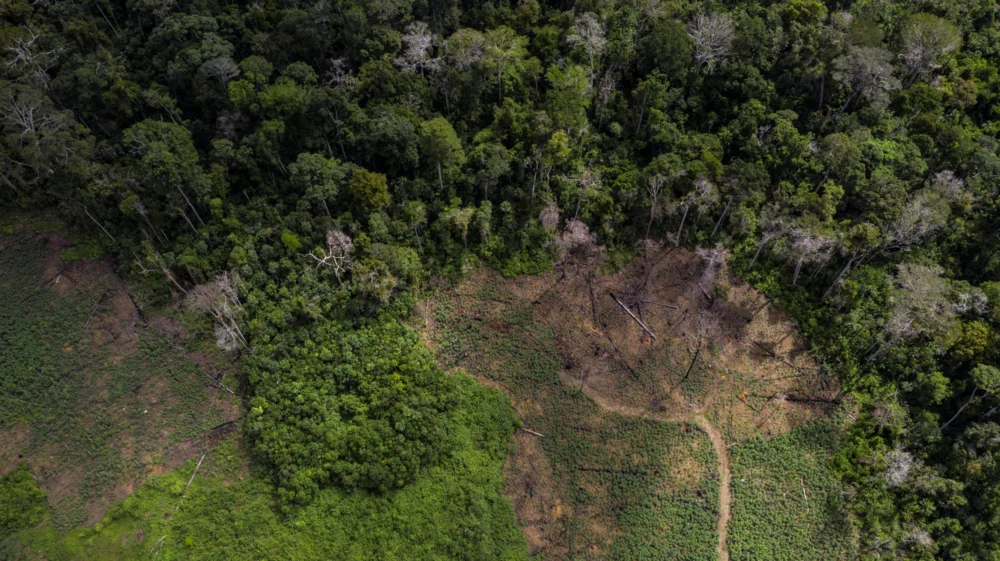
Aerial view of the Amazon rainforest with the front part burned by forest fires
Forest degradation causes large declines in carbon stocks, biodiversity, and ecosystem services, despite leaving some trees standing. Over the past two decades, numerous conservation policies to halt deforestation have been rolled out, but relatively little attention has been paid to tackling degradation. More information is needed to understand how deforestation and degradation are linked and how ongoing efforts to reduce deforestation are impacting degradation. With a focus on the case of the Brazilian Amazon, a place with highly dynamic deforestation, degradation, and policy conditions, the authors examine the effects of four types of deforestation policies on both deforestation and anthropogenic degradation. They find that with very few exceptions, both private supply chain policies and public deforestation policy mixes that successfully reduced deforestation failed to reduce anthropogenic forest degradation. This implies that deforestation control policies alone, which are the dominant approach to the conservation of forests, are insufficient to preserve biodiversity and carbon and safeguard forest-dependent livelihoods. Policy approaches that explicitly address fire, logging, fragmentation, and other degradation drivers are urgently needed to tackle these major gaps in current conservation policy approaches. Government and companies must also include forest degradation emissions in their evaluations of current policy effectiveness toward meeting emission reduction goals.
Journal article / This research explores how cattle ranching shapes the transition from forest frontiers to large-scale agriculture in the Brazilian and Colombian Amazon.
Journal article / This research compares the biodiversity, carbon and cost-effectiveness of forest protection, disturbance avoidance and restoration in the Brazilian Amazon.
Press release / As El Niño intensifies across the Amazon, new research in Science highlights the urgent need to better protect the region’s remaining forests from disturbances.