Stakeholders in Australia, Canada, Italy, the Netherlands and Sweden perceive that current flood governance arrangements fall far short of inclusive ideals.
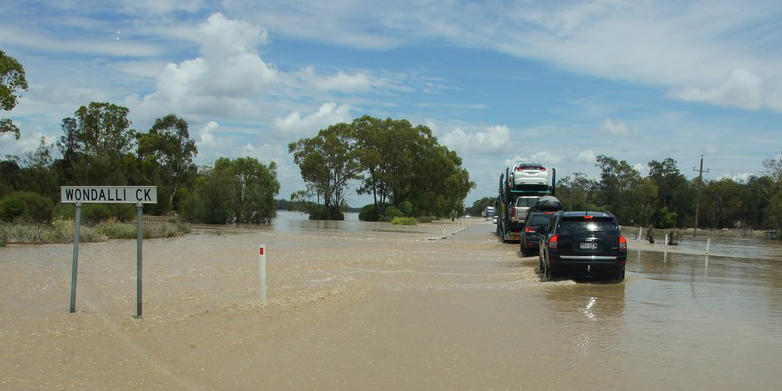
Flooding on the Cunningham Highway, Australia.
Photo: “Flooded road near QLD and NSW boarder” by Tatters ✾, CC BY-NC-ND 2.0
Flooding has extensive impacts on human well-being, economies and ecosystems. Thus, how decisions are made about floods (i.e. flood governance) is extremely important and evidence shows that it is changing, with civil society and the private sector becoming involved in new and sometimes hybrid governance arrangements.
This study investigates how stakeholders perceive floods to be governed and how they believe decision-making ought to occur, with the intent of determining to what extent changing governance is evident on the ground and how well it aligns with desired governance arrangements. Flood governance stakeholders were surveyed in five flood-prone geographical areas in Australia, Canada, Italy, the Netherlands and Sweden.
The findings suggest that a reconfiguration of flood governance is underway with relatively little consensus regarding the specific arrangements and mechanisms in place during this transitionary period. In the five cases, stakeholders indicated that they wanted flood governance to be organized at multiple levels, with strong government involvement and with diverse actor groups, and through mechanisms that match the involvement of these actors. Some specific configurations, particularly involving the private sector, were seen as undesirable.
Stakeholders generally saw current governance systems as a long way from the ideals they described, except for government involvement. Suggested future research directions highlight the importance of including stakeholder perspectives in assessing flood governance, and following the transition in flood governance over time.
Initiative / This initiative seeks to integrate disaster risk reduction (DRR) with equitable, sustainable and resilient development.
Journal article / Using a simulated Swedish food supply network, this research explores how agricultural losses caused by drought affect food distribution and consumer demand.
Journal article / The authors set out four key leverage points for change, and show where citizen science can strengthen plural valuation at each stage.