Blanket bog peatlands are important habitats and ecosystems, but it is often rare to encounter them in good condition in the UK. Management strategies such as rewetting and revegetation have been employed to improve them, but it has not been clear how these efforts have impacted the functioning of blanket bogs. Here, the authors assessed the composition and responses of testate amoebae communities to restoration and investigated their potential as bioindicators of peatland health.
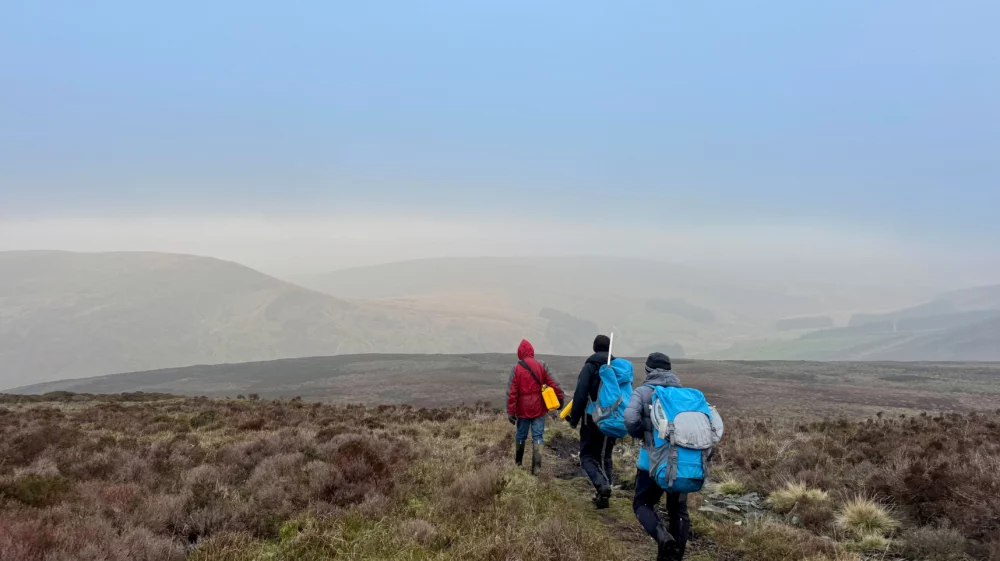
Photo: Tom Holmes / SEI
The research team compared testate amoebae (TA) communities and their functional traits at peatlands sites in varying habitat conditions, including modified, degraded, and intact sites. They examined the TA environmental responses and tested their potential as bioindicators for monitoring hydrological status and ecosystem recovery trajectories.
The study showed that TA communities differ depending on the conditions of their site: soil moisture, Sphagnum moss cover and phosphorous content are all important indicators of what communities may be present at a site. In particular, the overall hydrology of a given site strongly influences which TA communities will be found there. The team also found that TA have distinct response patterns depending on whether they are found in the Sphagnum moss or the peat itself, suggesting that they play different functional roles for carbon uptake, peat decomposition, or silica cycling.
The authors found that rewetting improves the composition of TA communities, which can be linked to ecosystem functions. They emphasized that research into peatland restoration must be considered over the long-term, and a timescale of 10 to 25 years may be needed to identify the full recovery of TA communities and blanket bog functions.
An open access version of this publication is available on the University of York’s Research Database.
Go to the menu on the right-hand side and click the link “Liu et al_SBB_2025_109790” to download.
The research was further supported by the Natural Environment Research Council; the Heather Trust; the Ecological Continuity Trust; Yorkshire Water Services; United Utilities; the Moorland Association; the British Association for Shooting and Conservation, and the Law Family Charitable Foundation.
Project / Through interdisciplinary collaborations between French and English institutions, we aim to better understand how citizen science can foster nature connection.
Feature / Learn how our group has evolved over 18 years to focus on improving best practice in citizen science and inclusive engagement for environmental sustainability.
Journal article / Sampling dominant Sphagnum moss from relatively flat positions in autumn or early winter offers a simple but effective strategy to gather testate amoebae.