Ukraine’s green recovery begins with documenting environmental destruction now, which is essential to pursuing accountability, guiding restoration and supporting sustainable reconstruction.
The environment is often described as the silent victim of war. Russia’s war of aggression against Ukraine is causing environmental damage that is both immediate and long-lasting: forests burned, habitats destroyed, and soil, water and air polluted. Of the immediate impacts visible now, some will persist for generations, including lost biodiversity, contaminated land and degraded ecosystems.
In a presentation to SEI earlier this month, Margot Wallström, former Swedish Minister for Foreign Affairs and former European Commissioner for the Environment, drove this message home. In 2023, President Volodymyr Zelenskyy asked Wallström to co-chair the High-Level Working Group on the Environmental Consequences of the War in Ukraine. The group’s report, An Environmental Compact for Ukraine, set out recommendations for documenting environmental harm, pursuing Russia’s accountability for war-related environmental destruction and alleged ecocide, and embedding sustainability in Ukraine’s reconstruction.
Speaking at SEI, Wallström emphasized that the environmental consequences of the war cannot be left until later. They must be documented and addressed now, as part of Ukraine’s recovery planning and long-term resilience.
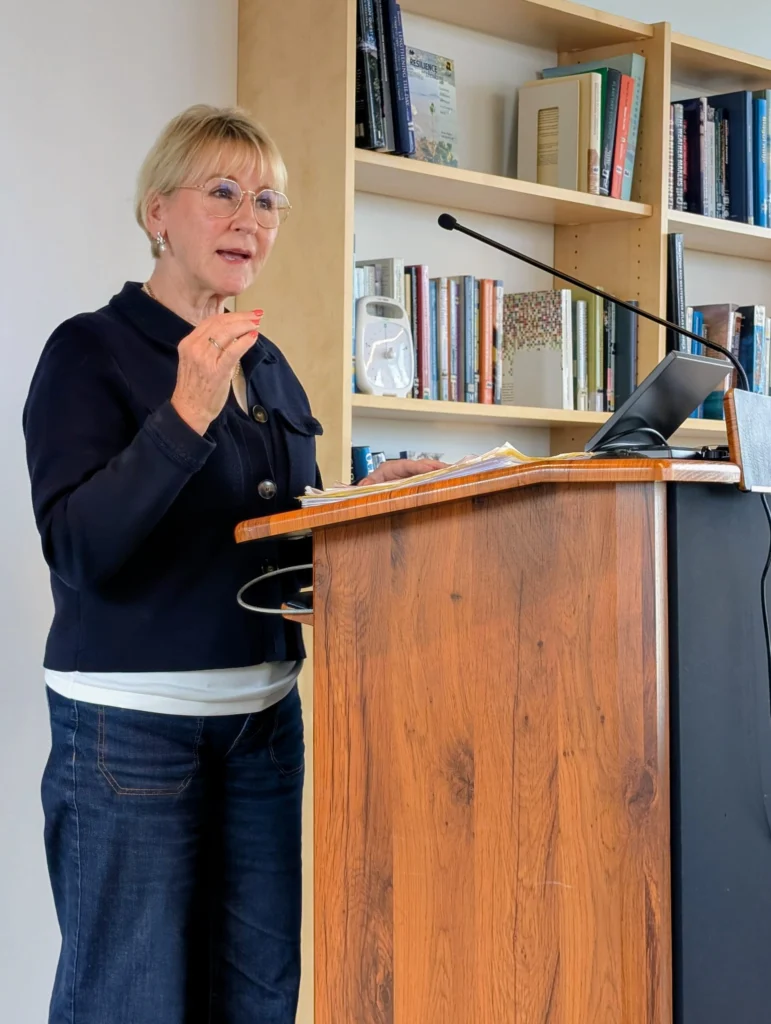
Margot Wallström, former Swedish Minister for Foreign Affairs and former European Commissioner for the Environment, visited SEI headquarters earlier this month. Photo: Jane Birch / SEI
When healthy soils, functioning ecosystems and clean water are destroyed, the consequences reach beyond environmental losses. Ecosystems are central to people’s health, livelihoods and long-term prosperity. Damage to land, water and air is not only an environmental issue; it affects food production, public health, economies both local and beyond national borders, and long-term resilience. This is especially important for Ukraine, where agriculture and food production are central to the national economy and to global food security.
Ukraine is home to around 35% of Europe’s biodiversity. Its forests, wetlands, rivers, fertile black soils and Black Sea ecosystems are of continental importance. The destruction caused by bombing, mining, fires, industrial damage and attacks on critical infrastructure therefore has implications far beyond Ukraine’s borders.
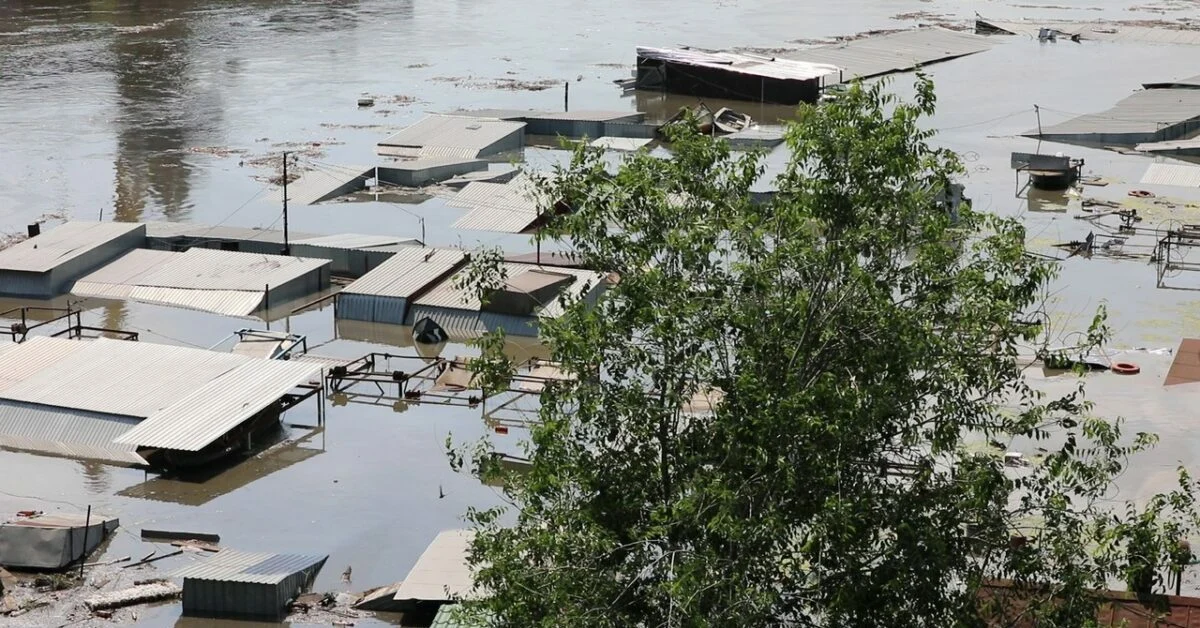
Wallström highlighted the scale of the challenge: destroyed energy and industrial facilities, chemical pollution, landmines, damaged forests and contaminated land. She noted that the breach of the Kakhovka Dam, for example, led to catastrophic flooding; destruction of lives, agriculture and wildlife habitats; and the release of pollutants from soils and water behind the dam – with the prospect of long-term chemical contamination. Some impacts have been immediate, while others will shape Ukraine’s landscape, economy and public health for decades, with implications for Europe as a whole.
A key message from Wallström’s talk was the need to document environmental destruction while the war is still ongoing, and before knowledge of what was lost disappears. Evidence is essential for pursuing Russia’s accountability, including possible future prosecutions related to environmental crimes. But documentation is also needed for practical recovery: Ukraine and its partners must understand the scale, location and nature of environmental harm in order to plan effective restoration.
This requires data, monitoring systems, technical expertise and cooperation between state institutions, researchers, civil society and international partners. Wallström underlined that Ukrainian environmental organizations and local experts often hold crucial knowledge from the ground and must be included in recovery planning – even if they are no longer employed as foresters, environmental monitors or other specialists. Without local expertise, institutional capacity, and environmental data, Ukraine risks losing not only evidence for future justice processes, but also the knowledge needed to rebuild safely and sustainably.
Ukraine has placed war-caused environmental destruction high on the international agenda. The destruction of the Kakhovka Dam has become a powerful example in global discussions about wartime environmental crimes.
One of the most important debates concerns ecocide: intentional severe and widespread damage to the natural environment. Ukraine already recognizes ecocide in national legislation. International law also contains provisions that can apply to severe environmental damage during armed conflict, including under the International Criminal Court’s Rome Statute, which currently does not recognize ecocide as a standalone international crime.
The challenge is not only establishing a legal definition. It also includes having evidence, enforcement, jurisdiction, legal pathways and political will. Wallström stressed that Ukraine’s experience could help shape future international norms so that severe environmental destruction is better recognized, documented and prosecuted, even in the midst of war.
Ukraine is already rebuilding, often immediately after attacks. This creates difficult choices. Fast reconstruction is essential for communities, but every decision about infrastructure, housing, energy, industry and land use also shapes the country’s future.
Demining is a clear example, Wallström noted, where environmental considerations must be built into recovery strategies from the start. Removing mines quickly and inexpensively is essential for safety and recovery, but methods must also protect Ukraine’s valuable soils.
The country’s fertile black soils are one of its greatest economic and ecological assets. They underpin agricultural productivity, rural livelihoods and Ukraine’s role in global food security. Demining approaches that remove or damage fertile topsoil could solve one urgent problem while creating another long-term one.
Wallström argued that reconstruction is an opportunity to build back “greener” and avoid locking Ukraine into outdated, polluting and inefficient systems. A green recovery can support public health, economic competitiveness, energy security and Ukraine’s path toward European Union membership. This is particularly important as Ukraine works to align with EU standards and the European Green Deal.
Green reconstruction can be a foundation for a modern, resilient and competitive Ukraine. International partners can support this by investing not only in visible priorities such as demining equipment, but also the knowledge, monitoring and local capacity needed to make recovery environmentally sound.
SEI’s Ukraine team for the Sida-funded Green Agenda for Armenia, Moldova and Ukraine project highlighted the institute’s engagement in Ukraine during Wallström’s visit to SEI. The project works with Ukraine’s Green Transition Office to support the Ministry of Economy and Environment in developing decarbonization roadmaps for key economic sectors. As part of this effort, it is developing models and tools to help Ukrainian policymakers plan green reconstruction and reforms in line with the country’s EU integration process.
The initiative focuses on sectors that are central to Ukraine’s future, including energy, agriculture, and heavy industry such as iron and steel production. By combining data, modelling and policy analysis, SEI’s Green Agenda project aims to support evidence-based decisions that help Ukraine rebuild in a cleaner, more resilient way, aligned with its European ambitions.
The strong focus on the environment in President Zelenskyy’s Peace Formula sends an important global signal: environmental security is part of peace, justice and recovery. The challenge now is to keep the environment on the agenda – during the war, in future peace discussions, and throughout ongoing and future reconstruction.
Ukraine’s recovery must not simply replace what has been destroyed. It should become a model for how countries rebuild greener and more sustainably after conflict.
As Wallström emphasized during her conversations at SEI earlier this month, protecting Ukraine’s environment also allows the country to protect its people, its economy and its future.
Project / Green Agenda supports Armenia, Moldova and Ukraine in their efforts to achieve climate neutrality through green transition.
Perspective / The war in Ukraine shows that to build resilience, European energy systems must embed local renewables, writes SEI Tallinn Expert Erika Tšerkašina.
Past event / This event brought together EU institutions, member states, and regional stakeholders from the Eastern Partnership (EaP) and Western Balkans countries.
SEI report / Insights into the complex dynamics of EU accession decisions are presented for policymakers, stakeholders and researchers working on the enlargement process.