Mangroves are returning to Montecristi, where an SEI-led living lab is piloting a comprehensive restoration approach. By reopening clogged channels, local community brigades are restoring water flows and reducing the hypersaline conditions that contributed to massive mangrove die-off. “This is really working,” says Robinson Jiménez from the local NGO Agrofrontera as he inspects the coastline where mangroves are again thriving.
The living lab in Montecristi is part of SEI’s Resilient Coasts Caribbean Sea project, which helps local communities test solutions to restore coastal ecosystems in decline. In Montecristi, the main challenge was hypersalinity. The disastrous 2017 hurricanes Irma and Maria wreaked havoc in the area and damaged its natural system for seawater exchange, causing salinity levels to spike and mangroves to die off.
But could the mangroves be brought back? In 2024, the living lab team began testing an ecological restoration approach that works with the mangrove’s natural recovery processes rather than relying on planting alone. The first step was to restore water circulation by reopening channels and reducing hypersaline conditions. In areas where flooding and local topography still make natural regeneration difficult, the team is also creating small, raised mounds, or dispersal centres, where mangrove propagules can settle and establish more easily.
The approach follows principles from the Mangrove Ecological Restoration Guide: Lessons Learned, but has been adapted to Montecristi’s hydrology, landscape, and available resources, with local community brigades directly involved.
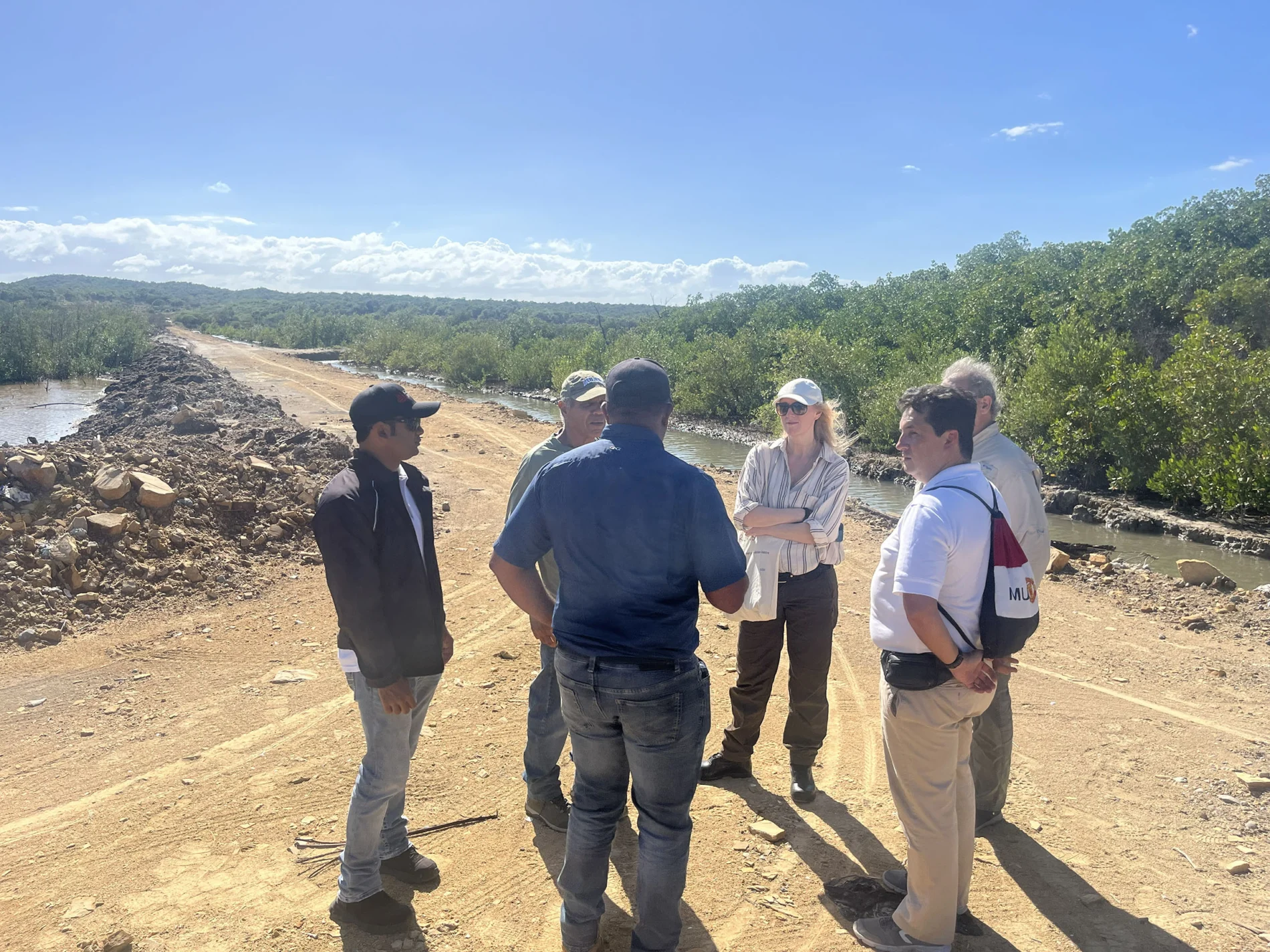
The efforts have worked. A little more than a year after the actual rehabilitation started, new mangrove growth is visible across the coastline. Jiménez and SEI’s Karina Barquet toured the developing mangrove with Jessica Nordström Sikkar from the project’s funder, the Swedish Postcode Lottery Foundation. Strolling through the living lab area, Jiménez points to the mangroves shooting up:
A year ago, there were no mangroves here. But as soon as we managed to bring salinity down, nature responded.
Robinson Jiménez, Agrofrontera
Agrofrontera has carried out most of the fieldwork, together with Instituto Dominicano de Desarrollo Integral (IDDI) and local community brigades. Community members, from crabbers to salt miners, receive practical training through direct participation in restoration activities, enabling them to maintain the channels and contribute to long-term mangrove recovery.
The community involvement and the focus on real solutions are two characteristics that set this project apart, according to Robinson Jiménez. As director of Agrofrontera’s Coastal programme, he is often asked to contribute data to different studies but rarely sees tangible results. “This project is different; it is an actual intervention that addresses the root cause of the problem and benefits the community and ecosystems here. It creates lasting change.”
The living lab at Montecristi has fostered new forms of collaboration among sectors that often have different interests and priorities, including private landowners, salt producers, crabbers, fishers, divers and farmers. By working together to restore water flows and support mangrove recovery, local actors have built new relationships and a shared sense of stewardship for the area. The process is also feeding into the forthcoming Management Plan for El Morro National Park, creating an opportunity for lessons from the living lab to contribute to the long-term protection and governance of the mangrove ecosystem.
Barquet is impressed by the level of community engagement and local knowledge. “Traditional crabbers, salt miners, landowners and other members of the community have played a key role by sharing detailed knowledge of local hydrology and land-use practices. This is essential so that the project can adapt hydrological interventions to local environmental conditions and community needs,” she says.
She believes the living lab approach can help communities, NGOs and researchers work together to test and adapt solutions in real-world conditions. This is crucial in the Caribbean, one of the world’s most climate-vulnerable regions, where mangroves, coral reefs and other coastal ecosystems are under acute strain.
Sikkar agrees. She describes it as incredibly valuable for her as a funder to visit Montecristi and see the results first-hand:
Meeting the local partners and communities behind this work demonstrated the strength of the living lab approach, where practical solutions are developed and tested in real-world conditions. It is especially encouraging to see how these lessons can also inform and strengthen similar efforts in other parts of the Dominican Republic and the wider Caribbean.
Jessica Nordström Sikkar, Swedish Postcode Lottery Foundation
Members of the team assess the impact of the Living Lab in Montecristi.
Project / The Resilient Coasts Caribbean Sea project operates "living labs" for coastal ecosystem management using nature-based solutions.
Past event / The SEI-hosted Adaptation Research Alliance, with support from SEI Africa, will host the workshop to connect adaptation research with policy and practice.
Feature / The coral reef in Varadero, Colombia, offers a striking lesson in resilience and is home to a SEI-led living lab.
Feature / Resilient Coasts – Caribbean Sea has officially been endorsed as a Decade Action under the UN Decade of Ocean Science for Sustainable Development.