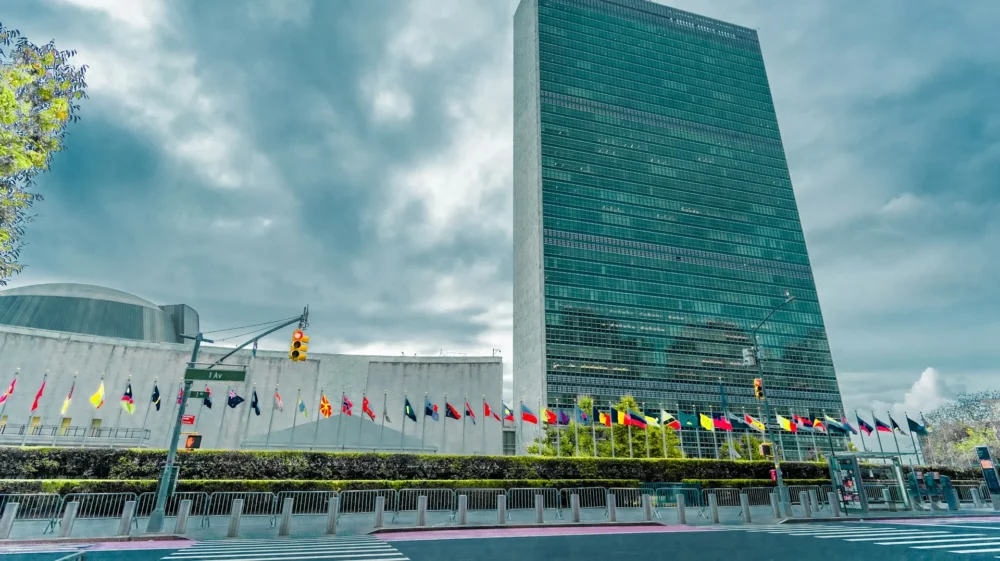
How do we address increasingly urgent sustainability challenges effectively in times of rising geopolitical insecurity? On 4 February, the Geopolitics of Sustainability conference will explore strategies to tackle some of these challenges.
The Earth, geopolitical connections in Europe.
How can we ensure global food security and just transition with rising threats like climate change and geopolitical turmoil? What will the current political shift in the US mean for international efforts to combat climate change?
On 4 February, the Mistra Geopolitics research programme will host distinguished national and international thought leaders and academics in Stockholm, Sweden. We will discuss how we can collectively navigate towards a more secure and sustainable future.
The conference will include discussions on the following thematic areas:
The conference is organized by Mistra Geopolitics and marks the conclusion of its eight-year research programme, which has involved contributions from over 60 researchers. The conference will end with a PhD poster exhibition and a reception.
Time: 4 February, 10:00- 17:00 followed by a poster exhibition and a reception.
Registration: The conference is by invitation only and held in-person in Stockholm. The registration is now closed. If you wish to be added to the waiting list, please send an email to [email protected].
Ylva Rylander, Press Contact for Mistra Geopolitics, Stockholm Environment Institute
[email protected], +46 (0) 73 150 3384
Maria Cole, Communications Lead for Mistra Geopolitics, Stockholm Environment Institute
[email protected], +46 (0) 70 224 2022
Mistra Geopolitics examines the interactions between environmental change, geopolitics and human security. The research programme brings together an interdisciplinary team of eight consortium partners: Stockholm Environment Institute (SEI), Stockholm International Peace Research Institute (SIPRI), the Universities of Linköping, Lund, Stockholm, and Uppsala, and the think tanks E3G and Adelphi.
The programme is hosted by SEI and funded by Mistra, the Swedish foundation for strategic environmental research.
Project / This project aims to critically examine how the dynamics of geopolitics, human security and global environmental change interrelate.
Press release / A new report, by SEI and Mistra Geopolitics, shows that climate change, geopolitical tensions and geoeconomic division are posing risks to food security.
Feature / Björn-Ola Linnér, Director of Mistra Geopolitics and Professor at Linköping University, has been appointed as an expert to the UN's Human Security Colloquium.
Other publication / The policy brief highlights the increasing security, environmental, and geopolitical threats facing marine infrastructure in the Baltic Sea region.