part of Systematic evidence synthesis
Graphic: Science Europe
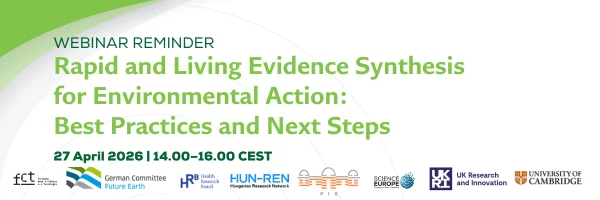
This webinar builds on an earlier exploratory webinar, which took place in June 2025, addressing the potential use of rapid and living evidence synthesis approaches in environmental research. It will continue the discussion, aiming to identify lessons and ways forward for research organisations. The first panel will serve to showcase the latest developments in rapid and living evidence synthesis, with a focus on relevant projects and initiatives. The second panel will discuss the implications for research funding and performing organisations, as well as policy-makers.
The world is facing an increasingly narrow window of opportunity to address the climate crisis and ensure climate-resilient development. To identify the development pathways, scientific evidence is needed. Rapid and living evidence synthesis approaches offer an opportunity to synthesise and deliver scientific evidence to end users in a faster, more concise and responsive manner. While these methodologies have certain limitations, they can potentially improve science-policy interfaces, facilitate uptake of scientific evidence in practice, and help identify gaps in existing scientific knowledge as well as avenues of future scientific collaboration. As such, they can be useful to research performing and research funding organisations, policy makers, and other end users of scientific knowledge, such as businesses.
The use of rapid and living evidence synthesis is growing across disciplines. These approaches have been especially popular in care and healthcare; however, they are also being used in the fields of education, built environment, crime studies, climate and environmental science, among others. The capacity to provide scientifically sound analysis on a shorter time scale is arguably all the more important now, when Large Language Models (AI) are being widely used to search for information. AI-powered and scientifically sound evidence synthesis can assist with exploiting the exponentially growing scientific literature more fully.
This webinar forms part of a planned series of three interlinked workshops building on the Guidance on Science for Policy Activities published by Science Europe in April 2024. Together, the workshops will explore innovative approaches to strengthening the science–policy interface, including how research can be more effectively embedded in policy making, how values-based and independent scientific engagement can be supported, and how institutional cultures, governance models, and emerging issues such as the use of artificial intelligence shape the production, validation, and use of evidence.
Within this broader framework, the present workshop focuses specifically on rapid and living evidence synthesis as a practical tool for improving the timely, credible, and accessible use of scientific knowledge in environmental decision-making. It aims to discuss best practices, identify both opportunities and constraints faced by research funding and performing organisations, and discuss the use of rapid/living evidence with policy-makers.
This webinar is co-organised by the Foundation for Science and Technology (FCT); German Committee Future Earth (DKN); Health Research Board (HRB) of Ireland; Hungarian Research Network (HUN-REN); Potsdam Institute for Climate Impacts Research (PIK); UK Research and Innovation (UKRI); University of Cambridge, and Science Europe.
Join the webinar on 27 April 2026, from 14:00 to 16:00 CEST, where experts will share insights on effective environmental action through research.

Journal article / This research examines how the Folke Bernadotte Academy navigates competing demands for accountability and adaptive partner-oriented practices in peacebuilding.
Perspective / Asia’s next financial revolution must make climate adaptation finance accessible to vulnerable households and small businesses.
Event on 20 October in Dublin / At the Global Bioeconomy Summit 2026, SEI’s Francis X. Johnson joins a workshop on how regional networks can turn bioeconomy innovation into impact.