As Eeva Primmer takes on the role of Executive Director at SEI, we spoke with her about her background, priorities and perspectives on the role of science in a changing world.
You’re joining SEI at an important moment. What drew you to the role?
SEI is an agile organization that combines global and local analyses, and that operates as a knowledge generator and broker rather than an advocate. That approach – collaborative, research-based, working across sectors – is how I want to work to advance sustainability. Other approaches, including more legalistic or antagonistic ones, are certainly also needed, but mine is to build evidence-based solutions with people. That competence is needed now more than ever.
My strength lies in connecting research and practice, and the communication and leadership that bridging requires. Coming from research, and from years of intensive engagement with science-policy platforms like IPBES, the Intergovernmental Science-Policy Platform on Biodiversity and Ecosystem Services, and IRP, the International Resource Panel, I bring relevant science-policy experience. At SEI I’m excited to combine the global work with my own research background and passion, which comes mostly from Europe. I’m an environmental governance and policy researcher with a keen interest in the empirical analysis of policy implementation.
There’s also a personal pull. I grew up on a farm in Southern Finland, and I lived in Zambia between 1978 and 1980 when my father was working there on a cattle project. Those early connections to ecosystems, and to people, in very different contexts have shaped how I think about sustainability.
The timing works for me personally too. My two adult children have found their professional paths in different countries, and my husband and I are used to co-existing in different countries – we’ve done the boat trip across the Baltic Sea between Sweden and Finland tens of times already, going back to when we were students in the 1990s.
Eeva (right) with her siblings, Zambia, 1980.
Photo: Kirsti Anttila.
You’ve mentioned that many foundational principles around science and cooperation are being tested. Could you expand on that?
There’s a paradox in the current moment. It’s very important to be able to explain where research findings come from, how models work, how evidence accumulates – and yet public debate increasingly rewards simplification and emotional shortcuts that boil down to identities and groupings. You can see this in environmental policy debates and in many other debates that intersect science and people’s lives, from energy to food systems.
This is a real challenge for SEI, because simplification – done well – is also a precondition for transparency and for public understanding of what sustainable solutions actually require. We have to do that hard work without falling into the shortcuts.
For scientists and experts working on issues that involve people and the natural world, it should be self-evident that values underpin our professional choices. As inter-disciplinary and trans-disciplinary professionals, we can understand and manage the division between what is known and what is important – facts and values. At SEI we are also analysts of how facts and values connect, operate and take new forms. Combining integrity with genuine devotion to the work can be a particular asset for SEI, but it needs to be actively nurtured.
SEI is well placed to support this kind of bridging – connecting isolated discussions, and bringing methods of accessible language, facilitation and deliberation across sectors, geographies and political contexts.
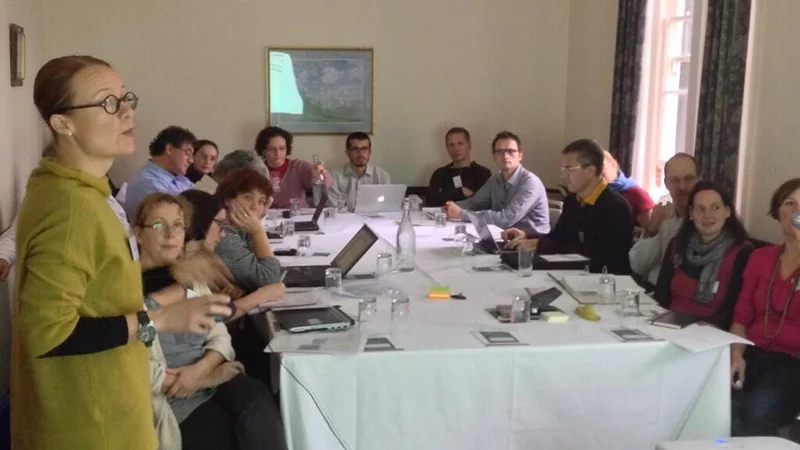
Facilitating a discussion at an OpenNESS project meeting, Loch Leven, 2014.
Photo: Allan Watt.
How do you see the role of science in policymaking today?
Our understanding of environmental crises is entirely dependent on science. Without sustained investment in research infrastructure and data collection, or in analytical capacity and global collaboration, we wouldn’t understand many phenomena that seem almost common knowledge today. We can thank science for unravelling why weather patterns are changing, why air is dirtier or cleaner in cities, or why water turns green and fish die far from any obvious industrial source. Almost everyone now knows that the climate is changing, that coal-based energy is particle-rich, and that mining and agriculture pollute waters.
Research has also built the evidence base used to control environmental damage in ways that are socially acceptable. At its best, evidence is used to develop policies that serve people and the environment, and that allow – even encourage – businesses to change their practices and innovate for resource efficiency, social cohesion and ecosystem resilience faster than their competitors. At their best, entire green innovation ecosystems can spill over good ideas about how sustainable solutions are developed, scaled and adapted to new needs. Such policies build on existing governance, and where windows of opportunity emerge, they can transform whole systems. We saw such evidence-based, policy-driven shifts during and after Covid-19, and again in response to the energy and material shortages driven by war.
But in a world where people’s immediate needs are used as a lever for quick political and commercial wins, attention can shift to defending existing industries and lifestyles instead of building new ones. The use of evidence can recede precisely when knowledge production and experimentation are needed most.
So how does research adapt to deliver in those conditions?
My view is that it requires more dialogue, iteration and co-creation between the producers and users of knowledge. Research needs to offer solutions – and parts of solutions – and work with willing forerunners across industry, policy and politics. That requires agility and new alliances, and it’s an area where SEI is particularly well placed given its strong partnering approach.
Sustainability, for me, isn’t an optimization problem with a single target. It’s a broad path – a wide pipeline with clear directionality and boundaries for a safe operating space – within which we have to actively search for innovative ways to advance. Science plays a key role in evaluating which dimensions of sustainability are advancing and how much.
SEI’s approaches support that kind of advancement in concrete ways. We connect sectors that address the same goals – aligning minerals and energy, or food and water management, with climate mitigation and adaptation targets. Our modelling-based, practice-supporting tools integrate different sustainability goals and are used to test and develop activities that can deliver against them. SEI’s mode of working is at the forefront of bridging theory, global analysis and specific real-world settings, supported by clear messaging and impact stories that make the theory of change visible.
You bring experience from science-policy processes, including IPBES. How does that shape your approach?
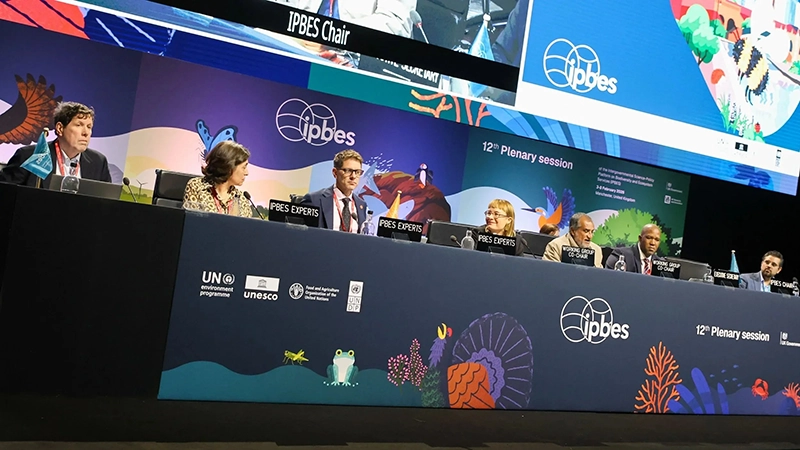
In February this year, I co-chaired the working group that addressed the summary for policymakers of the Business and Biodiversity Assessment at the 12th Plenary of IPBES in Manchester. Staying true to what science says while accommodating member countries’ deliberated ways of expressing those messages requires a real willingness to collaborate – and facilitating that kind of collective action is something I genuinely love. It captured for me what science-policy work is at its best
IPBES is the most formal of the science-policy roles I’ve held, alongside national and EU-level work and the International Resource Panel under UNEP. As an IPBES Bureau Member I represent the Western Europe and Other Countries group, overseeing processes and co-chairing the working groups that deliberate on the assessment summaries for policymakers.
What strikes me about these processes is how much they depend on a particular kind of trust. Scientists lead the consolidation of what evidence can tell us about biodiversity, or climate or transformative change. Governments frame the questions, review the work, and approve the outcomes. That programmed structure adds transparency and gives societal actors a way to orient and prepare for turning the accumulating knowledge into practice.
It’s a wonderful demonstration of how science and policy each play their roles and come together. That experience shapes how I think about SEI’s work: the value of patient, structured collaboration, and the importance of holding the line on what evidence says, yet leaving room for the deliberation that turns evidence into action.
Co-chairing the Business and Biodiversity Assessment working group at the 12th Plenary of IPBES in Manchester, February 2026.
Photo: Anastasia Rodopoulou / IISD ENB.
What kind of leadership approach do you bring to SEI?
The leadership approach SEI has had matches my own well. I describe my style as engaging, transparent and directional.
Engagement, as we know well at SEI, requires processes that invite new ways of thinking and that have set points where ideas are consolidated into action. That’s an exciting challenge for a distributed organization.
Transparency means more than rules and procedures being clear and accessible. It means clarity, coaching and guidance, and open sharing of information – which together bring predictability and a structure for operational work.
By directionality I mean that our purpose and strategic emphases are shared, and our theory of change is actively deployed to generate impact. That’s where the challenges and opportunities of project-based work really live.
I tend to lead motivationally and to manage change positively, and that should be useful in the turbulent times we’re in – times that are testing evidence-based sustainability policy. I’ll lead SEI to actively seek new ways to partner with those looking for research-based solutions, and to maintain high integrity in unfamiliar situations. I’m really looking forward to working with our SEI staff and with all our current and future partners.
Finally, what gives you optimism looking ahead?
A lot of knowledge and a lot of sustainable solutions already exist. The real work now is replicating successful experiments, co-developing locally adapted solutions, and scaling up – the kind of work SEI is genuinely good at.
Where we have particularly much to give is in policy implementation. The processes of setting environmental targets and monitoring systems need to be backed up by thorough analysis of how implementation actually unfolds: how different societal actors take up new roles, how they learn, adapt and change. To design policies based on incentives, information and regulation, we need to understand how the mechanisms of attracting, appealing and enforcing actually work in practice.
And optimism needs collaboration. With well-organized dialogue and continued iteration, even difficult issues become workable, because mutual understanding and trust can be built. That’s what makes me optimistic.
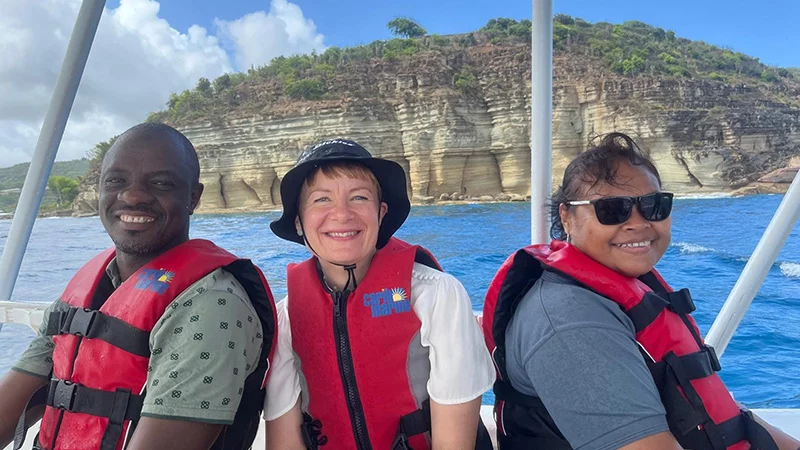
With Mohamed Alass Sylla (Guinea) and Ilima Kloulchad (Palau), at an IPBES capacity-building meeting, Antigua, 2025.
Photo: Ingunn Storrø.
Feature / SEI welcomes Eeva Primmer as Executive Director, bringing decades of leadership at the science–policy interface.
SEI annual report / Across a changing global landscape, SEI delivers knowledge and solutions to drive sustainable development forward.
Perspective / Flooding in Bangkok in late September exposed a critical gap: forecasts identified the threat days in advance, warnings and preparedness did not translate fast.