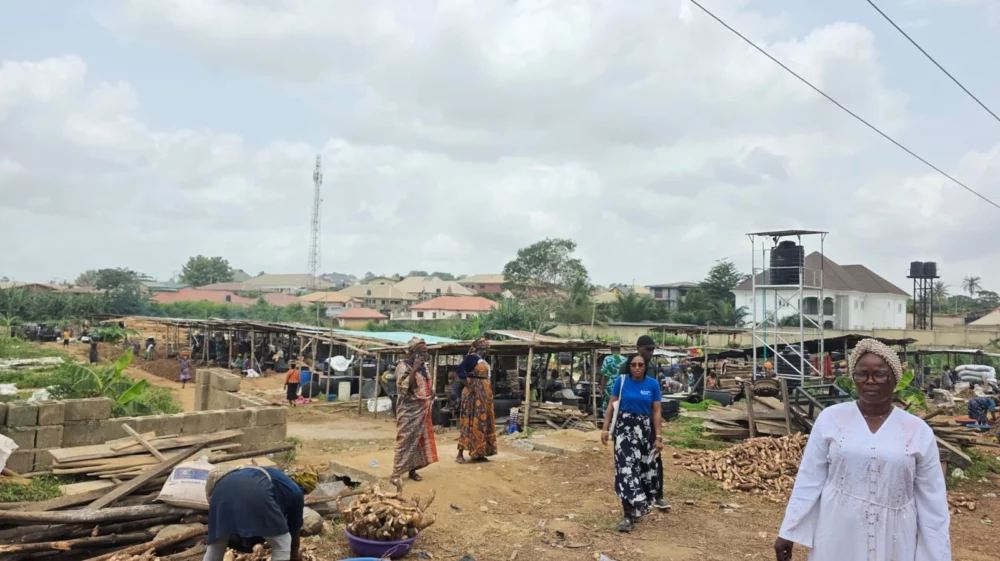
In May 2025, SEI researchers Annette Huber-Lee and Guillaume Bouchard, along with other US and Africa researchers, played a leading role in the SustainFood Collaborative Learning School (CLS) in Nigeria. The program aims to facilitate connections between early-career researchers from Africa and the US, emphasizing hands-on experiences in community resource planning, policy analysis and local engagement.
More than 342 million people in Africa lived in food-insecure conditions in 2023, according to the UN Food and Agricultural Organization. Farmers in rural regions lack resources and education to adequately improve their practices, causing them to fall further behind.
On the other hand, postgraduate enrollment in the region has more than tripled between the years 2005 and 2020. Students with the resources and education are willing to help their communities while learning practical ways to apply their education.
To link scholars with struggling farmers, SEI, Michigan State University and Penn State University created the Collaborative Learning School (CLS) as an effort to support early-career researchers in African regions and the US as well as to bridge farmers with decision-makers and to improve food security.
The goal of the CLS is to build a network of networks among early-career researchers who study the water, energy and food nexus, or the interdependencies between these resources. The project is part of SustainFood: Zero Hunger for Africa, which is a collaboration between Africa, Europe and the US with the goal of connecting science and policy networks to achieve zero hunger in Africa. The idea of the CLS originated with SEI researcher Annette Huber-Lee brainstorming with Michigan State University professor Laura Schmitt Olabisi.
It’s a very ambitious concept.
Annette Huber-Lee, SEI senior scientist
“It’s a very ambitious concept,” Huber-Lee says. “It requires the early-career researchers to learn and then lead workshops with farmers and policymakers using a variety of complex techniques quickly.”
Their vision of this project was to support mitigating food insecurity challenges faced by African farmers, while engaging with policymakers at different levels by hosting annual workshops including as many early-career researchers as possible.
The recent CLS was held in Oyo State, Nigeria and hosted by the International Institute of Tropical Agriculture, with the help of University of Ibadan professors Olushola Fadairo and Adelakun Olufolake Eunice. About 20 participants composed of recent Ph.D. graduates and graduate students – mostly from Nigeria and across Africa – were selected at the end of January.
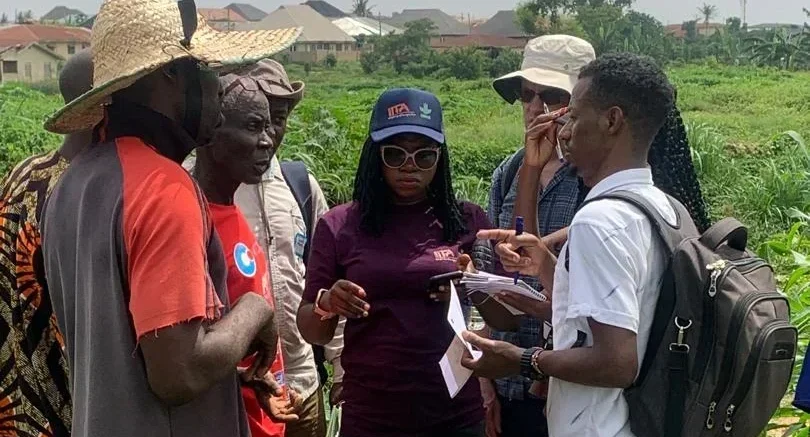
At the collaborative learning school workshop held in May, the early-career researchers were broken up into several groups. From waste management to market access, each group independently analysed a specific food access challenge. After discussing their findings, they met with a group of 20 decision-makers, including representatives from Oyo State and the Ona Ara local government area, and presented their findings.
In the next workshop, they discussed a wide variety of improvement strategies, such as putting educational and legal material in the local language of Yoruba and on the radio for those unable to read, as well as helping farmers with budgeting and loan applications. In the joint meeting, they worked through a vision of how policymakers could help farmers improve their practices as well as understand their challenges.
Subsequently, when SEI researchers checked in with the policymakers, they were already invested and were more than willing to support these improvements. Through the experience, they also learned about WEAP and LEAP, SEI’s flagship environmental modelling tools that support water and energy resource planning.
Dr. Oluwaseun Tosin Bamigboye, Andrew Akpose and Dr. Joseph Paul Omaye present their findings to the group at the 2025 Collaborative Learning School in Nigeria.
Photo: Annette Huber-Lee / SEI
As the only non-university institution on this US government-funded project, SEI brings a unique capacity-building angle to the project. Unlike typical Ph.D. programs, the CLS allows for a focus on policy engagement skills undervalued in graduate education, says SEI Analyst Guillaume Bouchard. The collaborative school gives the early-career researchers an opportunity to learn these skills and allows them to build confidence in bridging science and policy – the ultimate mission at SEI.
To date, there have been two separate collaborative learning workshops hosted in Africa: this year’s effort in Nigeria and one in Uganda in 2023. For the Nigeria CLS, SEI researchers travelled to the region before the main events. This allowed the team to host a one-week in-person preparatory workshop before the main CLS program, where the early-career researchers and the policymakers could meet each other and learn about WEAP and LEAP. In addition to the in-person workshops, there were also several weekly two-hour webinars between cohort selection and the main CLS event.
“Having the pre-CLS workshop really helped us build group cohesion prior to the main event,” Bouchard says.
In post-workshop surveys and interviews, early-career researchers expressed that the program allowed them to engage in hands-on learning combining theory and practice. Many of them were able to build strong professional relationships in just a few weeks while broadening their perspectives across engineering, social sciences, and other fields.
“This CLS overall was a transformative experience. It filled the gap of linking policymakers and farmers,” noted one participant in a survey response. Another researcher recalled how “meeting people from diverse places and building connections was a highlight.”
Early-career researchers lead policymakers in a problem formulation workshop.
Photo: Annette Huber-Lee / SEI
The CLS experience, however, extends beyond the pre-CLS workshops and the three main weeks in Africa. All participating early-career researchers become part of a larger network of previous CLS cohorts across the US and Africa. Virtual follow-up workshops promote continued engagement between participants.
As for the SEI team, each run of the CLS is a chance to evaluate and make improvements to the program. Answers from post-workshop interviews, conducted over Zoom, gave researchers insights on what worked during the workshop and what to improve. For example, participants also expressed overwhelming interest in a longer CLS, so that they would have more time to bond with farmers, policymakers, and other participants.
Each iteration so far has become richer and more effective. We’ve learned some integral lessons along the way that was able to make the recent [CLS] in Ibadan extraordinary.
Annette Huber-Lee, SEI senior scientist
“Each iteration so far has become richer and more effective,” Huber-Lee says. “We’ve learned some integral lessons along the way that was able to make the recent [CLS] in Ibadan extraordinary.”
Currently, the team looks to continue organizing CLS workshops in Africa. One possible location is Kenya, where the SEI Africa office is located, which would allow for increased support from local researchers and staff for the event.
Learn more about the program at: https://sustainfood.psu.edu/
SEI report / Farmer field schools offer an effective framework to promote agricultural sustainability, empower farmers and strengthen community resilience in Uganda.
Tool / The Water Evaluation and Adaptation Planning tool (WEAP) provides a comprehensive and user-friendly framework for policy analysis in water resources planning.
Tool / The Low Emissions Analysis Platform (LEAP) is a powerful, versatile system for energy planning and climate change mitigation assessment.
SEI brief / This brief examines how improving information exchange may help cassava processors in Nigeria can help them address the water and energy challenges they face.
SEI report / Farmer field schools offer an effective framework to promote agricultural sustainability, empower farmers and strengthen community resilience in Uganda.
SEI brief / This brief examines how interest-free cooperatives can help Nigerian smallholders address climate and sustainability challenges.