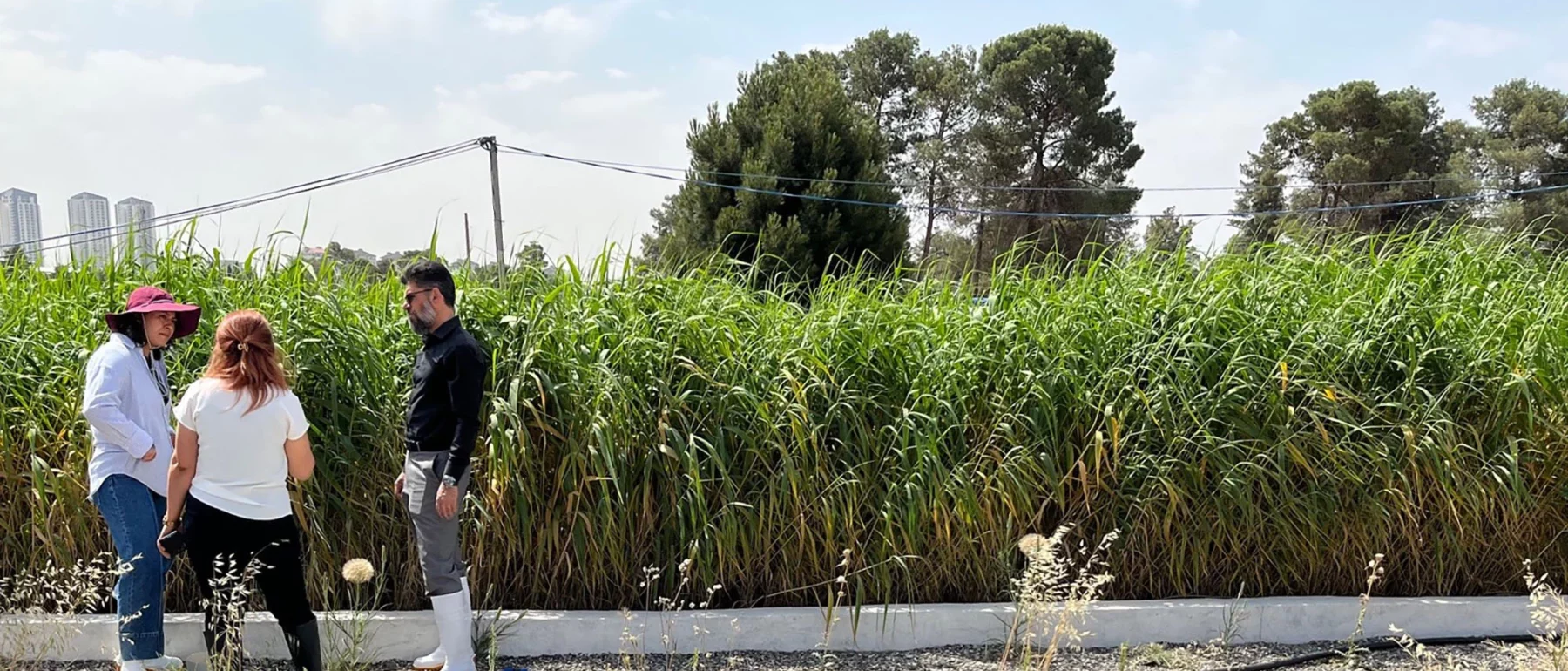
SEI sanitation and water resource management experts have been active in Iraq over the past year in the Water Innovation for Circularity and Enhanced Resilience (WICER) project. As the project comes to a close this month, they answer a few questions.
SEI experts who have been part of the WICER project focused on innovative, circular approaches for improving water management in Iraq. The goal is to enhance the country’s resilience to water scarcity and climate change.
At last month’s Fifth Baghdad International Water Conference, SEI co-organized two sessions:
This week, the project hosted partners and interested stakeholders for a closing event that showcased results and elicited feedback from participants. We asked several of the project researchers to respond to questions as the project comes to a close.
Highlight some of the challenges Iraq is facing regarding water, sanitation and agriculture and in the context of climate change.
Linus Dagerskog: Iraq is grappling with an interconnected crisis of water scarcity, poor sanitation and vulnerable agriculture. Upstream damming, climate change and pollution have severely reduced the flow and quality of the country’s rivers. Although most Iraqis have access to basic sanitation facilities, only 30% are connected to sewers, while the rest use cesspits or pit latrines. Untreated wastewater often ends up in rivers, often re-entering the food system through indirect reuse when river water is used for irrigation, exposing farmers, nearby communities and the consumers of the crops to health risks.
The nutrients from agriculture and sanitation waste end up in the river – nitrogen, phosphorus – as well as from animal waste that also runs off to the river. This risks impacting aquatic ecosystems through eutrophication. The water also has high levels of salinization, which diminishes crop yields and leads to soil degradation.
What would Iraq need to do to be resilient in the context of climate change, in relation to water resources?
Annette Huber-Lee: The country needs to have a better understanding of what water resources they have under a changing climate – which is not possible if they don’t have models that can capture both the effects of climate change on water availability and on water demands that will shift with climate as well. We collaboratively built two models – using SWAT and WEAP – which can model both the detailed hydrology and impacts of climate change, and the impacts on humans, on economic activities such as agriculture and industry, and on ecosystems. Scenarios are used to explore policy and infrastructure development to find more resilient solutions under deep uncertainty. Here, innovative solutions such as constructed wetlands and other nature-based solutions can generate multiple benefits, such as safe wastewater reuse irrigation and buffering of heavy rains.
How can Iraq leverage the potential of circularity practices within sanitation and agriculture?
Huber-Lee: More circularity practices could increase the resilience of water for Iraq. These could range from the reuse of treated wastewater for agriculture, which would have the double benefit of ensuring the treatment of wastewater, as well as a reliable source of water for agriculture.
Dagerskog: The organic matter and nutrient resources in animal and human waste are also significant. Organic matter can increase water holding capacity of the soil, and we estimated the available nutrients in manure and wastewater in Iraq to surpass the quantity today applied as chemical fertilizer.
What is Iraq (through the Ministry of Water Resources) currently doing to tackle these challenges?
Huber-Lee: Quite a bit. They are prioritizing resilience to climate change and actively pursuing ways to achieve that through the co-production of the SWAT and WEAP model. We are just at the beginning stages of developing scenarios that would allow them to explore what combination of policies and infrastructure could provide the most resilient future for Iraq.
Part of that includes nature-based solutions and procuring these solutions. And they are actively seeking training to enhance their local capacity. They are asking me and our team for more training on WEAP and SWAT, and that will help them build understanding of their local resources.
Carla Liera: Overall the government is adding these activities to their national adaptation plans for the Paris Agreement for climate change, and at our event yesterday, other partners said they are supporting this work.
What concrete actions are needed to increase water resilience in Iraq?
Huber-Lee: There are actions that Iraq can take locally, particularly around reuse of treated wastewater and nature-based solutions. Given that they are also dependent on two major transboundary rivers basins – the Tigris and Euphrates – understanding the implications of upstream decisions is key. Ideally there would be a collaborative and cooperative arrangement with upstream countries to find joint resilience.
How has the WICER project contributed to planning for water resilience in Iraq?
Dagerskog: There are already many both innovative and traditional circularity practices in Iraq that do not get the attention they deserve! With the help of our local partners, we documented two wastewater recycling practices and three agricultural waste recycling practices, spanning from constructed wetlands for wastewater treatment and reuse in the Kurdistan Region (KRI), to mulching with shredded date palm residues to boost date production in southern Iraq. Such documentation of good circularity practices can hopefully inspire new initiatives.
Liera: just being there and sharing our expertise has been huge – for us and for the people working there. The knowledge sharing between the partners – in addition to the ministries, the University of Sulaimani, the World Food Program, CEWAS-Iraq – to work together to help identify which solutions are sustainable. Without that knowledge of context and what works, these things will just fail.
What do you see as potential next steps to leveraging the outcomes of the WICER project?
Liera: Working on the sustainability of all these solutions we have worked on – the finance and management, who is going to take responsibility for all of these pieces and look forward?
Huber-Lee: The Ministry of Water Resources has expressed an interest to expand this work to the Tigris. This is an extraordinary opportunity to expand this work to the entire Tigris River Basin, which could have major impacts across Syria, Turkey and Iraq and the Middle East as a whole.
Kim Andersson: Many countries share similar needs for urgent water actions in the MENA [Middle East North Africa] region, and there are good opportunities to learn and exchange from one country to another. For example, water resources modelling and planning, as well as reuse of treated wastewater, are very advanced in Jordan, driven by the fact that the country suffers from increased water stress that is intensified by climate change. To facilitate diverse engagement and successful upscaling, it is crucial that future initiatives continue seeking broad partnerships representing governments, universities and research institutes, nongovernmental organizations and UN organizations, but also local communities when relevant.
In our final seminar, held yesterday in Stockholm at SEI, it was impressive to see the level of dedication among our partners and the results achieved during this short and intense project, from hands-on training of government officials and university students to influencing policy review on wastewater reuse. All the diverse organizations represented in the event, including embassies, government agencies, academia, UN organizations, NGOs, seemed to share a similar genuine satisfaction with our collaboration, and they expressed their commitment to expand the partnership beyond the close of the WICER project.
Project / The WICER project in Iraq tackles water security challenges through innovative water management, circularity promotion, resource recovery and capacity building.
SEI report / This assessment of urban sanitation and waste management in Basrah City identifies service gaps, evaluates current practices, and explores opportunities.
Feature / SEI trains Iraqi engineers in SWAT and WEAP tools to boost data-driven, climate-resilient water planning under the WICER project.
Feature / .يقوم معهد ستوكهولم للبيئة (SEI) بتدريب مهندسين عراقيين على أدوات SWAT وWEAP لتعزيز التخطيط المائي القائم على البيانات والمقاوم لتغير المناخ، ضمن مشروع WICER