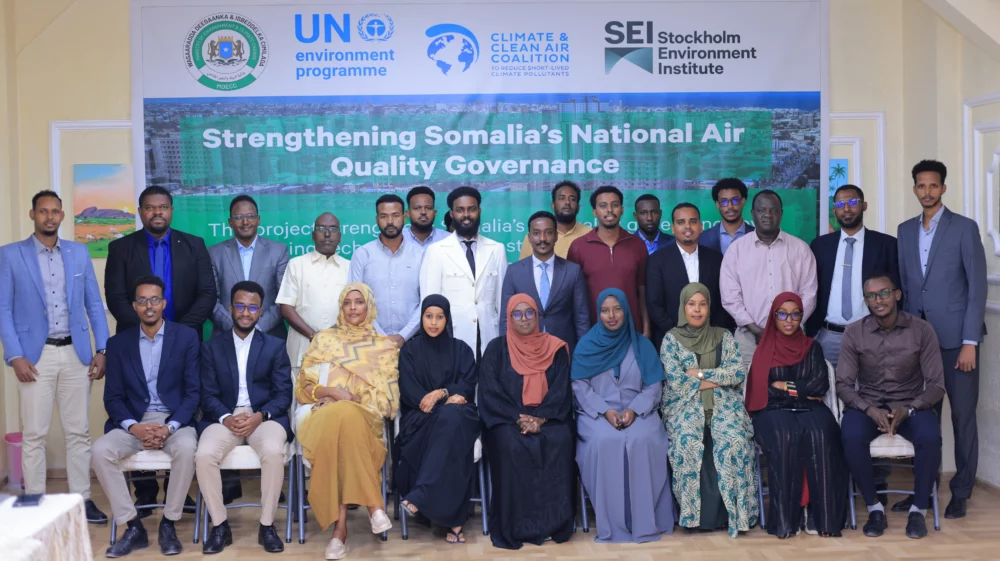
Somalia’s Ministry of Environment and Climate Change (MoECC), working through its Pollution Monitoring Unit (PMU), has now launched an initiative to establish the country’s first coordinated, evidence-based air quality governance system.
Somalia is taking a decisive step toward tackling one of its least visible but most harmful environmental threats: air pollution.
The country faces a growing air quality challenge shaped by rapid urbanization, widespread reliance on household biomass cooking (with 95% of the population lacking access to clean energy), increasing vehicle emissions and frequent dust storms and extreme weather events.
Yet Somalia still lacks the monitoring systems, data infrastructure and governance capacity needed to respond effectively. The human cost is already visible in the data: fine particulate matter is three times higher than the World Health Organization safe limits, and 45% of all stroke and heart disease deaths in the country are linked to air pollution.
Against this backdrop, the government of Somalia – in partnership with the Climate and Clean Air Coalition (CCAC), Stockholm Environment Institute (SEI) and the Intergovernmental Authority on Development Climate Prediction and Applications Centre (IGAD-ICPAC) – has launched a new initiative aimed at building the country’s first coordinated, evidence-based air quality governance system.
The project, “Strengthening Somalia’s National Air Quality Governance,” marks a foundational effort to address gaps in data, policy and institutional capacity. It will do so through SEI-led Targeted Expert Assistance (TEA), a structured approach that delivers hands-on technical support directly to national institutions. A key tool within this is the Air Quality Management Exchange (AQMx), a global platform by the CCAC, that gives countries a clear step-by-step roadmap for building air quality management systems. The initiative will support Somalia in developing air quality monitoring systems, strengthening technical expertise and integrating air pollution into broader climate and health policies.
The scale of the task is significant. Somalia currently has limited air quality monitoring infrastructure, minimal emissions data and no comprehensive regulatory framework for managing pollution. As Mohamed Abdi Hassan, head of Somalia’s Pollution Monitoring Unit (PMU) at the Ministry of Environment and Climate Change, acknowledged at the project’s official launch, the absence of operational forecasting systems and reliable emissions data makes it difficult to design effective responses, let alone track progress.
However, this initiative builds on recent policy momentum. Through its Ministry of Environment and Climate Change, Somalia established the PMU to oversee air, water, noise, and soil quality and provide early warnings on environmental hazards. As part of this effort, Somalia installed its first air quality monitoring device at Aden Adde International Airport in Mogadishu, a high-traffic area impacted by emissions from aircraft and surrounding activities. Additionally, Somalia’s National Transformation Plan (2025-2029) includes the nationwide expansion of air quality monitoring stations to protect public health and guide pollution control measures. These institutional building blocks give the project a strong foundation.
“This initiative marks a foundational step in Somalia’s efforts to build a coherent, evidence-based and nationally owned air quality management system.” said SEI Africa Centre Director Niall O’Connor, who delivered the keynote at the launch. One of the core ambitions of the project is to ensure that Somalia generates its own data, sets its own priorities and drives its own solutions, rather than depending indefinitely on external expertise.
In the short term, the focus is on building a national air quality monitoring framework, baseline assessments of emissions sources and the technical training needed to operate and sustain these systems. The PMU will be strengthened and the analytical groundwork laid for long-term air quality management. Over time, the outputs will feed into integrating air quality into Somalia’s broader climate and health policies.
The project will run through early 2027, focusing on delivering concrete outputs such as a national air quality framework, policy recommendations, baseline assessments and technical training programs.
Ultimately, the goal is to move Somalia from a position of limited data and fragmented efforts to one where air quality is systematically monitored, governed and integrated into national development planning.
As Somalia continues to build resilience to climate and environmental risks, the success of this initiative could serve as a model for how countries with limited infrastructure can move toward modern, data-driven environmental governance.
“This is an initial but strategic phase of support,” O’Connor emphasized. “The focus is not only on building systems but on ensuring those systems are credible, functional and nationally owned.”
Project / This project strengthens Somalia’s national air quality governance through policy development and targeted capacity building
Feature / For the first time, air quality is being prioritized alongside climate concerns such as drought, heat and floods.
Feature / SEI in partnership with the UNEP regional office for Africa held a science policy dialogue on the sidelines of AMCEN-20.
Feature / A three-day workshop in Mogadishu, supported by SEI Africa, ended with a new multisectoral working group to guide Somalia's air quality policy.