At Africa Climate Week, regional leaders introduced a new climate framework for the Greater Horn of Africa – the first of its kind on the continent. For the first time, air quality is being prioritized alongside climate concerns such as drought, heat and floods, marking a milestone built on years of scientific groundwork and policy dialogues led by SEI in Africa.
When leaders and climate experts gathered in Ethiopia in September 2025 for the second Africa Climate Summit (ACS), the spotlight was on the continent’s progress towards meeting the COP29 roadmaps laid out in Baku, Azerbaijan.
In this context, the Intergovernmental Authority on Development (IGAD) unveiled the Regional Framework for Climate Services for the Greater Horn of Africa (RFCS-GHA) – the first of its kind in Africa and one of only a few worldwide.
Unlike earlier frameworks for climate services, it makes air quality a central concern, placing it on equal footing with more established climate issues such as drought, heat and floods.
The Greater Horn of Africa is one of the world’s most climate-vulnerable regions. From prolonged droughts in Somalia and South Sudan to urban heat stress in Nairobi and Kampala, communities face environmental shocks on a near-constant basis.
Until now, climate services in the region have largely focused on rainfall forecasting, drought monitoring and heat early warnings. Air pollution, however, has been overlooked, despite being the second leading global risk factor for mortality.
“We cannot separate air quality from climate services. They are intertwined,” said Calistus Wachana, a regional climate services expert at the IGAD Climate Prediction and Applications Centre (ICPAC).
SEI’s collaboration with IGAD on the regional framework began with the CLEAR (Clean air for enhanced urban climate resilience in African cities) project, implemented with the United Nations Environment Programme (UNEP) and city authorities across Africa. Since 2023, SEI has installed more than 100 low-cost air quality monitoring sensors across the region, providing vital data on the scale and extent of air pollution.
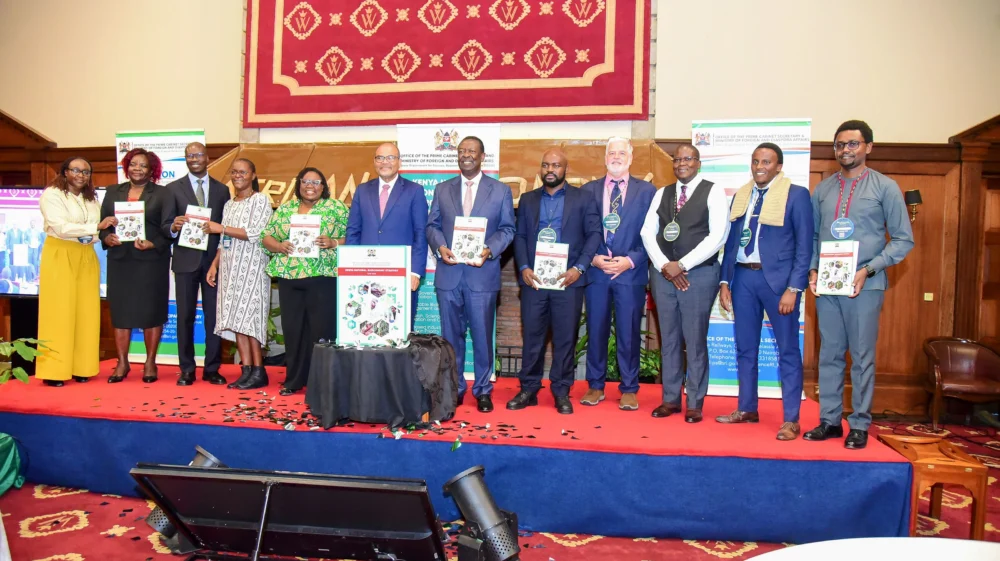
Building on this evidence, SEI convened two high-level policy dialogues on air pollution and early warning in Nairobi in July 2025. The first, on 13 July during the African ministerial conference on the environment (AMCEN-20), brought air pollution and early warning onto the continental agenda. The second, on 21 July, gathered regional meteorological departments, health institutions, policymakers and IGAD experts to identify opportunities for integrating air quality into the draft framework.
Photo: SEI.
The RFCS-GHA aims to bring climate services “closer to the people,” providing a unified vision for the eight IGAD member states and enhancing coordination among meteorological, disaster management and health agencies.
It also strengthens regional cooperation by linking platforms such as ClimWeb – which already delivers forecasts to governments – with efforts to identify capacity needs and direct resources where they are most needed.
In addition, the framework supports governments in developing their own national frameworks for climate services, aligned with the global framework developed by the World Meteorological Organization (WMO).
The RFCS-GHA rests on five strategic pillars:
According to IGAD’s roadmap, 2026–2030 will focus on putting the regional framework into practice. National frameworks will be developed from the regional model, enabling countries to better anticipate and respond to cross-border environmental hazards.
SEI is expected to continue providing technical expertise in air quality monitoring while helping governments and communities build resilience to climate shocks. But as David Kwaje, head of IGAD’s mission in South Sudan, warned, “the persistence of environmental challenges steadily reduces people’s resilience.”
Project / This project will build scientific evidence and knowledge platforms for urban air quality and climate resilience.
Project / The project supports the development of an Africa Clean Air Program continental roadmap and implementation plans.
Other publication / This study finds that air pollution harms not only human health but also insect pollinators, with potential impacts on crop and food production.
Feature / A new initiative aims to build Somalia's first national air quality governance system, laying foundations for monitoring, data and policy.
Feature / Kenya has launched its first National Bioeconomy Strategy, becoming one of a small number of African countries with a dedicated national bioeconomy strategy.