A delegation from China’s Ministry of Ecology and Environment visited SEI to exchange lessons with Swedish experts on how public investment, collective learning and carbon markets can drive the green and low-carbon transition.
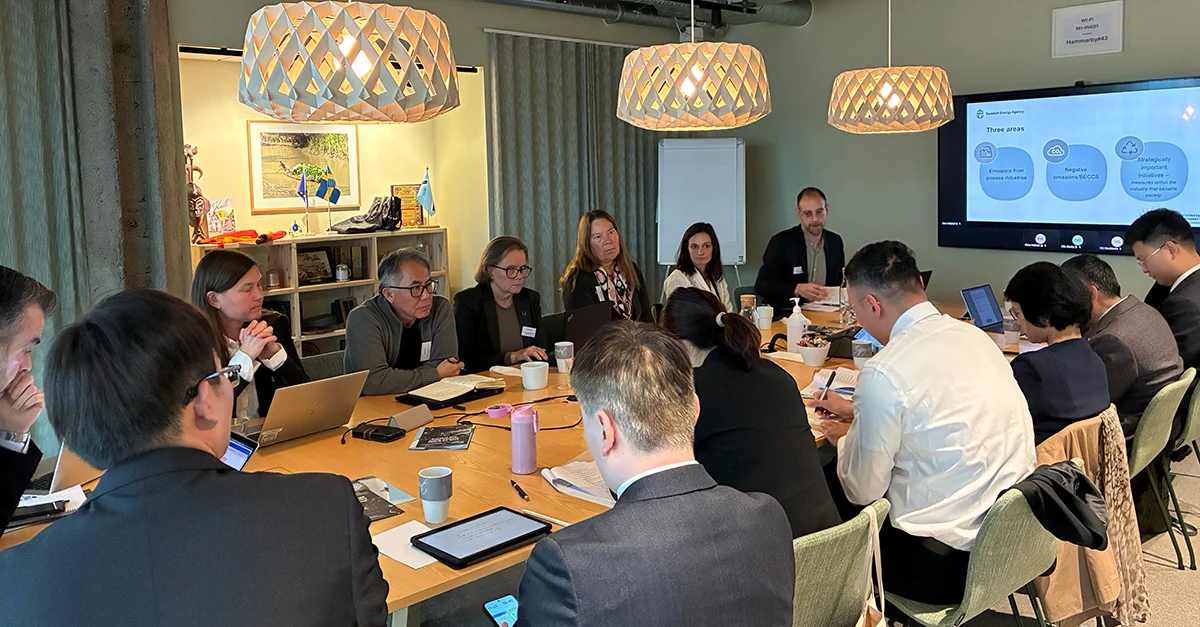
On 27 October, SEI hosted a policy learning seminar for a delegation from China’s Ministry of Ecology and Environment (MEE), focused on how public investment can drive the green and low-carbon transition.
The delegation was led by Ding Qiong, Deputy Director-General and First-Class Inspector of MEE’s Department of Solid Waste and Chemicals, and included division directors from departments across the ministry.
Experts from SEI, the Swedish Environmental Protection Agency (EPA), the Ministry of Climate and Enterprise, the Swedish Energy Agency and Viable Cities shared how Sweden uses its climate policy framework, public investment programs, collective learning platforms and carbon markets to encourage the green transition.
Annika Markovic, SEI’s Engagement and Impact Director, opened the day with an introduction to SEI’s work. Anna Otmalm, Senior Advisor on Environmental Data and Information at the Swedish EPA, then presented the agency’s work and its recent engagement with China.
Mattias Frumerie, Sweden’s Climate Ambassador and Head of Delegation to the UNFCCC at the Ministry of Climate and Enterprise, explained how Sweden’s climate policy framework and climate policy action plan work in practice, including the annual budgeting and reporting cycles. He described cross-government coordination as a key success factor, because it keeps different lines of work aligned over time.
For businesses, he said, climate action and competitiveness go hand in hand: producing net-zero products strengthens their position in an increasingly demanding market. He also stressed the need to decouple economic growth from climate impact, and the potential of closer international collaboration.
He added that every report shows climate efforts are still insufficient on all fronts, and that more must be done to strengthen global resilience. “How can EU and China collaborate to jointly lead the way towards the Paris Agreement target and work with partners to strengthen resilience globally?” he asked.
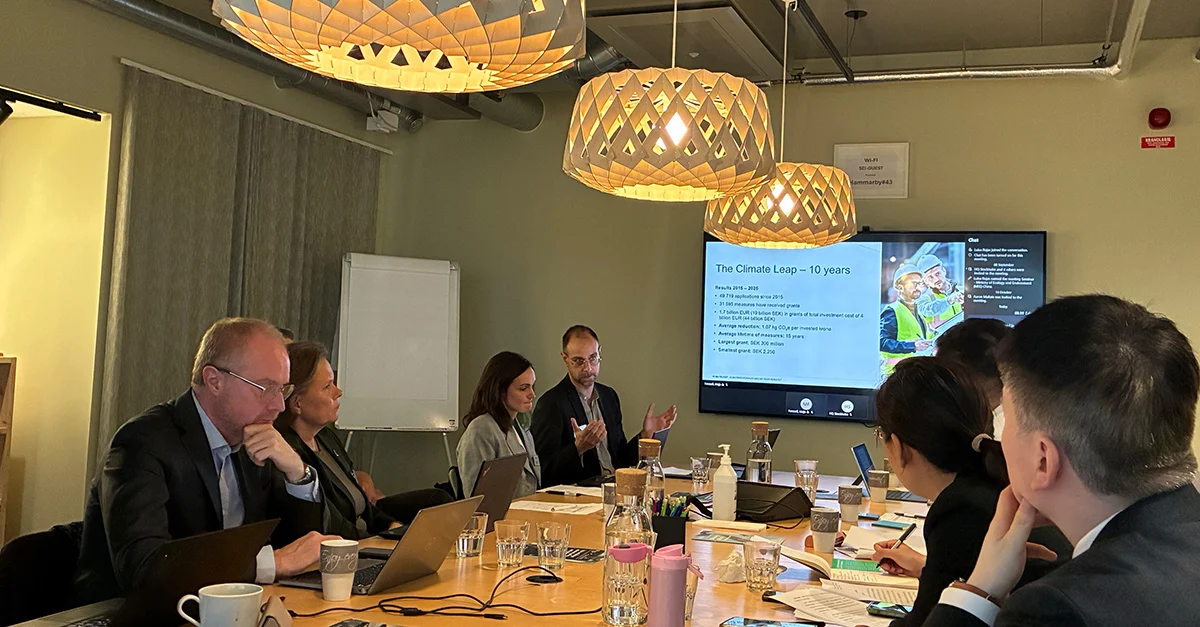
The Swedish EPA presented the Climate Leap, which funds projects led by municipalities, regions, companies and organizations across a range of sectors to cut emissions. The Swedish Energy Agency presented the Industrial Leap, which supports industry’s transition from research and pilots towards full-scale implementation. Both award funding through open calls, with robust evaluation and reporting, and both show how public funds can drive the green industrial transition and draw in private finance through co-financing.
The Swedish EPA presents ten years of results from the Climate Leap.
Photo: Yani Wang / SEI.
The Viable Cities case study showed how collective learning creates alignment, co-financing and demand. The program gives stakeholders a platform to understand needs and conditions, share expertise and form partnerships. As a result, it does not just channel funding: it also sends demand signals that prompt suppliers to act.
The final two case studies focused on carbon pricing. SEI presented the EU Emissions Trading System (EU ETS) and the Swedish EPA presented the Carbon Border Adjustment Mechanism (CBAM). They covered the scope and processes of each and recent simplifications, and discussion then turned to implementation phases, methods for counting emissions and approaches to verification.
Questions from the delegation ranged widely. They asked how to evaluate project applications and ensure additionality, and how to monitor implementation. They asked what level of data transparency is needed and realistic, and how to account for emissions reductions beyond domestic consumption. They also asked how China’s emissions trading system links to the EU’s CBAM, and how lessons from zero-waste cities and other sectors can be shared.
The delegation in discussion with Swedish experts.
Photo: Yani Wang / SEI.
The delegation in turn shared China’s experience of green public finance. A priority has been developing public finance frameworks and funds that reduce early-stage risk. Direct fiscal investment, green bonds and public funds have been used across recent Five-Year Plans and will continue to play a key role. China’s national emissions trading system was launched in 2021 for the power sector and expanded in 2025 to cover steel, cement and aluminium, with a cumulative trading volume of 961 million tonnes of CO₂ allowances by August 2026.
Project effectiveness is also becoming increasingly important in how public finance is evaluated. The government is now working to link funding more closely with evaluation methods, audit and transparency, cost-effectiveness and disclosure of performance information.
The seminar enabled a genuine two-way exchange of experiences on public investment for the green and low-carbon transition. Participants identified specific opportunities to bring Chinese cities’ zero-waste approaches into the Viable Cities program, and both sides welcomed continued dialogue to deepen this mutual learning.
“It was great to hear such valuable insights on public investment for the green transition from both Sweden and China,” said Annika Markovic. “We see similar approaches to encouraging blended finance, but also different kinds of challenges, and we hope to continue this mutual learning.”
SEI report / The report presents agricultural mitigation measures adoptable under Swedish conditions and with sufficient evidence for operationalization in the VCF dashboard
Press release / Berget AI releases an open-source method for calculating carbon emissions of every individual AI request, developed with SEI, WattTime and Klimatkollen.
Press release / As El Niño intensifies across the Amazon, new research in Science highlights the urgent need to better protect the region’s remaining forests from disturbances.