Trase analysis of water used to produce beef and soy in Brazil shows where commodity traders face the greatest risks of water scarcity. Addressing these supply chain risks requires urgent action by companies, banks and governments to invest in water-stressed areas and support farming practices that are more water efficient, says Water Witness.
Where does our food come from? Answering this question is challenging because the complex international supply chains that ensure our supermarket shelves are plentifully stocked obscure important connections between producers and consumers – especially their reliance on water resources.
While our food systems require water throughout their supply chains, much of it is out of sight of consumers. Companies often monitor freshwater withdrawals and discharge from their own operations, but the far larger volume required for their commodity supply chains – also called ‘indirect’ water use – is rarely accounted for. This hidden freshwater use in the supply chain is essential for consumer markets which often rely on distant river basins, and therefore may be linked to water-related risks and impacts far beyond corporate fences.
A new Trase report illuminates these hidden dependencies and risks in the Brazilian soy and beef supply chains. Building on peer-reviewed Trase research on water scarcity risks to European and Chinese imports, this report dives deeper into details of water use for soy and beef production and the water-related risks within the supply chains of some of the world’s largest commodity traders.
Brazilian soy and beef production require freshwater, but the source of that water and how it is stored varies. For soy production, rainfall is the primary source of water, although surface and groundwater are also used to irrigate soy. For beef production, drinking water for cattle is typically stored in small farm reservoirs. Yields of rainfed soy are sensitive to droughts or dry spells, and water for irrigation and livestock drinking can even become scarce as other business sectors, domestic users and ecosystems compete for resources.
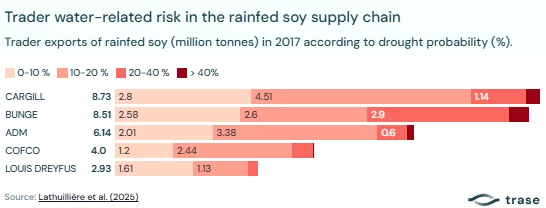
Water-related risks in the soy and beef supply chains are generally opaque to traders and consumers. By linking water use information for soy and beef production with Trase data, we can quantify commodity trader reliance on Brazilian water resources and risks to their supply chain. Our analysis shows that top soy traders are linked to regions with a high probability of drought.
Trader water-related risk in the rainfed soy supply chain.
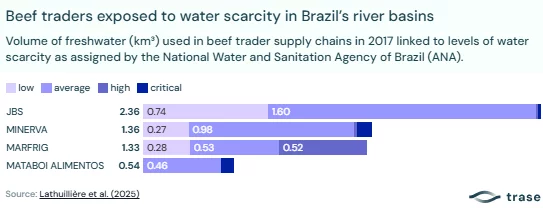
Top beef traders also depend heavily on river basins that already face high or critical water scarcity according to the Brazilian National Water and Sanitation Agency (ANA).
Beef traders exposed to water scarcity in Brazil's river basins.
Trase’s research also reveals how trader supply chains can be exposed to both deforestation and water scarcity impacts. This convergence means that policies or sourcing decisions guided by a single environmental metric may risk shifting impacts from one category to another. For instance, moving soy sourcing away from deforestation hotspots could inadvertently increase exposure to water scarce regions.
In Western Bahia, at the heart of the Matopiba agricultural frontier, the consequences of water scarcity are visible and profound. Participatory mapping by local organisations showed that more than 7,000 km of rivers and streams no longer flow year-round. These are only some of the casualties of deforestation, expanding crop irrigation and unchecked water extraction. Once-reliable watercourses now appear only after heavy rains, and reservoirs built for livestock or energy generation evaporate precious supplies. For the communities who depend on freshwater ecosystems, this loss threatens food security, traditional livelihoods and cultural identity.
The research evidences the aims of the Fair Water Footprints initiative, which focuses on establishing water stewardship as the international business norm. The initiative is supported by governments, companies, investors and civil society organisations including Water Witness.
Launched in Glasgow for COP26, Fair Water Footprints works primarily through international supply chains and trading relationships to stimulate action and investment on water and climate risks, to drive sustainable, resilient and inclusive growth. Identifying where water use in supply chains intersects with river basin water scarcity is a first step towards targeted action, from prioritising investment in water-stressed river basins to supporting farming practices that are more water efficient.
The intersection of global supply chains and water scarcity underscore why Fair Water Footprints matter: Ensuring water is used equitably and sustainably, and that supply chain decisions do not undermine the rights and resilience of those living upstream.
Trase research highlights several priority areas for companies, governments and financial institutions:
Understanding how water use, scarcity and deforestation intersect is critical for building resilient food systems. By combining high-resolution supply chain data with on-the-ground knowledge, we can better target action – protecting both global markets and the communities whose water sustains them.
As part of this new frontier of work, Trase will be focusing on providing revised water use metrics for global agricultural commodity trade through the Global Environmental Impacts of Consumption Indicator. This effort will allow for more up to date global assessments of water use in global consumption activities and associated supply chain. We will continue to support users and partners with the datasets behind this report, particularly around pilots that can advance initiatives focused on water use in supply chains. We are also exploring how our water data – along with broader climate-linked information – can be used to support discussions linked to food security and supply chain resilience.
This Trase Insight is written by Rafaela Flach, Michael Lathuillière and Charles Wright. It is originally published by Trase – Intelligence for sustainable trade – a global supply chain transparency initiative by SEI and Global Canopy.
Press release / A new Trase report quantifies how trader supply chains are exposed to water scarcity risks, alongside exposure to deforestation.
Journal article / The study links Brazilian soy and beef exports to China and the EU with river basin water use and scarcity.
Feature / Over the past 10 years, Trase has demonstrated that action to curb commodity-driven deforestation is both necessary and possible.