Editor’s choice
This project aims to investigate trade-offs between water use, deforestation and greenhouse gas emissions associated with soy and beef commodity production and exports from Brazil.
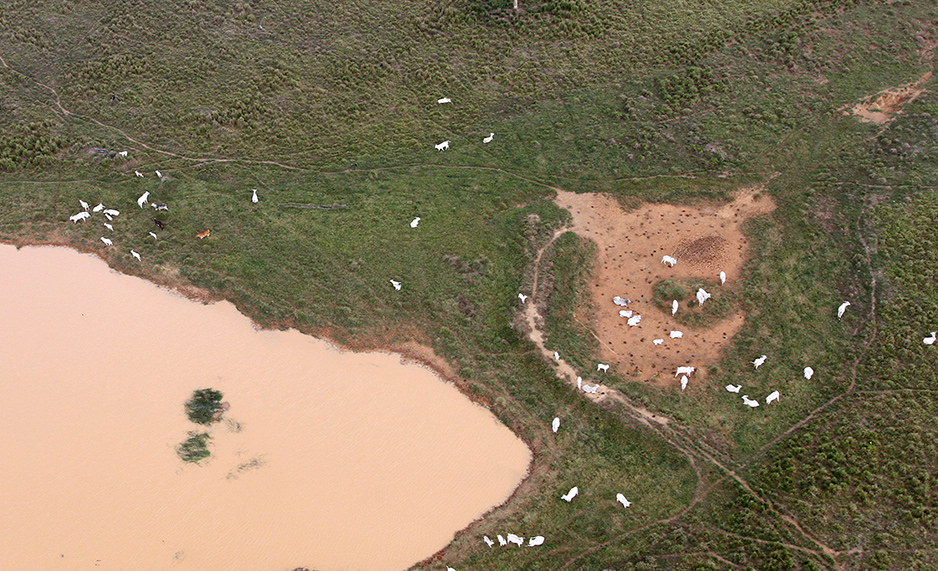
Aerial view of cattle near body of water in Lindoeste, Pará State, Brazil. Photo: Ricardo Lima / Moment Open / Getty Images.
2021–2025
The production and trade of soy and beef from Brazil is linked to deforestation, greenhouse gas emissions, and biodiversity. These impacts motivate existing zero-deforestation commitments from countries and companies, but the effects of such commitments on local water use and scarcity are poorly understood.
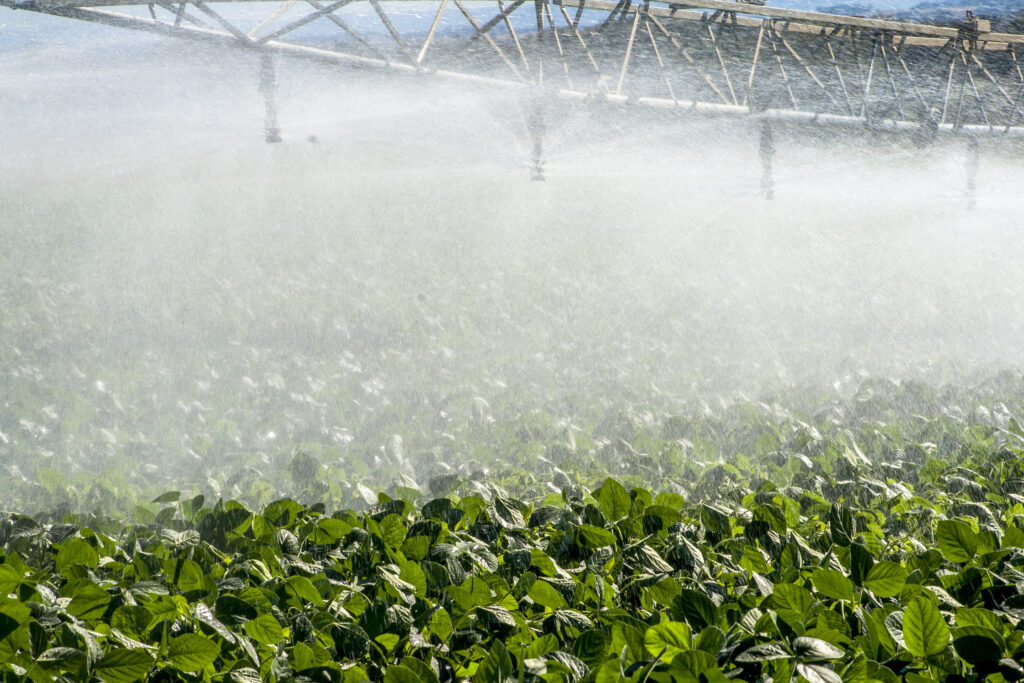
One of the main pathways for achieving deforestation-free supply chains is to intensify agricultural production – a process which can be highly demanding on water resources. Brazilian soybeans rely almost entirely on rainfall whose magnitude can decrease with upwind deforestation and increase with upwind irrigation; a growing Brazilian cattle population will require an increasing amount of drinking water typically stored in farm impoundments on the landscape.
This project explores the links between the global trade of Brazilian soy and beef commodities, water use and water scarcity, and policies designed to improve the sustainability of supply chains (particularly zero-deforestation commitments).
Our work also seeks to use Trase to highlight the links between water use for soy and beef and commodity exports from Brazil, and the effects of land use and land use change on regional precipitation.
Funder: Formas
Partner: Stockholm Resilience Centre

Photo: Alfribeiro / Getty Images.
Feature / A new Trase report illuminates hidden dependencies and risks regarding freshwater use in Brazilian soy and beef supply chains.
13 January 2026 / About Forests, Public policy, Supply chains and Water resources
Press release / A new Trase report quantifies how trader supply chains are exposed to water scarcity risks, alongside exposure to deforestation.
13 January 2026 / About Business, Forests, Public policy, Supply chains and Water resources
Press release / Unique research by Trase published in Nature shows hotspots of water use linkages to soy and beef imports.
25 August 2025 / About Business, Climate policy, Public policy, Supply chains and Water resources
Journal article / The study links Brazilian soy and beef exports to China and the EU with river basin water use and scarcity.
25 August 2025 / About Food and agriculture, Supply chains and Water resources
Journal article / By proposing a unified framework for classifying deforestation metrics, this article aims to provide clarity and consistency in sustainability reporting.
6 October 2025 / About Adaptation, Food and agriculture, Forests and Land use
Journal article / The Supplemental Data for the publication entitled "International reliance of Brazil's water through soy and beef supply chains" are available for download.
17 October 2025 / About Food and agriculture, Supply chains and Water resources
SEI brief / Deforestation is not the only factor that should be considered in a crop's environmental footprint. Water use is often overlooked in agricultural policy.
2 May 2022 / About Business, Food and agriculture, Forests, Land use, Public policy, Supply chains and Water resources
Senior Research Fellow and Team Leader for Trase Research and Development
SEI Headquarters
Tool / Trase permite a los gobiernos, empresas y otros abordar los impactos ambientales de las cadenas de suministro.
About Climate policy, Forests and Supply chains
Tool / Trase enables governments, companies and others to address the environmental impacts of supply chains.
About Forests and Supply chains
Project / Bolivia WATCH works to arm the country's institutions with the information and capacity to connect two spheres: safe sanitation and watershed management.
2018 / About Sanitation and Water resources
Program / SUMERNET brings together research and policy partners to engage with water insecurity in the Mekong Region.

2019 - 2028 / About Climate policy, Forests, Geopolitics, Water resources and Water-energy-food nexus