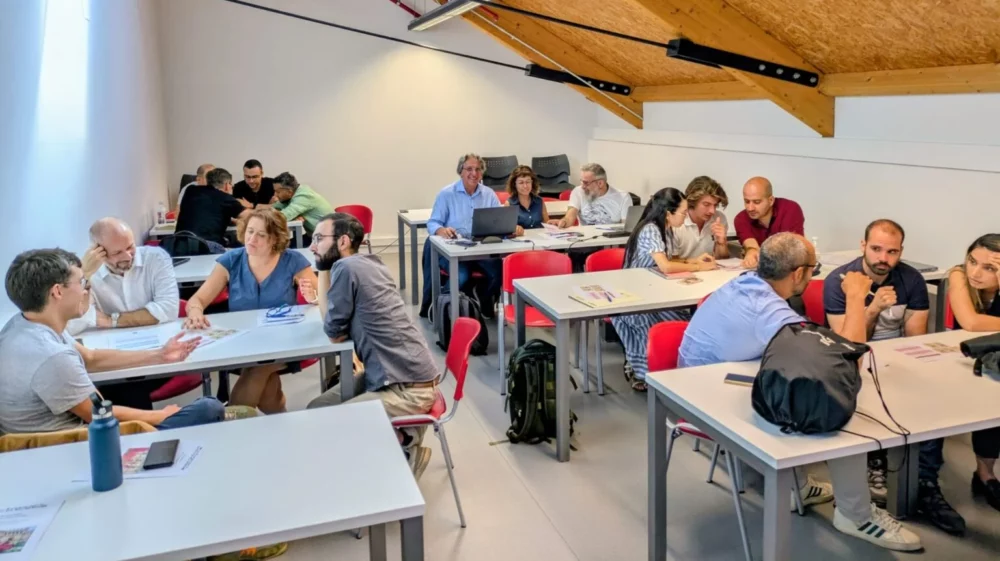
The second Thailand Groundwater Symposium, held 19-21 August 2024 in Bangkok, focused on the theme of “Strengthening Groundwater Sustainability Under Climate Change”. The event brought together researchers, practitioners, policymakers and development organizations to share their experiences in groundwater management, innovation and technology.
As part of the project to support the development of a groundwater management framework in Cambodia, I had the opportunity to attend the symposium alongside two Cambodian officials from the Department of Water Supply and Sanitation (DWSS). We are all part of a project to develop a groundwater management framework in Cambodia, a collaboration between the DWSS, SEI and the Asian Institute of Technology. The DWSS officials’ participation highlighted the importance of engaging in international events such as this symposium, and allowed them to learn about potential approaches to improve groundwater management efforts in Cambodia while sharing the country’s experiences.
Cambodia has a large potential groundwater resource, and it is currently used in various sectors with increasing demand, especially in domestic and agriculture, as explained by Raksa Pen of the Cambodian DWSS. He further highlighted the challenges of groundwater management in Cambodia, including the lack of a comprehensive framework, regulation, laws and up-to-date data on groundwater storage and usage. Moreover, Cambodia needs human resources, especially expertise in both the technical and management sectors, as well as public awareness and knowledge of groundwater.
The symposium offered the Cambodian DWSS officials exposure to technical and policy knowledge, as well as insight into how other countries manage their groundwater resources. It also provided information on how groundwater management has advanced elsewhere, starting from little to no regulatory framework.
Many experts highlighted the impact of climate change on groundwater resources. Higher rainfall variability with climate change makes surface water less reliable, so people shift to more reliable sources like groundwater. This global trend is evident in the Lower Mekong Basin, where increasing water demand and over-extraction are pushing the limit of groundwater resources. Moreover, the rise in sea level combined with depleted groundwater levels leads to a higher chance of saline water intrusion, degrading groundwater quality.
While these issues are global, they are unique and pressing in specific regions, such as the Lower Mekong Basin, where the economy and population depend heavily on agriculture. A presentation from Sinxay Vongphachanh, an agriculture and irrigation specialist from the Mekong River Commission, highlighted the importance of groundwater for agriculture in the Lower Mekong Basin. Agriculture in countries such as Cambodia and Laos significantly contributes to their GDP and employs the majority of the population, and farmers here depend heavily on groundwater. Groundwater reliability allows farmers to plan cropping effectively, enhancing productivity. Sustainable management is crucial to prevent overexploitation and ensure long-term availability, as excessive pumping can lead to aquifer depletion and environmental issues.
The evolution of groundwater management in Australia, shared by Steve Barnett, a principal hydrogeologist for the Australian Department for Environment and Water, was particularly interesting in the context of Cambodia, with insights for how to transition from unsustainable extraction to regulated and sustainable use. I found it interesting to see how serious attention was brought to groundwater management in Australia after an impact was found from the rapid development and over-extraction of groundwater. Only then was legislation introduced to areas under stress to control groundwater extraction. Then, following the UN promotion of sustainable development principles in the 1980s, the Australian government committed to adopt the sustainable development principles that now govern Australia’s groundwater resource management, the Australian National Water Initiative.
Timeline of Thailand’s groundwater policies to tackle land subsidence. Photo: Parichat Pinsri / SEI Asia.
Cambodia is now at a stage of developing groundwater resources without regulation, and many studies have found the impact of over-extraction in the country. This is critical, as damage to groundwater leads to severe environmental issues such as land subsidence and saline intrusion as sea level rises. Introducing policies such as groundwater monitoring, groundwater licensing, and compliance measures is essential for sustainable groundwater management. Furthermore, comprehensive monitoring and education for stakeholders are significant needs, as groundwater resources are complex systems which require extensive understanding and collective efforts for sustainable use.
One good approach to involving groundwater users and at the same time obtaining data is through citizen science. Torben Bach of the Geological Survey of Denmark and Greenland pointed out that one way to strengthen groundwater sustainability is to strengthen the data collection process. He showed how citizen science could enhance data collection while fostering public engagement. Through simple and low-cost water table measurement tools installed in residential backyards and within the vicinity of schools, locals and school children could report groundwater data daily. The data accumulated could capture the groundwater response to different weather conditions and reveal greater complexity of the groundwater system than previously known. This approach has shown itself to be cost-effective, resulting in community participation and valuable data.
I think Cambodia could launch citizen science projects, as they are cost-effective for data collection and would be one way to help build knowledge despite Cambodia’s lack of financial and human resources. To ensure applicability, they could start with a pilot area, preferably in areas under stress where close monitoring is required. Locals are more likely to cooperate when it can improve their livelihoods. They could begin by finding strong communities to assure successful implementation, and provide training on the data collection method and raise awareness by emphasizing the importance of sustainable groundwater use and talking about why they need data. Frequent training on data collection methods are necessary to refresh the practice and ensure the data are accurately captured. Citizen science not only provides data, it also brings a sense of community and ownership to shared resources.
As climate change intensifies the transition from surface water to groundwater use, Cambodia should have strong institutional and regulatory frameworks in place to avoid the irreversible effects of future rapid development of groundwater and achieve sustainable groundwater management. Technologies and community involvement alone are not enough. Regulations and mandates should exist for government officials as an enabling environment to take action for the sustainable development and management of groundwater resources.
While the presentation and discussion provided innovative approaches to groundwater management, the reflections from DWSS officials shed light on the challenges on the ground. Their insights provided a practical lens to the discussion, as they face issues regarding managing groundwater with no formal governing framework and enforcement.
Vina Nget, one of the officials from the DWSS, works closely with the drilling of groundwater wells for water supply in Cambodia. He is involved in groundwater data collection with the local administrative offices. He said that his experience at the symposium reminded him of how, despite the availability of advanced technology, few, if any, can be applied in Cambodia due to the lack of funding. His view on the application of citizen science in Cambodia was not as positive as mine: he mentioned that people still have little to no knowledge of groundwater. They might find it hard to go out of their way to learn new things and collect data for the government.
While a lack of basic knowledge would be a challenge in applying citizen science in Cambodia, I believe it is critical to include communities in groundwater management, as it is a vast resource. Groundwater flows underground, through many lands regardless of political boundaries, so it requires a multitude of possible efforts. An awareness campaign, for example, could slowly build people’s understanding and build their capacity to protect groundwater resources. They could then come to understand how much the environment is part of their livelihoods as well.
From a broader perspective, DWSS’s Raksa Pen said that engaging in events like the Thailand Groundwater Symposium has helped him understand the importance of groundwater management. Participating in international conferences and workshops, he has noticed that groundwater management has become crucial, “almost a global agenda”, he said. He recently learned of the impact of the overdevelopment of groundwater in Bangkok, which caused severe land subsidence, driving the government to issue and enforce strict groundwater regulations. Gaining insight from attending these international meetings has prompted him to add this issue to DWSS’s main agenda, and he emphasized that “without this international experience, I would not be able to share and advocate to management at all”.
This goes both ways: as he learns about other countries, Raksa Pen said he can share about the issues and experiences he faces in Cambodia as well. Cambodia is still very behind regarding groundwater management. He noted that the gap between Cambodia and other countries needs to be lessened, and much support is needed. That is why he seeks support and partnerships from other countries whenever he can attend international events. In fact, his attending an international workshop led to the beginning of the project to develop a groundwater management framework in Cambodia, a collaboration between the DWSS, SEI and the Asian Institute of Technology.
Feature / Key messages from the second Joint Steering Committee (JSC) meeting on water-related collaboration between ONWR and SEI Asia on 20 August 2026
Feature / The European Union recently recognized TRANSCEND, an interactive water planning approach supported by SEI.
Project / Horizon Europe project advancing innovative, participatory approaches to water management and climate adaptation under deep uncertainty.