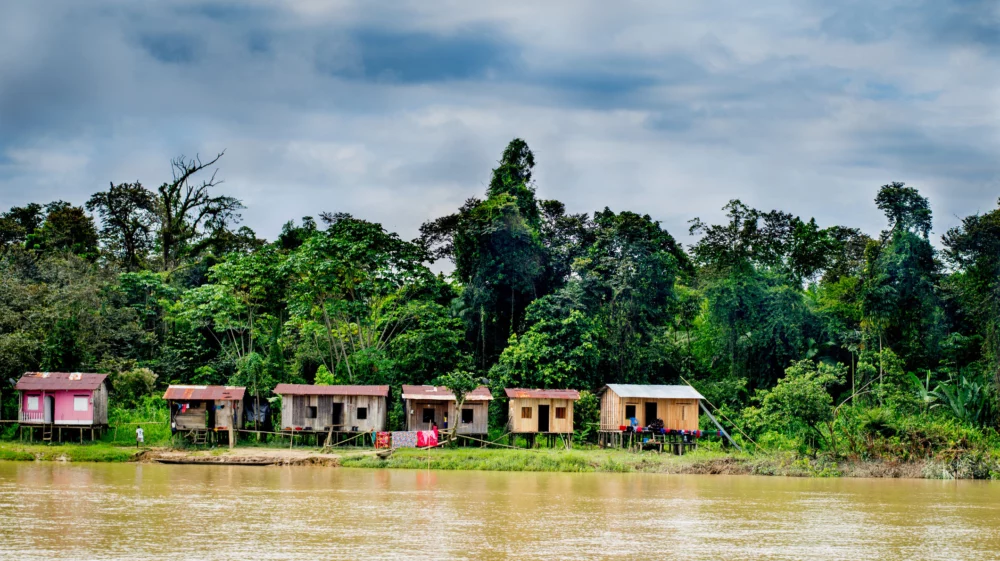
Working on modeling the transboundary Meghna River straddling India and Bangladesh, the author reflects that in transboundary rivers, accessing information meant navigating data access amidst geopolitics, requiring adaptability and persistence.
When I joined SEI Asia as a Hydrological Modelling Intern, I didn’t expect data collection to become the defining challenge of my internship. My project focused on the Meghna River Basin—one of South Asia’s most ecologically dynamic and politically complex basins, spanning northeastern India and Bangladesh. The basin is vital for agriculture, biodiversity, and livelihoods on both sides of the border. Yet, in a region so rich in life and cultural connections, I quickly discovered that the one thing that didn’t flow freely was data.
From the outside, data collection may sound like a routine step in any scientific project. But in transboundary river basins, it’s where the real work begins. In this blog, I share my experiences with accessing, validating, and compiling hydrological and agricultural data—and the roadblocks I faced along the way. What began as a simple task evolved into a lesson in persistence, adaptability, and the unspoken politics of information sharing.
My first task was identifying rainfall stations within the Meghna Basin. On the Bangladesh side, I easily accessed the complete station list from the Bangladesh Meteorological Department (BMD) website. The interface was straightforward, the data structured, and I had what I needed within minutes. But the Indian side proved far more challenging. Official meteorological portals either blocked access, denied permission, or failed to load. After repeated attempts, I realised the issue wasn’t just technical—it was institutional.
To work around this, I turned to literature reviews. But even here, I hit another challenge: most studies focused on the Lower Meghna Basin. The Upper Meghna, particularly the Barak River in northeastern India, had few peer-reviewed studies. By experimenting with keywords like “Barak River,” “northeastern India,” and specific districts like Assam and Meghalaya, I finally located a few studies mentioning rainfall stations.
This experience taught me that data won’t always come to you-you have to chase it. Sometimes, success is defined by knowing how to look using location-specific search terms.
After mapping the stations, the next hurdle was obtaining the actual rainfall data. Again, Bangladesh’s data was easy. I retrieved monthly averages from the BMD website and additional reports from the Bangladesh Water Development Board (BWDB), although the latter only covered two years.
The Indian side was a different story. While some studies included rainfall data, it was hidden in graphs. That’s when I discovered WebPlotDigitizer, a tool to extract numerical values from plotted graphs to digitize monthly rainfall trends. The tool is powerful but imperfect: low-resolution or congested graphs led to errors that I was forced to manually correct or discard the data.
Eventually, I found a paper referencing an open-access Indian data portal with historical rainfall data (1951 to 2000). The dataset was national-level needing filtering to match my station locations. But at least I now had the raw numbers and organized the dataset I needed.
This phase showed me the value of secondary sources. Research papers, government reports, and open-access portals can fill gaps when primary data is unavailable. I also learnt that real insights often lie beyond the first page of search results and are often hidden in footnotes of an academic paper.
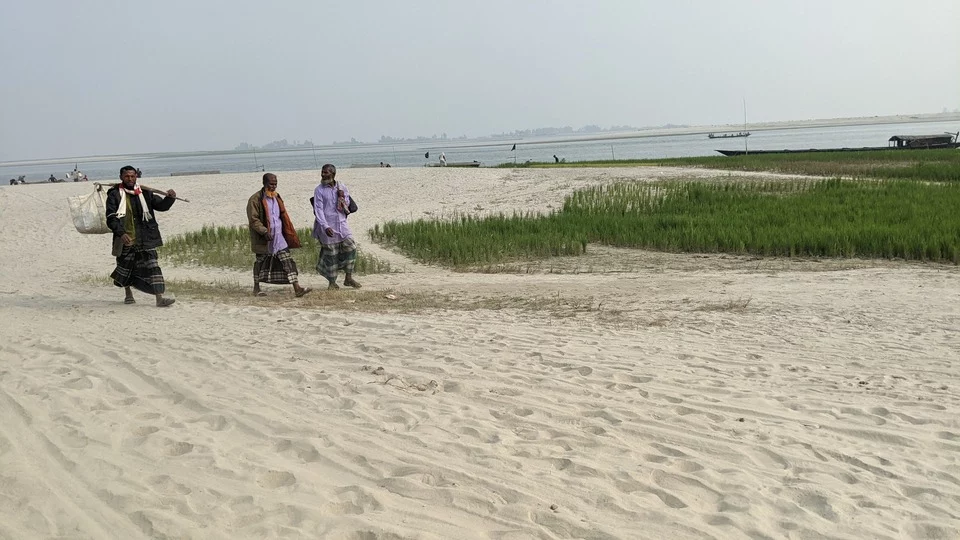
A day off for the fishers of the Shiber Pachi Char, heading to buy their weekly groceries from the nearest haat (weekly market) across the river. Photo: Sushmita Mandal / SEI Asia.
Next, I shifted to agriculture, aiming for a crop calendar for the Haor region—a seasonally flooded wetland ecosystem in northeastern Bangladesh. The goal was to understand planting, harvesting, and fertilizer application timelines. I combined research papers with reports from the Bangladesh Agricultural Research Council (BARC), which offered detailed fertilizer recommendations and crop management timelines.
To speed up the search, I used an AI-powered tool called Perplexity that helped me locate credible sources faster than traditional search engines. With its help, I built a reliable crop calendar including fertilizer timing, types, and dosage.
This experience highlighted how AI tools can streamline research by pointing to the right resources.
For future climate projection data, most researchers rely on ECMWF, but its data often lacks downscaling. Our modeling needed finer resolution, so I turned to a NASA resource offering downscaled climate data under various SSP scenarios at a 25 km × 25 km grid resolution. This dataset proved invaluable for capturing spatial variability.
For land use and land cover data, we decided to maintain consistency with national references, using a 2015 map by the Bangladesh Forest Department. As a government-validated dataset, it provided a strong baseline for modeling.
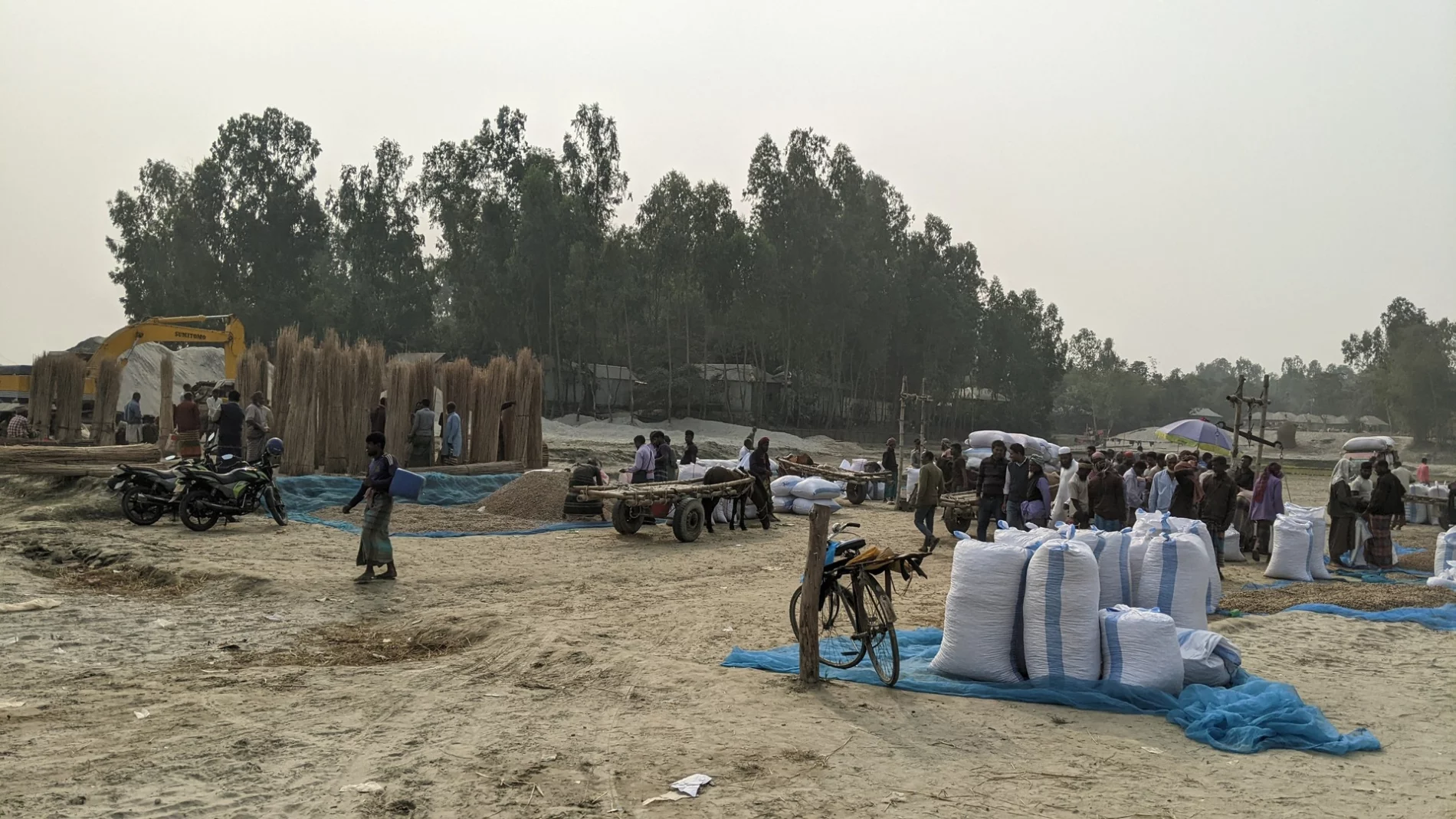
A scene from a haat (weekly market) for Char residents to buy and sell their produce, Jatrapur, Bangladesh. Photo: Sushmita Mandal / SEI Asia.
The most invisible challenge I faced was also the most powerful: data politics. It didn’t show up in errors or missing graphs but in restricted portals, unanswered emails, and inaccessible databases.
Hydrological data, particularly in transboundary basins, is often treated as sensitive. While global climate models are freely available, localized, high-resolution observed data—especially station-level hydrology—is often locked behind national policies or institutional gatekeeping.
This isn’t just a research obstacle. It’s a systemic flaw. When countries treat data as a national asset rather than a shared resource, it fragments our understanding of the basin.
The consequences are real: without comprehensive data, we can’t accurately model floods, droughts, or salinity intrusion—threatening the communities that depend on these rivers. In places like the Meghna River Basin, where upstream and downstream communities are deeply connected by the same flow of water, a lack of data cooperation is not just a research issue—it’s a justice issue.
Throughout my work, the lack of accessible Indian rainfall data didn’t just slow down my work, it limited the accuracy, and reliability of our basin-wide analysis. The barrier was not technical or cost, it was political.
There’s an urgent need to rethink transboundary data cooperation, especially in the era of climate change. Shared basins demand joint monitoring systems, harmonized datasets, and open repositories. Until then, researchers like me will keep piecing together data from scattered sources, graphs, and reports and relying on data crumbs.
But it doesn’t have to be this way. If the Meghna River can flow freely across borders, perhaps one day, its data can too.
Final Thoughts: What Data Taught Me
My work in the Meghna River Basin taught me more than just about data collection, it revealed hidden truths:
To researchers working on a transboundary river or in data-scarce regions: don’t give up. Whether it’s rainfall data, crop calendars, or climate projections, the information exists. You just need to look in more places than one.
A heartfelt thank you to Uttam Ghimire, my mentor throughout this internship, whose guidance helped me navigate these challenges. This internship has shaped not only my technical skills but also my understanding of the systems—seen and unseen—that shape how we study our world.
Program / This 4-year program aims to foster stronger cooperation in managing shared water resources and building resilience among riparian communities.
Press release / SEI researchers publish analysis on whether “rights of rivers” initiatives have led to environmental protections.
Project / Does granting rivers legal rights help people and nature? This study analyzes the Atrato, Whanganui, and Turag rivers to find fair, effective governance.
Tool / This tool supports in monitoring and analysis of riverbank erosion, shoreline change, and wetland dynamics using satellite-based earth observation data.