Skip navigation
Tool

Asia River Monitoring

Asia River Monitoring is a web-based platform offering a suite of open-access tools to monitor changes in riverbanks, coastlines, and wetlands using satellite observations. The platform supports evidence-based planning for erosion management, wetland conservation, and climate-resilient decision-making across South and Southeast Asia.

Active

Last updated on 22 December 2025

Asia River Monitoring is a digital decision-support platform developed by the Stockholm Environment Institute – Asia (SEI – Asia) to support monitoring and analysis of riverbank erosion, shoreline change, and wetland dynamics using satellite-based earth observation data. The platform was developed in response to growing needs among governments, practitioners, and communities for accessible, spatially explicit information to inform climate adaptation, disaster risk reduction, and ecosystem management in riverine, coastal, and wetland landscapes.

The Asia River Monitoring platform integrates three complementary tools:

  • River Erosion Tool, which analyses long-term riverbank erosion and deposition using multi-decadal satellite imagery to identify erosion hotspots, track river morphology changes, and support local- to regional-scale planning.
  • Coastal Erosion Tool, which monitors shoreline change using annual and monthly satellite-derived coastlines and erosion indicators to support coastal risk assessment and climate-resilient coastal planning.
  • Wetland Monitoring Tool, which maps and tracks seasonal and long-term changes in wetland extent and vegetation using Landsat imagery and established spectral indices such as NDWI, NDVI, and MNDWI.

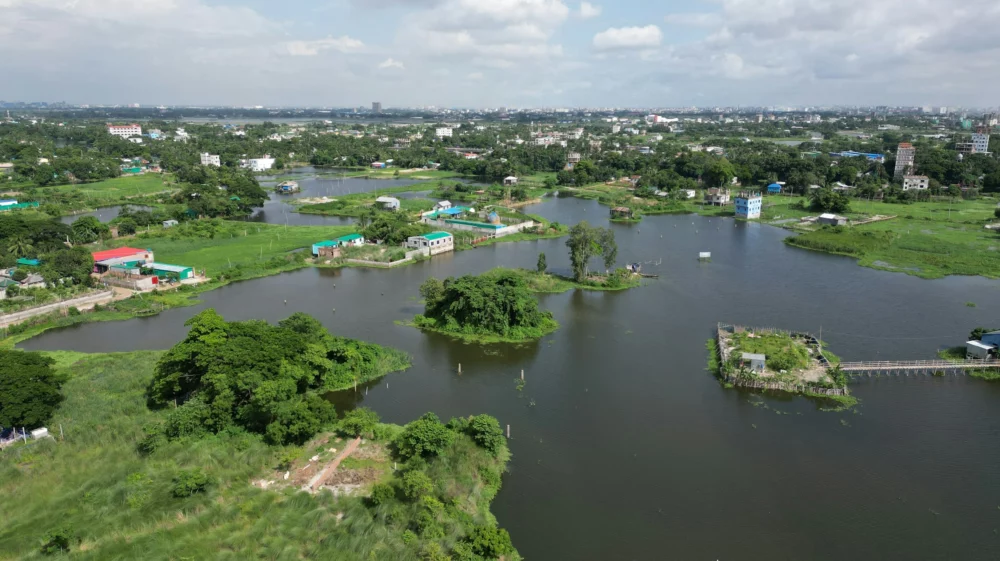
Asia River Monitoring currently focuses on river basins and coastal zones in South and Southeast Asia, where data gaps and rapid environmental change pose significant challenges for planning and governance. The tools have been applied in multiple contexts, including riverbank erosion assessment (Ayeyarwady River – Myanmar, Brahmaputra River – India), coastal change analysis (Gulf of Martaban – Myanmar), and wetland monitoring (Songkhram River Basin – Thailand and Meghna River Basin Wetlands in Bangladesh and India) at national and sub-national scales.

All tools are accessible through a web-based interface at www.asiarivermonitoring.com, with interactive maps and downloadable outputs designed for both technical and non-technical users. The platform uses open-access satellite data processed through cloud-based infrastructure (google earth engine), and guidance materials are being developed to support responsible interpretation and use of results.

Asia River Monitoring is designed for a diverse range of users engaged in river, coastal, and wetland management, particularly in data-scarce and climate-vulnerable regions of South and Southeast Asia. The platform supports both technical and non-technical users by providing accessible, map-based insights derived from satellite observations that can be directly applied to planning, risk assessment, and environmental management.

Key user groups and applications include:

  1. Government agencies and disaster risk managers: National, regional, and local authorities can use the River Erosion Tool and Coastal Erosion Tool to identify erosion hotspots, monitor high-risk riverbanks and shorelines, and support evidence-based planning for disaster risk reduction, infrastructure siting, and land-use regulation.
  2. Environmental planners and coastal zone managers: Practitioners working on river basin management, coastal planning, and climate adaptation can apply the tools to analyse long-term trends in erosion and shoreline change, supporting climate-resilient planning and ecosystem-based management approaches.
  3. Wetland authorities, conservation agencies, and researchers: The Wetland Monitoring Tool supports mapping and analysis of seasonal and long-term wetland dynamics, including changes in wetland extent and vegetation condition. Outputs can be combined with field surveys, biodiversity assessments, and hydrological analyses to inform conservation planning and policy processes.
  4. Civil society organisations, youth groups, and local communities: Through interactive visualisations and downloadable outputs, the platform enables non-technical users to better understand local river, coastal, and wetland changes. These insights can support community-based monitoring, awareness-raising, and local advocacy related to environmental risk and resilience.

The tools can be used alongside other spatial planning, hydrological modelling, and field-based assessment approaches, strengthening the integration of satellite-derived evidence into decision-making processes across scales.

Asia River Monitoring was established as a web-based platform to make satellite-derived information on riverbank erosion, coastal change, and wetland dynamics more accessible to decision-makers, practitioners, and researchers working in complex and data-limited environments. The tools were developed to respond to recurring challenges faced by governments and local stakeholders in monitoring environmental change over large areas and long time periods using consistent and transparent data sources.

The platform is built on cloud-based geospatial processing workflows and uses open-access Earth observation data, primarily from the Landsat satellite programme. Data processing and analysis are carried out using Google Earth Engine, with results served through a web interface developed using a server-based architecture. This approach allows users to interact with large spatial datasets without the need for specialized software or local computing resources.

Each tool offers a set of interactive features tailored to its thematic focus:

  • The River Erosion Tool analyses long-term riverbank change by comparing river morphology across multiple years, enabling users to visualise erosion and deposition patterns, identify hotspots, and extract location-specific summaries.
  • The Coastal Erosion Tool provides annual and monthly shoreline change information derived from satellite imagery, supporting the analysis of erosion trends and spatial variability along coastlines.
  • The Wetland Monitoring Tool uses annual Landsat composites and established spectral indices—such as NDWI, MNDWI, and NDVI—to map wetland extent, differentiate open water and wetland vegetation, and track seasonal and long-term changes in wetland systems.  

Accessibility

The tools are accessible through a standard web browser at https://asiarivermonitoring.com/ and are freely available to users. No specialized software installation is required. Outputs are presented through interactive maps, charts, and downloadable spatial and tabular data to support further analysis, validation, or reporting. While the platform currently focuses on river basins, coastal zones, and wetlands in South and Southeast Asia, the underlying methodologies are based on globally available satellite datasets and can be adapted to other geographic contexts, subject to data availability and local calibration requirements.

Ownership

Stockholm Environment Institute – Asia (SEI – Asia) retains ownership of the platform, including its source code, documentation, and derived datasets. Quality assurance processes draw on peer-reviewed remote sensing methods, validated data sources, and internal review of analytical workflows. Documentation and user guidance are being further developed to support responsible interpretation of results and to clearly communicate data limitations.

Intellectual property

https://asiarivermonitoring.com/ is Copyright © 2024 Stockholm Environment Institute for SEI Asia.

Access and use of the code

The source code for the platform and its tools is maintained by SEI, with plans to make relevant components available through SEI’s GitHub infrastructure in line with internal policies and licensing considerations.

As the platform continues to evolve, additional case studies, perspectives, and tool-focused publications will be shared through SEI channels to document applications, lessons learned, and impacts.

Asia River Monitoring is developed and maintained by Stockholm Environment Institute – Asia (SEI – Asia) through a combination of internal and project-based funding aligned with SEI’s research and tool development priorities.

The Wetland Monitoring Tool has been developed with support from the SEI Tools and Methods Fund and through the Transboundary Rivers of South Asia (TROSA) Phase-2: Rivers, Rights, and Resilience (T2:3R) project. TROSA Phase-2 is implemented by SEI and led by Oxfam Novib, with funding from the Swedish government.

The platform and its tools are developed in consultation and collaboration with government agencies, research institutions, and civil society partners at national and sub-national levels across South and Southeast Asia. These partnerships support the application, validation, and refinement of the tools in real-world contexts related to riverbank erosion, wetland management, coastal change, and climate resilience.

Satish Prasad

Research Fellow

SEI Asia

Ridhi Saluja
Ridhi Saluja

Research Fellow

SEI Asia

Thanapon Piman
Thanapon Piman

Senior Research Fellow

SEI Asia

Variya Plungwatana

Communications Officer

Communications

SEI Asia

Asia River Monitoring is under active development, with planned enhancements focused on expanding geographic coverage, strengthening documentation, and supporting wider uptake through capacity-building and outreach. Planned development priorities include:

  • Expansion of the Wetland Monitoring Tool with additional datasets and coverage for wetlands in Thailand, building on existing methodologies and user feedback.
  • Extension of the River Erosion Tool to include additional river reaches in the Brahmaputra in Bangladesh and Mekong basins, enabling more comprehensive analysis of erosion dynamics in these transboundary river systems.
  • Continued improvement of technical documentation and user guidance, including clearer explanations of methods, assumptions, and data limitations to support responsible interpretation of results.
  • Progressive consolidation of the code base and development workflows in line with SEI’s internal GitHub and quality assurance practices.
  • Capacity-building and training activities for government agencies, practitioners, and civil society organisations to support effective use of the tools in planning, monitoring, and decision-making contexts.

These developments are planned to be implemented progressively through 2026. SEI welcomes collaboration with partners interested in applying, testing, or further developing the tools in new geographic or thematic contexts.