This project applies transitions theory and leverage points research to the problem of persistent forest loss in the tropics. It will analyse the causes of deforestation lock-in and how innovative sustainable arrangements can replace the present land-use regime.
2021–2024
Tropical deforestation remains an urgent environmental issue. Much of it is caused by the production of a few agricultural commodities (e.g., beef, soy), whose demand also provides entry points for change. However, growing zero-deforestation commitments from governments and companies are yet to spur effective action. Supply chain transparency and monitoring capabilities have seen major advances, but policy and governance have not kept pace. Tropical deforestation remains high, and there is a pressing need to understand what institutional innovations can help realize pledges.
This project will help understand why so little progress has been achieved and identify the innovations needed to drive change. Focusing on the Amazon – the largest expanse of tropical forest left on the planet – as a flagship case, it will: (1) identify leverage points in the Amazon’s current land-use regime; (2) analyze promising institutional innovations that can help provide seeds for sustainability transitions; and (3) examine barriers and opportunities for scaling up such innovations.
The results will inform on concrete pathways to help avert a tipping point of irreversible ecosystem change in the Amazon and provide lessons for promoting sustainable land-use transitions elsewhere.
This project is funded by Formas

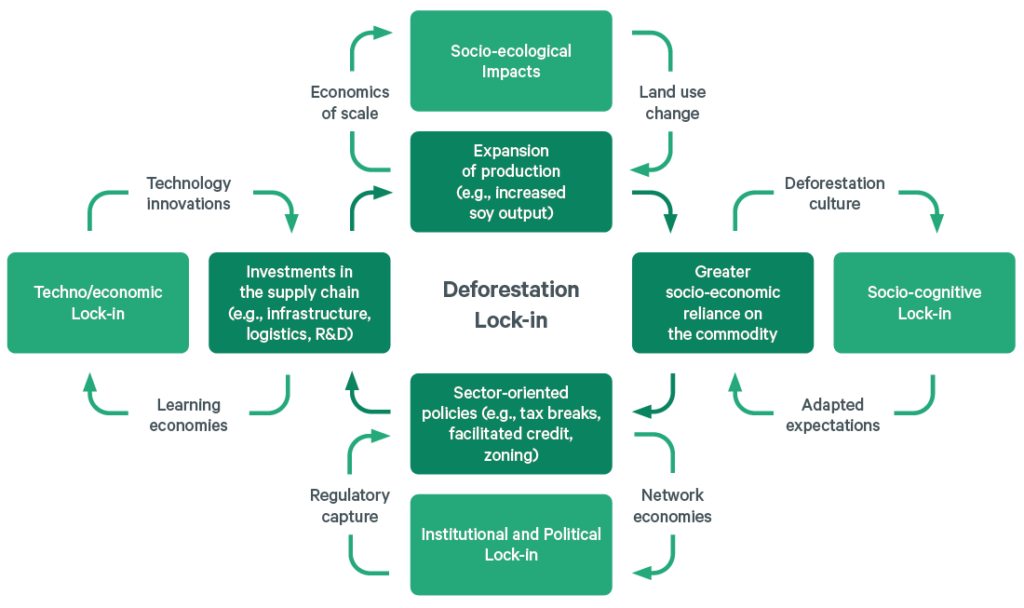
Figure 1. Illustrative schema of positive feedback loops creating a deforestation lock-in from the unsustainable expansion of an agricultural commodity. Adapted from Russo Lopes & Bastos Lima (2022).
Journal article / The paper offers a new conservation model and highlights the need to tackle distant wealth-related drivers of biodiversity loss, while empowering local stewards
24 May 2023 / About Forests and Supply chains
Journal article / The study draws on over 70 in-depth interviews in two states of Brazil to understand what has motivated people not to join deforestation activities.
Journal article / This article draws from scholarship on sustainability transitions to propose a more comprehensive systems view of unsustainable land-use patterns.
Journal article / A just bioeconomy transition also requires sustainable farming and land use, as two transitions in one.
25 January 2022 / About Bioeconomy, Food and agriculture, Forests, Land use and Public policy
Project / This project will generate key insights and practical recommendations to strengthen transboundary water governance in the Acre Trinational River Basin
2025 / About Sustainable Development Goals and Water resources
Other publication / How Brazil–China cooperation can reshape agricultural trade, reduce deforestation risks and drive more sustainable global supply chains.
24 April 2026 / About Climate policy, Food and agriculture, Forests and Supply chains
Past event / Join Trase and the Tropical Forest Alliance to explore how Brazil and China can scale up their collaboration on sustainable trade.
15 April 2026 / About Climate policy, Finance, Forests and Supply chains