Research on mobility options must take a holistic, intersectional approach to understand how the quality of urban environments impacts urban residents’ wellbeing. In this paper, the authors examine infrastructure provision in two Kenyan cities, focusing on socio-economic equity. They compare the specific mobility and wellbeing experiences of vulnerable road users, those who are typically excluded from transport planning processes.
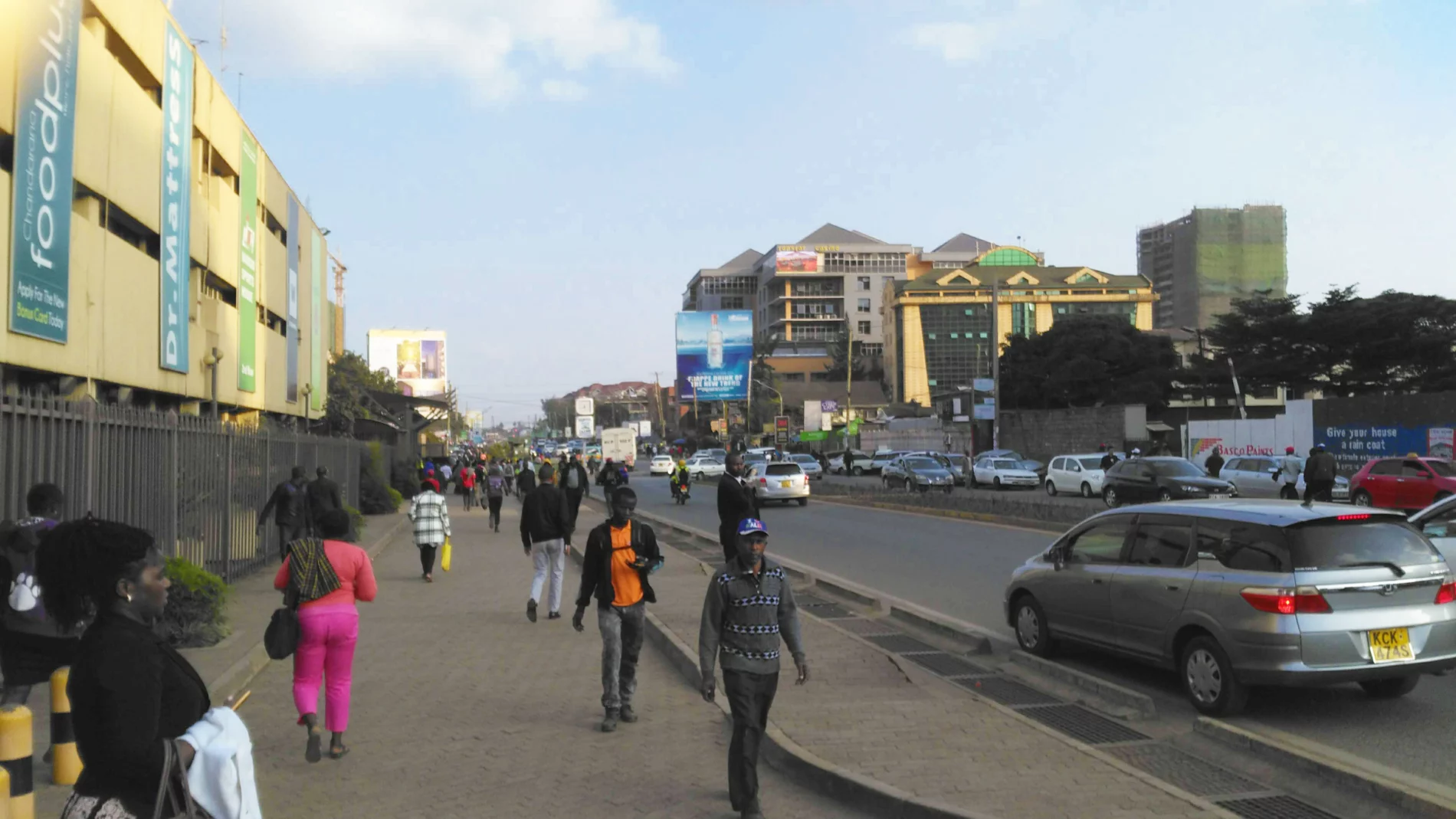
A snapshot of pedestrian mobility on Ring Road in Hurlingham, Nairobi.
Steve Cinderby / SEI
Researchers worked with participants to generate case studies from two specific areas in Kenya: Mathare, an informal settlement in Nairobi and Likoni, a densely populated area just south of Mombasa. In both areas, residents face mobility challenges.
To better understand the wellbeing impact of mobility affordance in these areas, the team used a mix of approaches. They used participatory mapping methods, which included mapping individuals’ journeys on important or regular trips. They also collected representative digital stories, using imagery and video, to understand the temporal dimensions of these journeys.
A sub-group of participants were invited to take co-designed transect walks – walking along a pre-determined route – to generate a detailed picture of the health and wellbeing impacts of mobility. Participants wore devices to monitor their heart rate variability and their exposure to air pollution as they walked. In addition to generating this health data, participants were also asked to map which parts of the route they found stressful, neutral or relaxing.
The study found that walking is ubiquitous for mobility, and that the quality of pedestrian infrastructure greatly impacts people’s wellbeing. The study also found that the quality of passenger infrastructure is critical for vulnerable road users (i.e. waiting and transit areas). The authors highlight that, when planning improvements, a focus on overall journey experience would help with infrastructure investment, as opposed to assessing infrastructure provision alone.
The authors concluded that to support people’s health and wellbeing, inclusive and equitable mobility solutions must do more than provide safe and appropriate infrastructure. The benefits of any improvements will only be realized with effective governance, including user awareness and behaviour change. If these are not in place, efforts to enhance the wellbeing of vulnerable road users could be undermined.
An open access version of the paper is available on the University of York’s Research Database.
Go to the menu on the right-hand side and click the link titled “Complete 160725” to download.
Journal article / Reflecting on projects conducted in Kenya and Thailand, researchers have produced a six-step methodology to support others using citizen science approaches.
Journal article / This study explores at risks in informal settlements from hazards and inequalities, highlighting the potential of nature-based solutions for equitable planning.
Journal article / Urban green spaces play a vital role in enhancing health, livability and attractiveness in rapidly urbanizing cities.