As a result of international trade in forest-risk commodities, forest degradation has increased and environmental concerns risen. Trade regulations are emerging as key instruments to influence global production practices. To understand their implications, this article outlines a theory of change for pro‑environmental trade measures by using the recent EU Regulation on Deforestation-free products (EUDR) as an illustrative example.
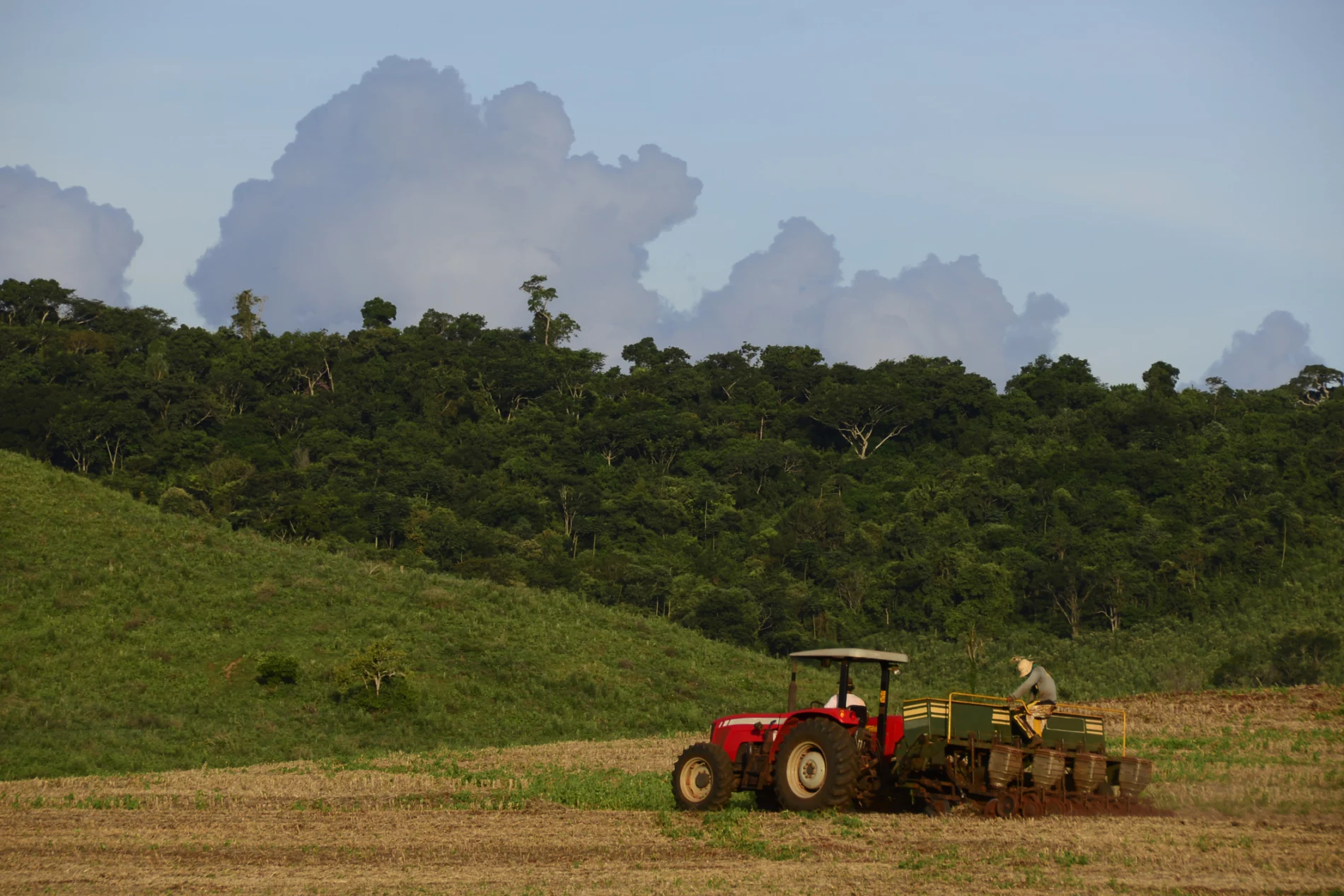
Red fertile land for agriculture for the planting of corn, soybeans and wheat in the northern region of the state of Paraná, in the Londrina region of Brazil
Demand-side trade regulation is promoted as a policy tool to reduce negative environmental and socioeconomic footprints associated with global commodity supply chains. The authors present a theory of change (ToC) that explains how the economics of pro-environmental trade regulation can be expected to work, using the recent EU Regulation on Deforestation-free products (EUDR) as a topical illustration. Along this complex ToC, they review and characterize multiple factors that might either constrain overall policy effectiveness or enhance it. Evidence suggests that, in addition to land-use leakage (the displacement of environmental pressures to unregulated domains), predictably strong market-segregating responses might rearrange sourcing and trading patterns, especially where EU commodity import shares are low. Lacking observable and attributable land-use changes, segregation spillovers are harder to document. The authors outline an economically informed interdisciplinary research agenda around the potential impact pathways of demand-side trade regulations. However, their ex-ante conceptual policy assessment also cautions of potential functional shortcomings in reaching the desired global forest-protective goals.
Program / Understanding and improving the performance of supply-chain policies aimed at halting tropical deforestation.
Journal article / This research explores how cattle ranching shapes the transition from forest frontiers to large-scale agriculture in the Brazilian and Colombian Amazon.
Journal article / This research compares the biodiversity, carbon and cost-effectiveness of forest protection, disturbance avoidance and restoration in the Brazilian Amazon.
Press release / As El Niño intensifies across the Amazon, new research in Science highlights the urgent need to better protect the region’s remaining forests from disturbances.